DEWALT Jump Starter vs NOCO Boost GB70 Jump Starters: Bench Power vs Pocket Lithium
A dead battery does not care how big your engine is — it cares whether the jump starter in your trunk can turn it over. The DEWALT jump starter in this comparison is a bench-style power station: a sealed lead-acid box with heavy clamps, a built-in air compressor and USB charging, built to live in a garage and do more than start a car. The NOCO Boost GB70 is the opposite idea: a pocket-size lithium pack that starts the same dead battery and then fits in a glove box. Both are rated for big engines, and they could hardly be more different to own.
The short answer: if you want one box that jump starts, inflates tyres and charges your phone, buy the DEWALT jump starter. If you want the smallest jump starter that still starts a V8, buy the NOCO Boost GB70. And if the DEWALT idea is right but you want more starting power and mains power as well, the bigger DXAEPS14 is the third option in this comparison. The three jump starters below cover all three jobs — two bench power stations and one pocket lithium pack.
As an Amazon Associate I earn from qualifying purchases.
Quick Pick: DEWALT Jump Start vs NOCO Boost GB70
| Pick | Product | Best For | Check Price |
|---|---|---|---|
| Overall Winner | DEWALT DXAEJ14 Digital Portable Power Station Jump Starter, 1600 Peak Amps, 120 PSI Compressor | The default buy: jump starting, tyre inflation and USB power in one garage-ready box | Check Price on Amazon |
| Pocket Lithium Pick | NOCO Boost GB70 2000A UltraSafe Jump Starter, 12V Lithium Battery Booster, for 8.0L Gas and 6.0L Diesel Engines | A pocket-size lithium jump starter rated for big petrol and diesel engines, with a flashlight and USB power bank built in | Check Price on Amazon |
| Bigger Bench Pick | DEWALT DXAEPS14 2000 Peak Amp Jump Starter and Power Station, 120 PSI Compressor, 500W AC Inverter | The bigger DEWALT bench unit: more starting power and mains power from a built-in inverter, for the garage and the campsite | Check Price on Amazon |
Table of Contents
DEWALT DXAEJ14: The Bench Power Station
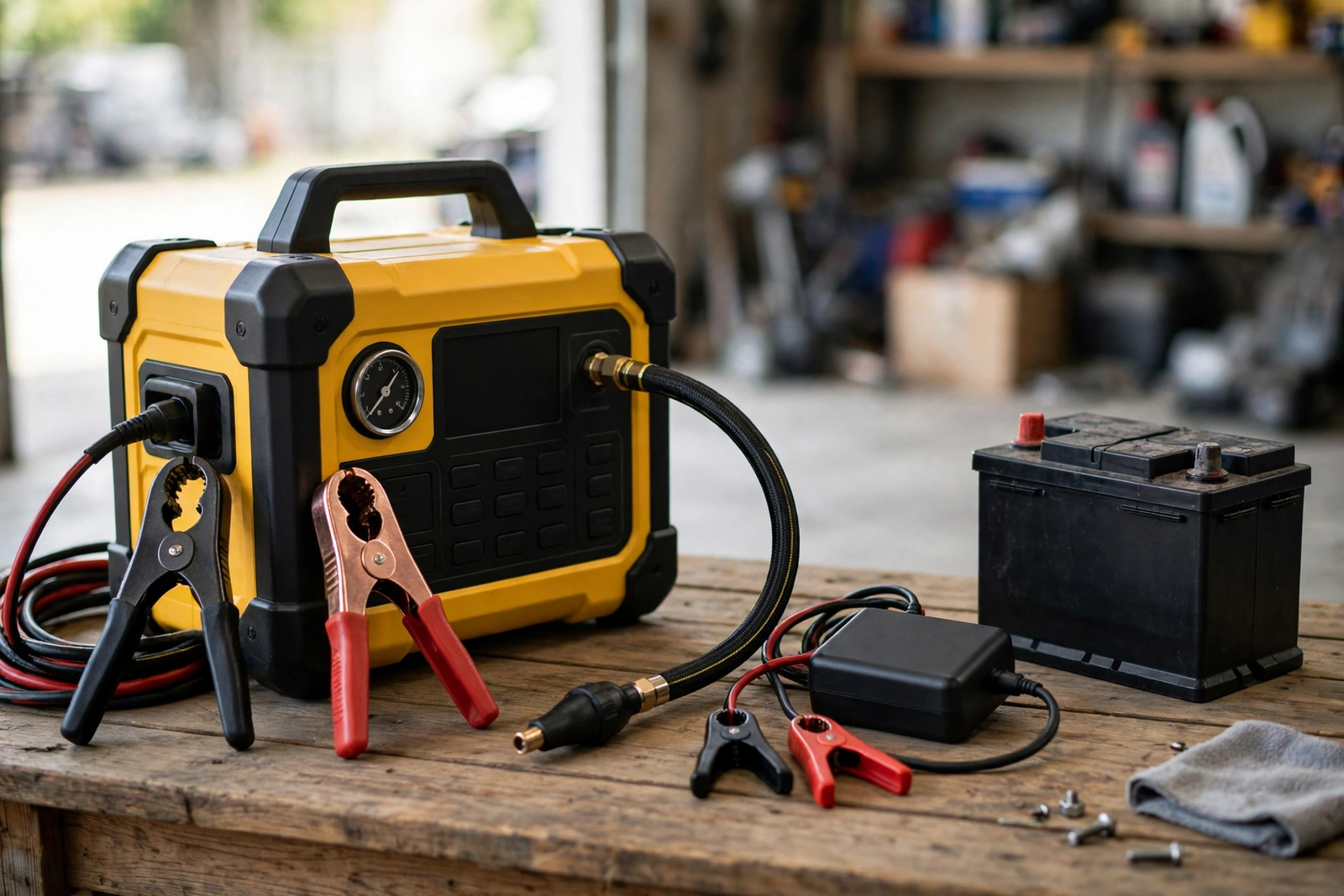
The DEWALT DXAEJ14 is not a jump starter you carry in a jacket pocket — it is a bench. The current listing is the Type3 version, rated at 1600 peak amps with a 120 PSI digital air compressor, 15W USB-A and 25W USB-C power, in a rugged yellow-and-black case made by Baccus Global LLC under the DEWALT brand. It is a sealed lead-acid power station: heavy, solid, and built to sit in a garage ready for the next dead battery, flat tyre or phone that needs charging. Our DEWALT DXAEJ14 jump starter review covers this unit on its own, including the version trap below.
The trap is the model number. An older DXAEJ14 listing is rated at 1400 peak amps with 700 instant amps, while the current Type3 listing is rated at 1600 peak amps — same model number, different power. Check that the listing title says 1600 amps and Type3 before you order, and confirm the same figures on the box when it arrives. The compressor is the DEWALT jump starter’s real advantage over the NOCO: a digital 120 PSI pump with automatic shut-off that inflates tyres, sports equipment and bikes, so this one box replaces a jump starter, a tyre inflator and a USB power bank in one purchase.
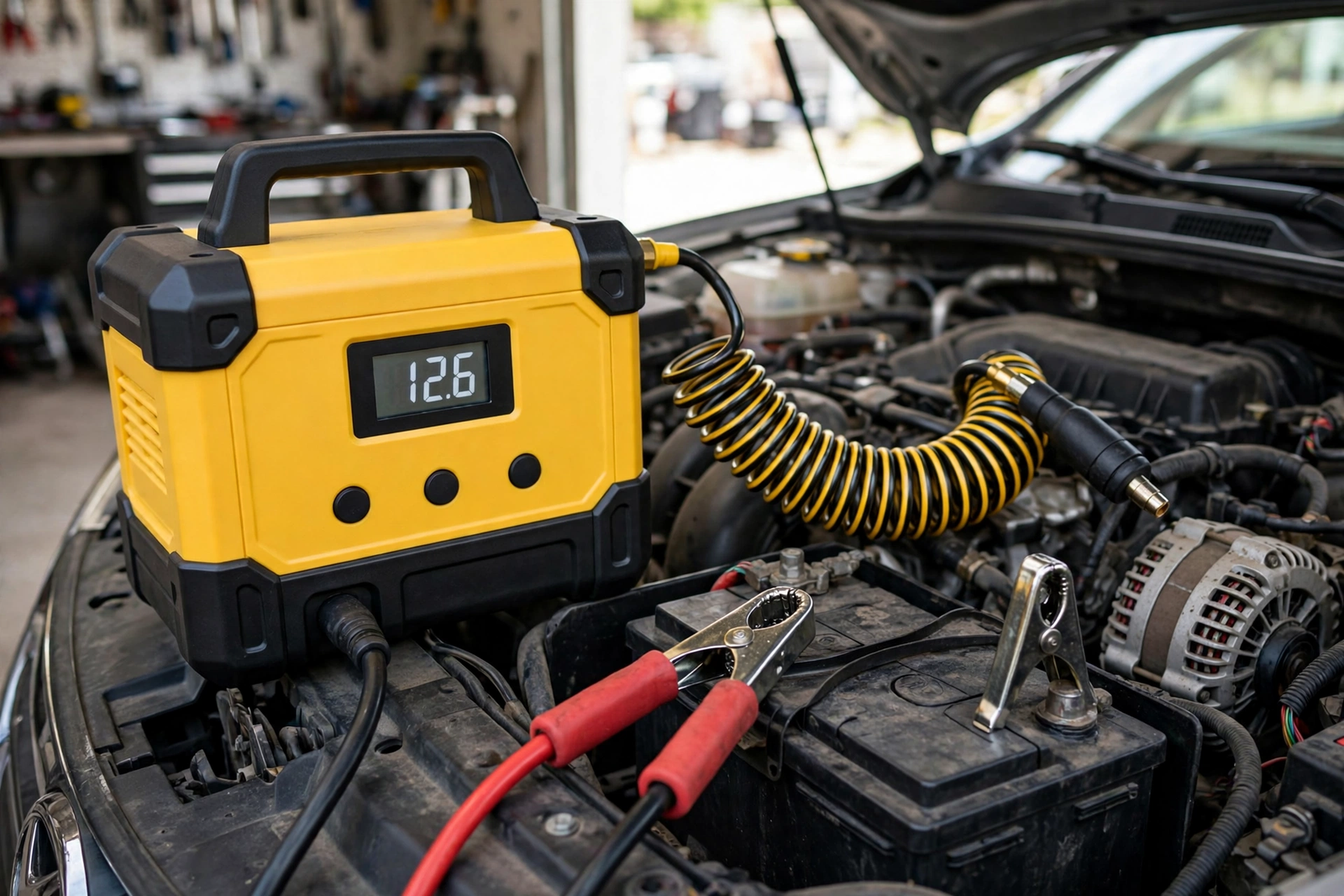
A DEWALT jump starter in bench form is the right shape for a driver who works on cars at home. It lives in the garage, it charges from the mains, and its weight is a non-issue because it never leaves the property except in the trunk. The lead-acid battery inside is an older technology than the NOCO’s lithium cells — heavier per amp, and it needs regular topping up on the charger — but it is also a forgiving one, and the DXAEJ14’s size means the clamps, the compressor hose and the USB ports are all full-size and easy to use with cold hands.
DEWALT DXAEJ14 Digital Portable Power Station Jump Starter on Amazon: 1600 peak amps, 120 PSI digital air compressor with automatic shut-off, 15W USB-A and 25W USB-C power, Type3.
Buy the DEWALT DXAEJ14 if: you want one box that jump starts, inflates tyres and charges devices, and you have a garage shelf or a trunk corner for it. It is the pick in this comparison for the driver who does their own car care at home.
NOCO Boost GB70: The Pocket Lithium Jump Starter
The NOCO Boost GB70 is the DXAEJ14’s opposite in almost every way. It is a pocket-size lithium jump starter rated at 2000 peak amps — more than the DEWALT bench unit — in a pack that weighs a little over four pounds and fits in a glove box. The listing rates it for petrol engines up to 8.0 litres and diesel engines up to 6.0 litres, claims up to 40 jump starts on a single charge, and builds in a 400-lumen LED flashlight and a USB power bank, with spark-proof and reverse-polarity protection. Our NOCO Boost GB70 jump starter review covers this unit on its own.
Two thousand peak amps from a pocket pack sounds too good to be true, and the honest reading is that peak amps are a headline number, not a measure of sustained cranking power — see the Peak Amps section below. What the GB70 genuinely offers is starting power in a shape you will actually carry: a lithium pack small enough to live in the car all year, light enough to hold in one hand while you connect the clamps, and quick enough to recharge over USB. The heavy-duty clamps ride on short 12-inch cables, which is the trade-off for the small size — they reach a battery in an open engine bay, but a buried battery in a tight bay can be a stretch.
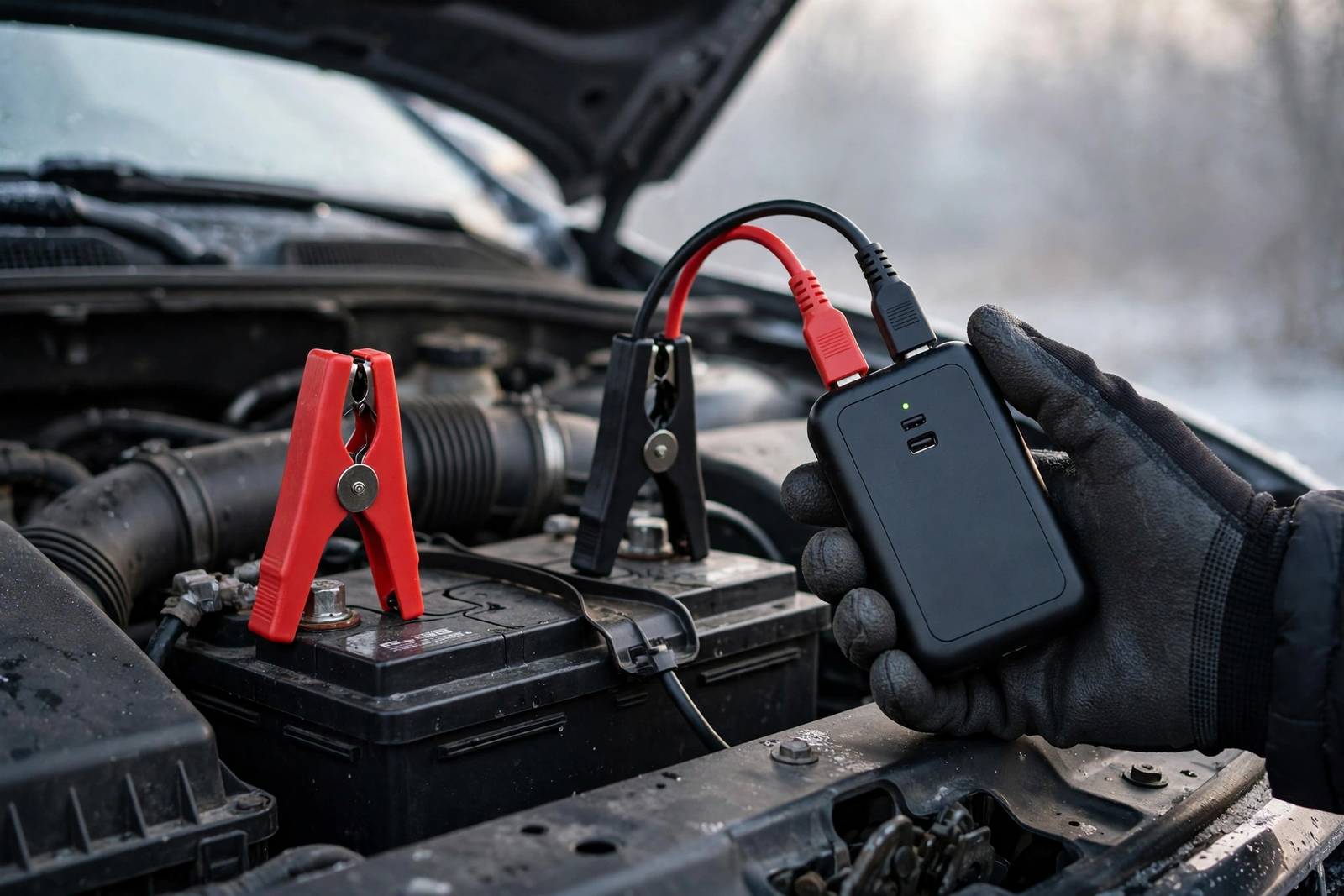
The GB70’s other advantage is what it does not need: no mains socket, no shelf, no tyre hose to wind up. It charges over USB, it holds its charge for months in a glove box, and the flashlight in the end is the light you actually have with you when a battery dies at night. The listing gives it a one-year warranty and says it is engineered in the USA. One honest caution: several older crawls of this listing showed no featured offers available, while a November 2026 live API pull showed it in stock as a best seller — check the listing before you buy, as offers change.
NOCO Boost GB70 2000A UltraSafe Jump Starter on Amazon: 2000 peak amps, rated for 8.0L petrol and 6.0L diesel engines, up to 40 jump starts per charge per the listing, 400-lumen flashlight, USB power bank.
Buy the NOCO Boost GB70 if: you want the smallest jump starter that still starts a big engine, and you want it in the car rather than in the garage. It is the pick in this comparison for the driver who wants starting power they will actually carry.
DEWALT DXAEPS14: The Bigger Bench Option
The DXAEPS14 is the DXAEJ14’s bigger brother, and it exists for the buyer who likes the bench idea but wants more of everything. The listing rates it at 2000 peak amps — the same headline figure as the NOCO GB70 — with the same 120 PSI digital compressor, plus a 500W AC inverter that the DXAEJ14 does not have. That inverter is the point of the upgrade: it turns the power station into mains power for a laptop, a small tool or a light at a campsite or a job site, where the DXAEJ14’s USB ports are not enough.
The trade-off is the same one the DXAEJ14 makes, only larger: a sealed lead-acid DEWALT jump starter is heavy, it lives in the garage or the trunk, and it needs regular charging to stay ready. It is not a pocket pack and it never pretends to be one. If the DXAEJ14 is the default buy for the home mechanic, the DXAEPS14 is the buy for the driver who also wants portable mains power — a camper, a tradesperson, or a driver with a second vehicle that needs both jump starting and power away from the house.
DEWALT DXAEPS14 2000 Peak Amp Jump Starter and Power Station on Amazon: 2000 peak amps, 120 PSI digital compressor, 500W AC inverter, Type2.
Buy the DEWALT DXAEPS14 jump starter if: the bench idea is right but the DXAEJ14 jump starter’s power is not enough, or you need mains power away from the house. It is the pick in this comparison for the buyer who wants the biggest DEWALT bench unit rather than the smallest NOCO pack.
Peak Amps, Honestly: 1600 vs 2000
Peak amps are the number every jump starter leads with, and the number least worth comparing on its own. A peak-amp rating is the maximum current the unit can deliver in a short burst — not the sustained cranking current it delivers while your engine turns over, and not a figure measured the same way by every brand. The DEWALT DXAEJ14 is rated at 1600 peak amps, the NOCO GB70 and the DXAEPS14 at 2000 peak amps, and those three numbers do not mean the three units are 25 percent apart in real starting ability. They mean each brand’s headline figure, measured each brand’s way.
What matters more is the engine rating attached to the number. The NOCO GB70 states its rating plainly: petrol engines up to 8.0 litres, diesel up to 6.0 litres. The DEWALT bench units do not state a displacement rating — the DXAEJ14 is positioned for engines up to V8 size, a cylinder count rather than a litre figure, and that gap is worth knowing before you buy. A V8 in a pickup and a V8 in a sports car are very different engines to crank, and a displacement rating tells you more than a cylinder count does. Our NOCO GB40 vs DEWALT jump starters comparison makes the same point for the smaller NOCO pack, and it holds here too: read the engine rating, not just the peak amps.
Lead-Acid vs Lithium: Weight, Size and Storage
The real difference between the DEWALT jump starter and the NOCO GB70 is not the peak amps — it is the battery chemistry inside. The DEWALT jump starters are sealed lead-acid: the same technology as the car battery they are jumping. Lead-acid is heavy, it is big, and it loses charge sitting on a shelf, so a bench unit needs a regular top-up on the mains charger to stay ready. In return it is a forgiving, proven technology, and the size of the box is what lets DEWALT fit a full-size compressor, full-size clamps and a mains inverter inside.
The NOCO GB70 is lithium: the same technology as a phone battery, scaled up. Lithium packs far more starting power into far less weight — a little over four pounds against a bench unit that weighs several times that — and it holds its charge for months in a glove box without a top-up. Recharging it is an overnight job rather than a quick top-up, and sources disagree on how long: NOCO states about 7 hours at a 2-amp input, while one tested review measured about 3 hours. The trade-off is that lithium is more sensitive to cold and to being left flat: a lithium pack that has sat dead for a year may not come back, while a lead-acid bench unit may come back with a long charge — though a year flat can kill either type. Store either unit charged, check it every few months, and keep it somewhere you can reach it without unpacking the trunk.
The Compressor Question: A DEWALT Jump Start With a 120 PSI Pump
The compressor is the DEWALT jump starter’s strongest card, and it is the feature the NOCO GB70 simply does not have. Both DEWALT jump starters carry a 120 PSI digital air compressor with automatic shut-off: set the pressure, start the pump, and it stops itself at the target. That turns a jump starter into a tyre tool — a slow leak on a cold morning, a trailer tyre before a trip, a bike tyre in the garage — and it is the feature that makes the bench unit worth its weight for a driver who does their own car care.
The NOCO GB70 answers with a different kind of extra: a 400-lumen LED flashlight and a USB power bank, both built into a pack you can hold in one hand. A flashlight matters when a battery dies at night, and a power bank matters when your phone is the thing that calls for help. Neither is a compressor, and no flashlight inflates a tyre. The choice is simple: if you already own a tyre inflator, the NOCO’s extras are the more useful pair. If you do not, the DEWALT jump starter’s compressor is worth more than the flashlight and the power bank combined.
Cold Weather and Big Engines: Gas and Diesel Coverage
Cold weather is where jump starters earn their keep, and it is also where both battery types lose power. A cold battery cranks slower and needs more current, while the jump starter itself delivers less — lead-acid and lithium alike. The honest rule is to buy more starting power than your engine needs on a warm day, because a cold morning takes the margin away. The NOCO GB70’s 8.0-litre petrol and 6.0-litre diesel ratings give you that margin in writing; the DEWALT bench units give it in bulk, with a bigger battery behind the same job.
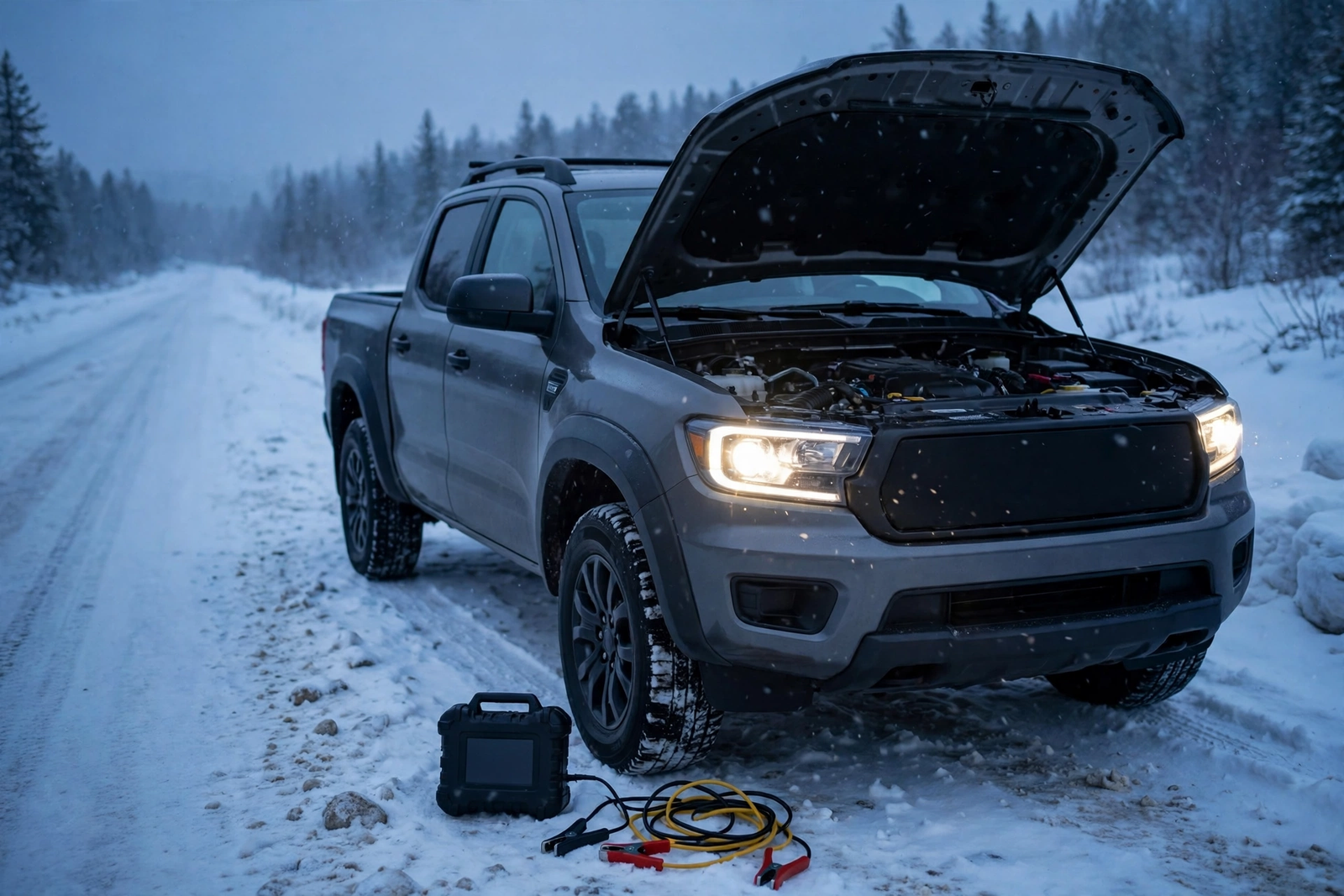
Diesel owners should read the ratings with extra care. A diesel engine needs more cranking current than a petrol engine of the same size, which is why the GB70’s diesel rating (6.0 litres) is lower than its petrol rating (8.0 litres) — and why a diesel driver should treat the petrol figure as irrelevant. If you drive a large diesel, the GB70’s 6.0-litre diesel rating is the number that decides it, and the DEWALT jump starters’ lack of a stated displacement rating means you are buying on trust rather than on a number. In that case the bigger DEWALT jump starter, the DXAEPS14, with its 2000-amp headline and its larger battery, is the safer DEWALT choice.
Mistakes to Avoid With a Jump Starter
The most expensive jump starter mistake is buying the wrong version of the right model. The DXAEJ14’s 1400-amp and 1600-amp versions share a model number, and the older one is still listed — check the title for 1600 amps and Type3, and confirm it on the box. The second mistake is buying on peak amps alone: a 2000-amp headline from one brand is not the same as a 2000-amp headline from another, and the engine rating is the number that matters. The third is storing a jump starter flat: a lead-acid DEWALT jump starter left dead for a year and a lithium pack left dead for a year both come back badly, if they come back at all — charge it every few months and check it before winter.
The fourth mistake is connecting the clamps wrong. Red goes to the dead battery’s positive terminal, black to a bare metal ground on the engine block — not to the dead battery’s negative terminal — and the clamps come off in reverse order. The NOCO’s spark-proof and reverse-polarity protection helps if you get it wrong, but protection is a safety net, not a method. The fifth is buying a jump starter with no plan for the tyres: a dead battery and a slow leak often arrive together on a cold morning, and the DEWALT jump starter’s compressor is the only tool in this comparison that answers both. And the sixth is leaving the jump starter at home: a pocket pack in the glove box beats a DEWALT jump starter in the garage every time the battery dies away from the house.
Who Should Buy Which Jump Starter
Buy the DEWALT DXAEJ14 if: you work on cars at home, you want a jump starter and a tyre inflator in one box, and you have a garage shelf for it. It is the default buy in this comparison, and the one that does the most jobs.
Buy the NOCO Boost GB70 if: you want starting power in the car rather than in the garage, you drive a big petrol or diesel engine, and you want the smallest pack that still does the job. It is the pick for the driver who carries their jump starter rather than storing it.
Buy the DEWALT DXAEPS14 if: the bench idea is right but you want more starting power and mains power from a built-in inverter — for camping, for a job site, or for a second vehicle that needs both. If you are still sizing up the market, our best portable car jump starter guide puts these three in their wider classes, with amp classes by engine size.
Do not buy any of these three if: your battery is dying every week. A jump starter is a rescue tool, not a repair: a battery that needs jumping every week is a battery that needs replacing, and no jump starter fixes that. Get the battery tested first — a failing battery will strand you again, whichever jump starter you carry.
The Verdict
The DEWALT jump starter wins this comparison for most drivers — the DXAEJ14 jump starter is the default buy, because it jump starts, inflates tyres and charges devices in one garage-ready box, and it does all three well. The NOCO Boost GB70 wins for the driver who wants starting power in the car: a 2000-amp pocket pack rated for 8.0-litre petrol and 6.0-litre diesel engines, with a flashlight and a power bank built in, is the jump starter you will actually have with you when the battery dies. The DXAEPS14 is the buy for the driver who wants the bench idea with more power and mains output.
Whichever you choose, check three things before you order: the exact version of the model, the engine rating rather than the peak amps, and whether the listing still shows a live offer — the crawls behind this comparison are months old, and a listing that showed an offer then may not show one now. Keep the unit charged, keep it where you can reach it, and test it before winter. A jump starter only earns its keep on the morning your battery does not.
Frequently Asked Questions
Which is better, DEWALT or NOCO jump starter?
It depends on what you want the jump starter to do. The DEWALT DXAEJ14 is better if you want one box that jump starts, inflates tyres and charges devices — it is a bench power station for the garage. The NOCO Boost GB70 is better if you want the smallest jump starter that still starts a big engine, because it fits in a glove box and carries 2000 peak amps. For most drivers the DEWALT is the default buy; for drivers who want starting power in the car, the NOCO is the pick.
Will the NOCO Boost GB70 start a V8?
Yes, per the listing: the GB70 is rated for petrol engines up to 8.0 litres and diesel engines up to 6.0 litres, which covers most V8 engines. The rating is the listing’s claim, not a tested result, and a cold morning or a deeply discharged battery makes any engine harder to start. If your V8 is a large diesel, the 6.0-litre diesel rating is the number that decides it, not the 8.0-litre petrol figure.
How do I know which DXAEJ14 version I am buying?
Check the listing title before you order: the current version is the Type3, rated at 1600 peak amps with a 120 PSI compressor. An older DXAEJ14 listing is rated at 1400 peak amps with 700 instant amps, under the same model number. Confirm the title says 1600 amps and Type3, and check the same figures on the box when it arrives. If the listing does not state the version, do not guess — ask the seller or pick a listing that does.
Can a jump starter inflate tyres?
Only if it has a built-in compressor. Both DEWALT bench units in this comparison carry a 120 PSI digital air compressor with automatic shut-off, so they inflate tyres, sports equipment and bikes. The NOCO Boost GB70 has no compressor — it is a jump starter, a flashlight and a USB power bank. If tyre inflation matters to you, the DEWALT jump starter is the pick; if it does not, the NOCO’s smaller size is the advantage.
How long does a jump starter hold its charge?
It depends on the battery inside. A lithium pack like the NOCO GB70 holds its charge for months in a glove box without a top-up. A sealed lead-acid bench unit like the DEWALT DXAEJ14 loses charge sitting on a shelf and needs a regular top-up on the mains charger to stay ready. Whichever type you own, check it every few months and charge it before winter — a jump starter that has sat flat for a year may not come back.
Do I need a jump starter if I have roadside assistance?
A jump starter is still worth having. Roadside assistance can take an hour or more to reach you, and it may not reach you at all on a remote road or in bad weather. A jump starter in the car starts the engine in minutes, with no phone call and no wait. It does not replace roadside assistance for a breakdown you cannot fix yourself — but for a dead battery, it is faster than waiting, and it works where there is no phone signal.