Milwaukee M18 vs AirMoto Tire Inflators: Power vs Pocket
The Milwaukee M18 tire inflator is a tool-battery inflator built for truck tires: it runs on an 18-volt M18 battery, pushes to 150 PSI, and is built for large tires. The AirMoto is the opposite idea — a pocket-size inflator with its own built-in battery, rated to 120 PSI, that lives in a glove box and tops up a car tire, a bike tire or a ball. Both inflate tires, but they are built for different drivers, and the wrong one means carrying a heavy tool you do not need or a small pump that cannot keep up.
The short answer: if you already own M18 batteries and you inflate truck or SUV tires, buy the Milwaukee M18 tire inflator — the only tool here built for large tires, sold as a tool only, so you need a battery and charger of your own. If you want an inflator that is always in the car for a slow leak or a bike tire, buy the AirMoto — small, USB-C charged, and needing nothing else. The DEWALT below is the third option, for DEWALT battery owners.
As an Amazon Associate I earn from qualifying purchases.
Quick Pick: Milwaukee M18 Tire Inflator vs AirMoto
| Pick | Product | Best For | Check Price |
|---|---|---|---|
| For Truck Tires | Milwaukee M18 Inflator 2848-20, Tool Only | A 150 PSI tool-battery inflator for truck and SUV tires, for drivers who already own M18 batteries | Check Price on Amazon |
| For the Glove Box | AirMoto Tire Inflator Portable Air Compressor, BP198 | A pocket-size 120 PSI inflator with a built-in battery, for top-ups, bikes and balls, always in the car | Check Price on Amazon |
| For DEWALT Owners | DEWALT 20V MAX Tire Inflator DCC020IB, Tool Only | A tool-battery inflator for DEWALT owners, with three power sources and a high-volume mode for air mattresses | Check Price on Amazon |
Table of Contents
Milwaukee M18 Tire Inflator: The Tool-Battery Inflator
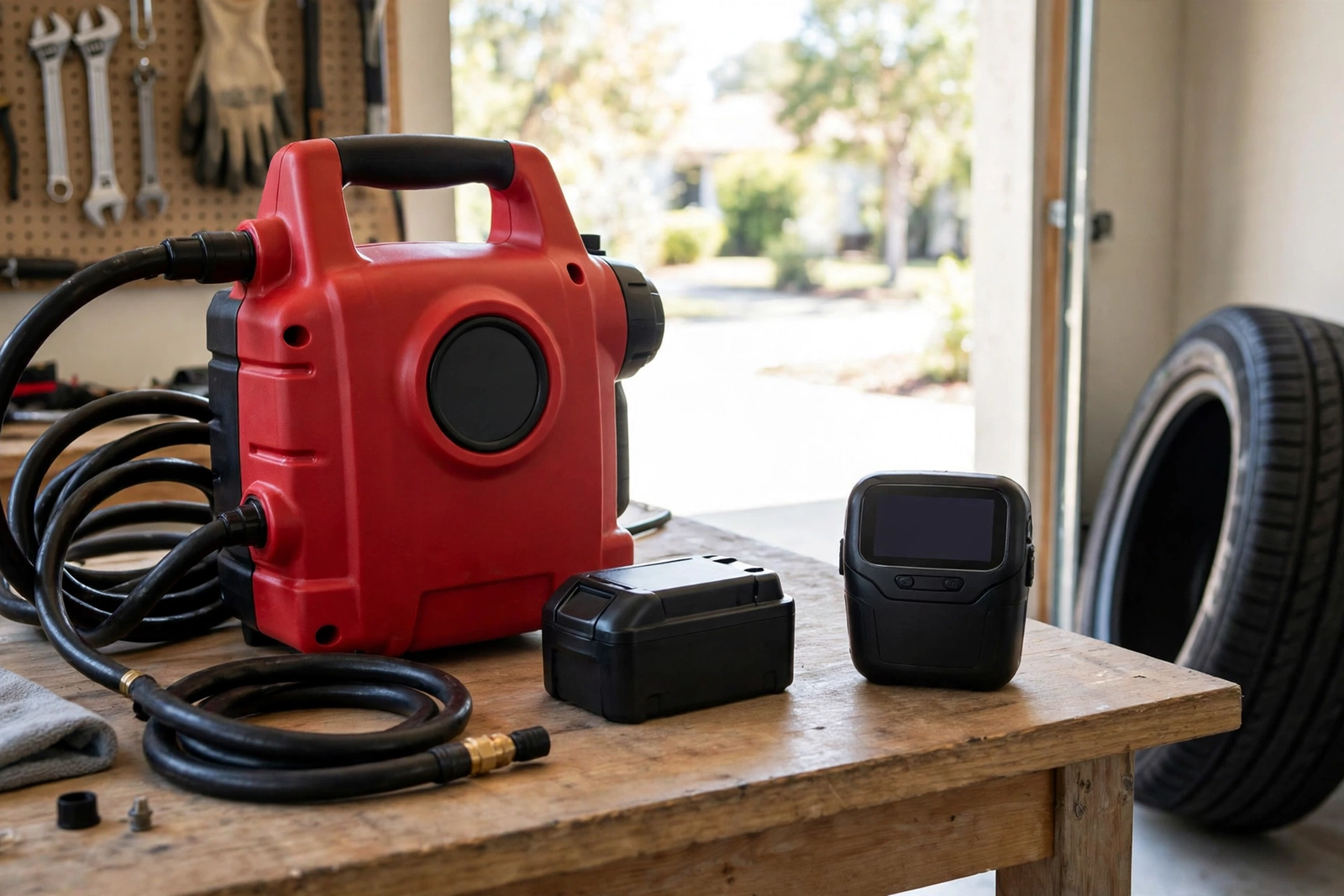
The Milwaukee M18 tire inflator — the M18 Inflator 2848-20 — is a tool, not a gadget. It runs on an 18-volt M18 battery, it is rated to 150 PSI, and it weighs 7.7 pounds with a 36-inch hose. The listing’s own claim is that it tops off 33-inch light truck tires in under a minute, and a review roundup cites an independent truck-tire test that timed it fastest, reaching 50 PSI in 6 minutes 39 seconds. That pace figure is second-hand — no tire was inflated for this article — but it matches what the tool is built for: large tires, filled fast, by a driver who already owns the battery platform.
Four memory presets and an auto shut-off do the thinking: set the target pressure, press start, and the inflator stops when it gets there. The kit in the box is the tool, a brass Schrader chuck, an inflation needle, an inflator nozzle and a Presta chuck — the adapters for balls and bike tires ride along, but the tool itself is a car and truck tire inflator first. It is sold as a tool only, which is the catch that matters most: no battery and no charger in the box. If you own no M18 batteries, the inflator alone will not run, and the battery and charger are a separate purchase. Our DEWALT vs Milwaukee tire inflators comparison puts this same Milwaukee tool against the DEWALT head to head, for drivers choosing between the two platforms.
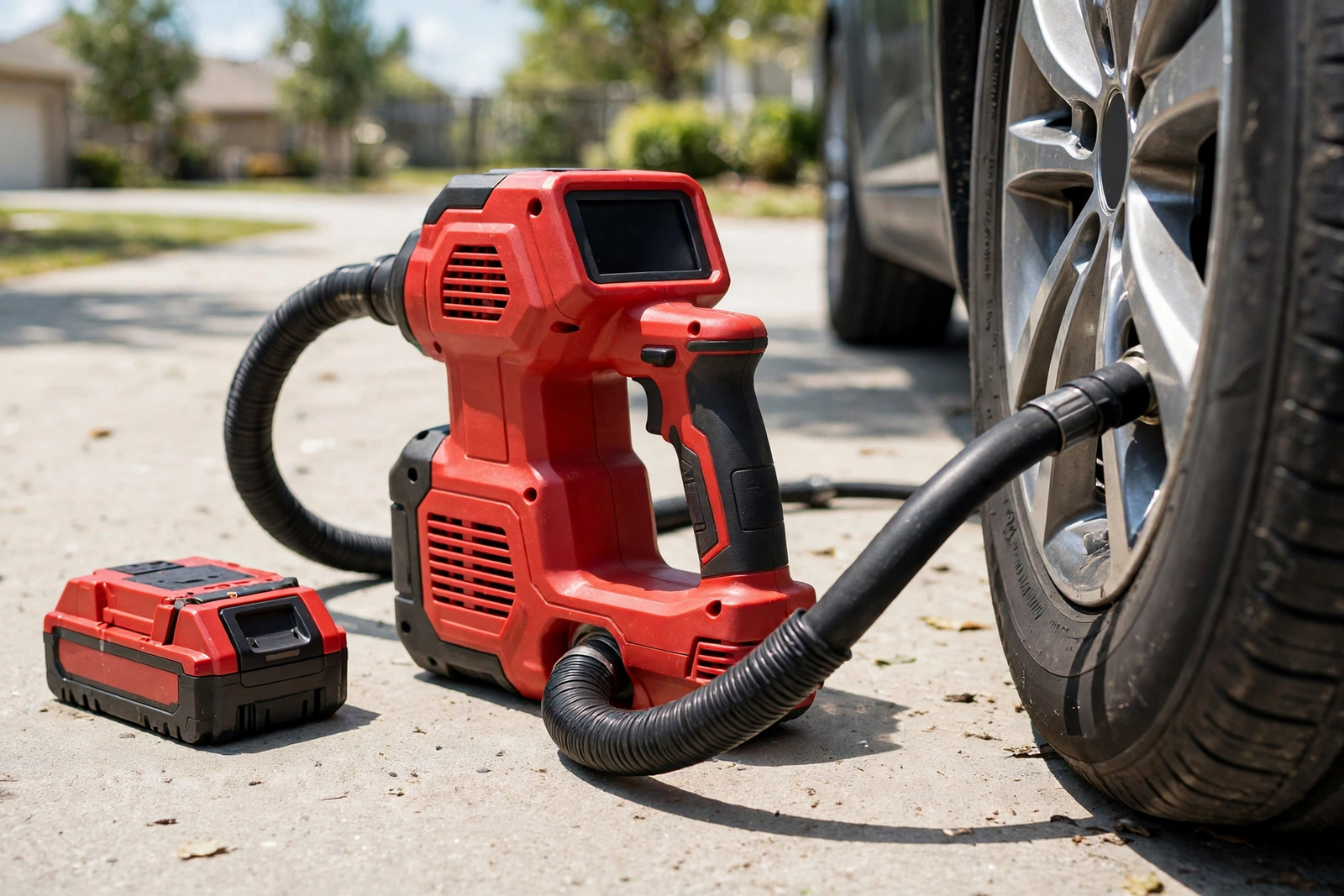
The Milwaukee M18 tire inflator is also the biggest tool in this comparison by a wide margin: 14.7 inches long, 7 inches wide and 8.3 inches tall, at 7.7 pounds. It lives in a garage, a truck bed or a tool bag — anywhere except a glove box. The listing gives it a five-year warranty. Check the listing before you buy: the tool-only catch and the live offer both need confirming on the day you order — the listing’s own offer history is mixed.
Milwaukee M18 Inflator 2848-20 on Amazon: 150 PSI, M18 battery powered, tool only, 7.7 pounds, 36-inch hose, four memory presets, auto shut-off, five-year warranty.
Buy the Milwaukee M18 tire inflator if: you already own M18 batteries and you inflate truck or SUV tires. It is the pick in this comparison for large tires and for a driver who is already invested in the M18 platform.
AirMoto Tire Inflator: The Pocket Inflator
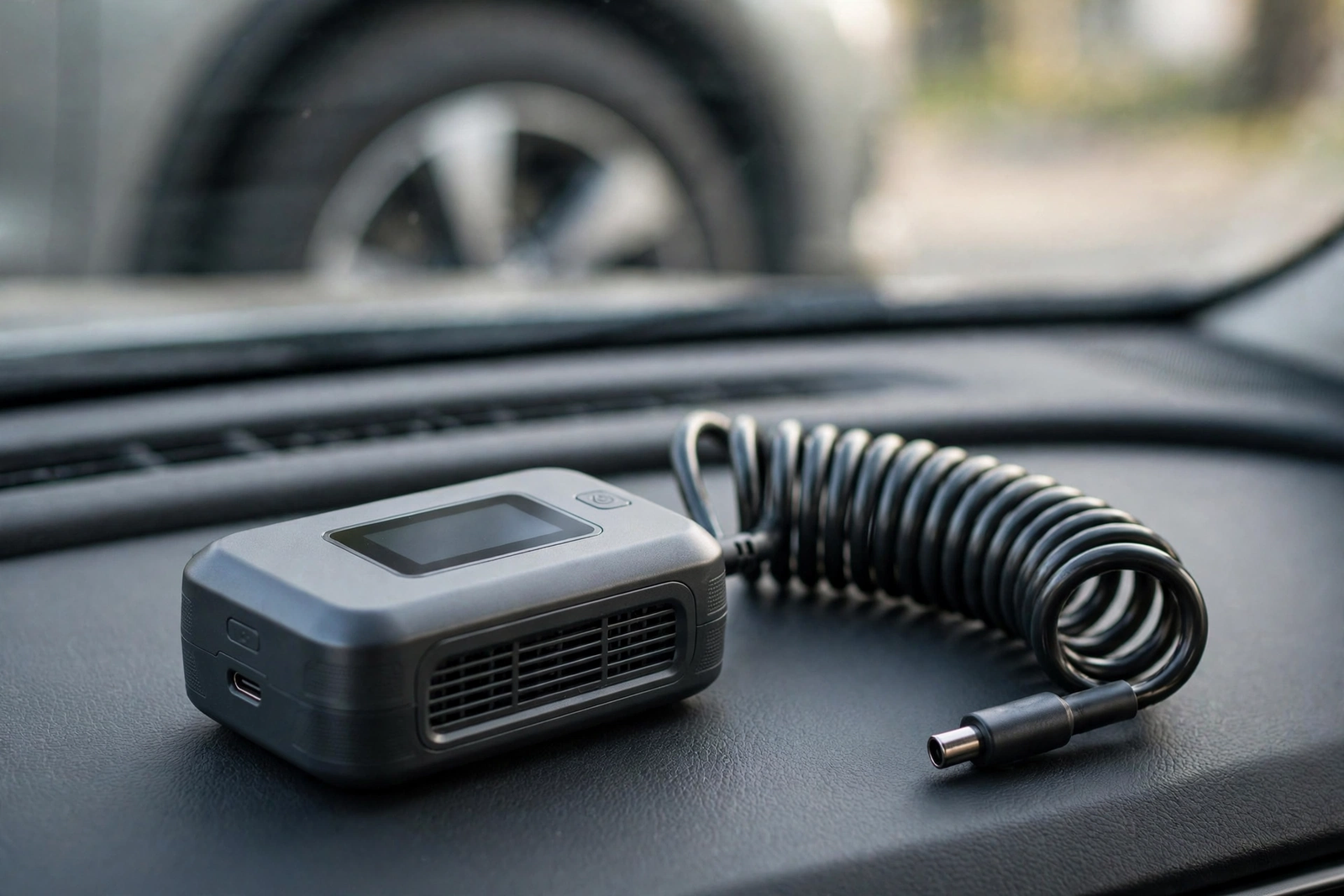
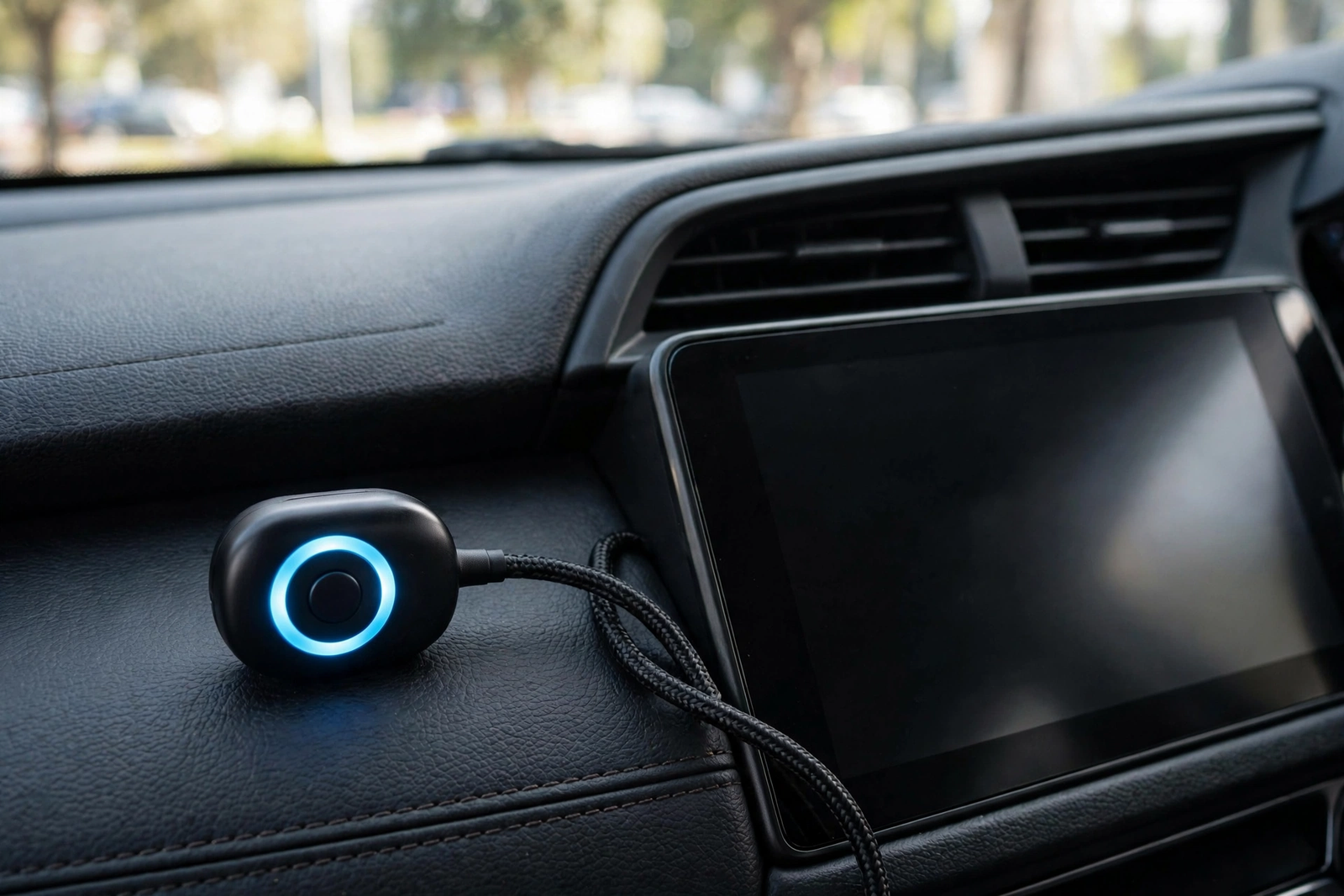
The AirMoto Tire Inflator — model BP198 — is the opposite of the Milwaukee in almost every way. It is about 6 inches long, it has a built-in 2000mAh battery, it charges over USB-C, and it is rated to 120 PSI with a digital pressure gauge, auto shut-off and a built-in LED light. The listing says it moves air at 20 litres per minute and inflates tires in just minutes, with accuracy up to 120 PSI. It fits in a glove box, a door pocket or a bike bag, and it needs no other battery, no charger and no tool platform — the battery is inside it.
That independence is the whole point of the AirMoto. A slow leak on a Sunday, a bike tire before a ride, a ball before a game: the AirMoto is the inflator that is already there, because it lives in the car. The trade-offs are the ones that come with the size. A 2000mAh battery holds enough charge for top-ups, not for filling four large tires from flat, and the listing’s own notes say battery performance depends on tire size and temperature — cold weather and large tires drain it faster. The 120 PSI ceiling is lower than the Milwaukee’s 150 PSI, but it covers every car tire, motorcycle tire and bicycle tire a pocket inflator is bought for. Our AirMoto portable tire inflator review covers this same inflator on its own, with the full detail on its battery and its gauge.
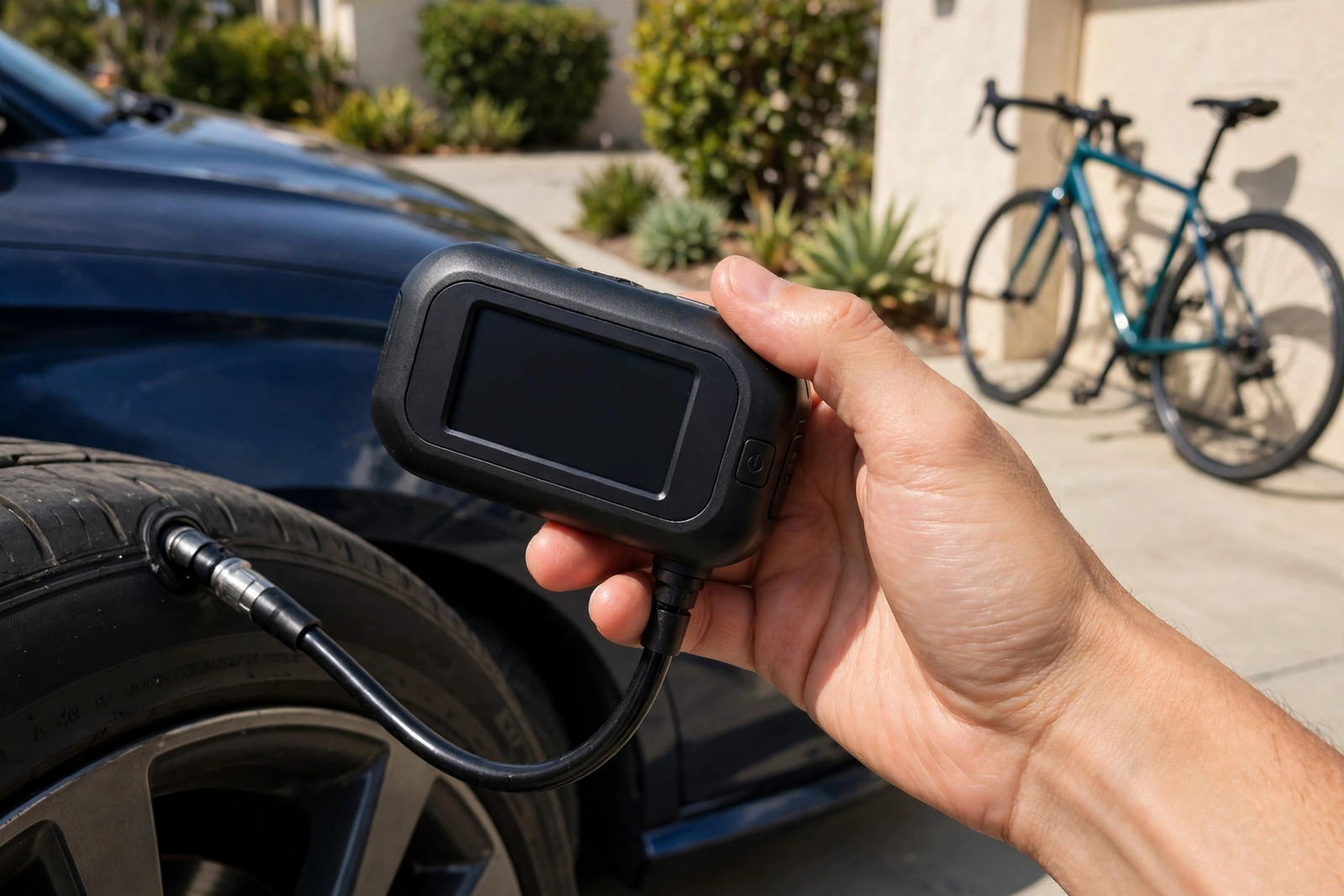
The AirMoto’s gauge is its best feature after its size: a digital readout with a target pressure and an auto shut-off, so you set the number and the pump stops when it gets there. The LED light is a small thing that matters at night on a roadside, and the USB-C charging means the same cable that charges a phone charges the pump. Check the listing before you buy: the standalone inflator and the charger bundle are separate listings, and this article links the standalone inflator — the bundle, which adds a car and a home charger, is a different listing under a different ASIN.
AirMoto Tire Inflator Portable Air Compressor on Amazon: model BP198, 120 PSI, 2000mAh built-in battery, 20 litres per minute, digital gauge, auto shut-off, LED light, USB-C charging.
Buy the AirMoto if: you want an inflator that is always in the car for top-ups, bikes and balls, and you own no tool batteries. It is the pick in this comparison for the glove box.
The DEWALT Alternative: A Second Tool-Battery Option
The DEWALT 20V MAX Tire Inflator DCC020IB is the third option in this comparison, and it exists for one reason: some drivers own DEWALT batteries, not Milwaukee ones. Like the Milwaukee, it is sold as a tool only — no battery and no charger in the box — and like the Milwaukee, it is a tool-battery inflator rather than a pocket pump. Its maximum pressure is 160 PSI per DEWALT’s manual, though one Amazon product table for the same ASIN lists 80 PSI, and the two figures are stated here side by side rather than resolved. The DEWALT’s own listing gives no per-tire inflation time, so no pace figure is claimed for it in this article.
What the DEWALT does that neither of the other two inflators does is run on three power sources: a 20V MAX battery, a 12V car outlet and 110V mains power. That is the most flexible power setup in this comparison — a Milwaukee owner is tied to the battery, an AirMoto owner is tied to the built-in battery’s charge, and a DEWALT owner can plug into the car or the wall. The DEWALT also has a high-volume mode for air mattresses and inflatables, which is a different job from tires and the reason to keep it in mind for camping. Our DEWALT DCC020IB air inflator review covers this inflator on its own, and our AstroAI vs DEWALT tire inflators comparison puts it against a handheld cordless inflator head to head.
DEWALT 20V MAX Tire Inflator DCC020IB on Amazon: tool only, 160 PSI per the manual, three power sources, high-volume mode, auto shut-off.
Buy the DEWALT DCC020IB if: you already own DEWALT 20V MAX batteries and you want a tool-battery inflator with mains and car-outlet backup, plus a high-volume mode for inflatables.
Power: M18 Battery vs Built-In Battery
Power is the first real difference between the Milwaukee M18 tire inflator and the AirMoto, and it decides which one fits your life. The Milwaukee runs on an M18 battery — a big, swappable 18-volt pack from a tool platform. A full battery fills tires fast, and a spare battery in the truck doubles the work. But a dead battery means no inflator at all, and a driver with no M18 tools owns neither the battery nor the charger. One marketplace listing for the Milwaukee mentions a 12V car-outlet option, while a review roundup says it has no 12V or AC backup — the two sources disagree, and this article claims neither; the battery is the power source the listing’s own specification gives.
The AirMoto carries its own battery: a 2000mAh pack built into the pump, charged over USB-C. There is nothing else to buy and nothing else to carry — the pump is the whole system. The cost of that simplicity is capacity: a small built-in battery tops up tires and fills bike tires, but it will not fill four large tires from flat, and cold weather drains it faster, as the listing’s own notes say. The DEWALT sits between the two: a tool battery first, with a 12V car outlet and mains power as backup, so it keeps working when the battery is flat. If you already own the batteries, the tool inflators win on power; if you own none, the AirMoto is the only one of the three that works out of the box.
Inflation Speed: Truck Tires vs Top-Ups
Speed is where the Milwaukee earns its size. The listing claims it tops off 33-inch light truck tires in under a minute, and a review roundup cites an independent truck-tire test that timed it fastest, reaching 50 PSI in 6 minutes 39 seconds. Both figures are claims from other sources — no tire was inflated for this article — but they point the same way: a large motor on a big battery moves air fast, and the Milwaukee is built for the tires that take longest to fill. A truck tire holds far more air than a car tire, and the gap between a tool inflator and a pocket pump grows with every litre.
The AirMoto’s pace is a different kind of speed: the listing says it moves air at 20 litres per minute and inflates tires in just minutes, which is a top-up pace, not a from-flat pace. On a car tire that is a few PSI low, the AirMoto is quick enough that the difference from the Milwaukee is seconds, not minutes. On a large tire from flat, the difference is the whole job: the Milwaukee finishes it, and the AirMoto’s battery may not. The DEWALT publishes no per-tire inflation time in the sources checked, so no pace figure is claimed for it here — anyone quoting a minutes-per-tire figure for the DCC020IB is guessing. Buy speed for the tires you actually inflate: truck tires need the Milwaukee, top-ups do not.
Pressure: 150 PSI vs 120 PSI
The Milwaukee M18 tire inflator is rated to 150 PSI, the AirMoto to 120 PSI, and the DEWALT to 160 PSI per its manual. On paper the DEWALT wins the number and the Milwaukee sits in the middle, but the number matters less than it looks: a car tire runs at roughly 30 to 35 PSI, a motorcycle tire at roughly 30 to 42 PSI, and a road bike tire at roughly 80 to 100 PSI. All three inflators clear every one of those pressures with room to spare. The extra headroom only matters on high-pressure jobs — a truck tire at 80 PSI, or a road bike at 100 PSI — and even there, 120 PSI is enough.
What matters more than the ceiling is the gauge. All three inflators in this comparison have a digital gauge with a target pressure and an auto shut-off, so you set the number and the pump stops when it gets there. A gauge that reads a pound high or low is a bigger problem than a ceiling you never reach, and no gauge in this comparison was tested for accuracy — no tire was inflated for this article, and no claim about gauge accuracy is made here. Set the target from your door placard, not from the tire sidewall, and check the pressure with a separate gauge if the reading ever looks wrong. The PSI ceiling is a tiebreaker, not a buying reason.
Size, Weight and Where It Lives
The Milwaukee M18 tire inflator is 14.7 inches long, 7 inches wide and 8.3 inches tall, and it weighs 7.7 pounds. It lives in a garage, a truck bed or a tool bag — anywhere except a glove box. The AirMoto is about 6 inches long and fits in a glove box, a door pocket or a bike bag. That size gap is the whole comparison in one number: the Milwaukee is a tool you go and get, and the AirMoto is a tool that is already there.
Where an inflator lives decides whether it gets used. A slow leak found in a car park at night is fixed by the inflator in the glove box, not by the one in the garage at home. A truck tire that needs air before a long drive is filled by the inflator in the truck bed, not by a pocket pump whose battery may be flat. The DEWALT is a tool-battery inflator like the Milwaukee, and it lives in the garage or the truck — and the AirMoto is the only one of the three that a driver can carry without thinking about it. If you have room for one inflator and one only, the question is not which one is better; it is which one will be there when the tire needs it.
Display, Presets and Auto Shut-Off
All three inflators in this comparison share the same idea: a digital display, a target pressure, and an auto shut-off that stops the pump when it gets there. The Milwaukee has four memory presets, so a driver with two cars can store a pressure for each and recall it without retyping. The AirMoto has a digital gauge with preset modes for cars, motorcycles, bicycles and balls, and the same auto shut-off. The DEWALT has a digital gauge and an auto shut-off, with a high-volume mode for inflatables that the other two do not offer.
Presets are a small feature with a real payoff: setting a target pressure by hand is a fiddly job in the dark, and a stored preset removes it. The Milwaukee’s four presets are the most in this comparison, and they suit a household with more than one vehicle. The AirMoto’s preset modes suit a driver who inflates different things — a car tire at 32 PSI, a bike tire at 90 PSI, a ball at 8 PSI — and who wants the pump to know the difference. The LED light on the AirMoto is the other small feature that matters: a roadside top-up at night needs light, and the AirMoto carries its own. None of these features was tested hands-on for this article; the descriptions are the listings’ own.
Who Should Buy Which Inflator
Buy the Milwaukee M18 tire inflator if: you already own M18 batteries and you inflate truck or SUV tires. It is the pick for large tires and for a driver who is already invested in the M18 platform — and it is the only tool here built for that job.
Buy the AirMoto if: you want an inflator that is always in the car for top-ups, bikes and balls, and you own no tool batteries. It is the pick for the glove box, and for a driver who wants the pump to be there when the tire needs it.
Buy the DEWALT DCC020IB if: you already own DEWALT 20V MAX batteries and you want a tool-battery inflator with mains and car-outlet backup, plus a high-volume mode for inflatables.
Do not buy any of these inflators if: your tires hold pressure and you already carry a working inflator — a second pump adds nothing. And do not buy a tool-only inflator without owning the battery platform: a Milwaukee or DEWALT tool with no battery is a paperweight, and the battery and charger are a separate purchase.
The Verdict
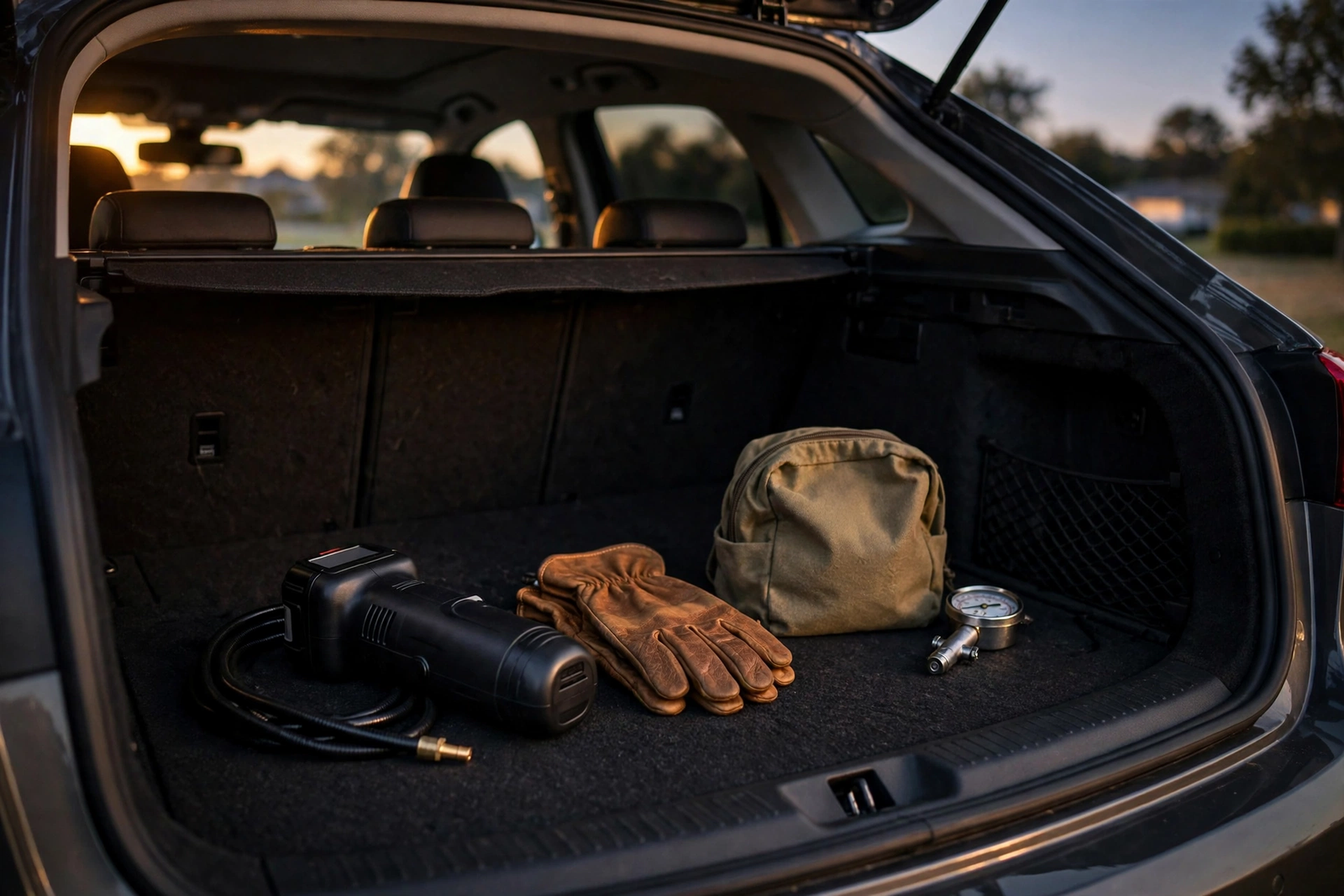
The Milwaukee M18 tire inflator is the winner of this comparison for drivers who inflate large tires, because it is the only tool here built for that job: 150 PSI, a big battery, four presets and the fastest pace on truck tires in the sources checked. The AirMoto is the winner for everyone else — it is small, it needs nothing else, and it is in the car when the tire needs air. The DEWALT is the right answer for DEWALT owners, with the most flexible power setup of the three.
Choose by what you own and what you inflate. If you own M18 batteries and drive a truck, buy the Milwaukee. If you own no tool batteries and drive a car, buy the AirMoto. If you own DEWALT batteries, buy the DEWALT. And whichever you choose, check the listing before you buy: confirm the tool-only catch on the Milwaukee and the DEWALT, confirm the live offer — the Milwaukee’s offer history is mixed — and confirm the pressure your tires actually need from the door placard, not from the sidewall.
Frequently Asked Questions
Is the Milwaukee M18 tire inflator worth it?
Yes, if you already own M18 batteries and you inflate truck or SUV tires. The Milwaukee M18 tire inflator is rated to 150 PSI, it has four memory presets and an auto shut-off, and the sources checked call it the fastest tool here on large tires. If you own no M18 batteries, it is not worth it — the tool is sold without a battery or a charger, and buying both for one inflator adds a second purchase on top of the tool. In that case the AirMoto is the better buy.
Can the AirMoto inflate a truck tire?
It can top one up, but it is not the right tool for filling a large truck tire from flat. The AirMoto is rated to 120 PSI, which is enough pressure for a truck tire, but its built-in 2000mAh battery holds enough charge for top-ups, not for filling four large tires — and the listing’s own notes say battery performance depends on tire size and temperature. For truck tires, the Milwaukee is the tool built for the job; the AirMoto is the tool for the glove box.
Does the Milwaukee M18 inflator come with a battery?
No. The Milwaukee M18 Inflator 2848-20 is sold as a tool only — no battery and no charger in the box. You need an M18 battery of your own to run it, and a charger to charge that battery. The same applies to the DEWALT DCC020IB in this comparison: tool only, no battery or charger. The AirMoto is the only inflator here that works out of the box, because its battery is built into the pump.
What PSI should I inflate my tires to?
Use the pressure on your door placard — the sticker on the driver’s door frame — not the number on the tire sidewall. The sidewall number is the tire’s maximum pressure, not the pressure your car needs. A car tire usually runs at roughly 30 to 35 PSI, a motorcycle tire at roughly 30 to 42 PSI, and a road bike tire at roughly 80 to 100 PSI, but your placard is the only number that matters for your car. Set the target on the inflator and let the auto shut-off stop the pump.
How long does the AirMoto battery last?
The AirMoto has a built-in 2000mAh battery, charged over USB-C, and the listing says it recharges in about two hours, though one tested review measured 2 hours 40 minutes. How many tires that charge covers depends on tire size and temperature — the listing’s own notes say large tires and cold weather drain the battery faster — so no fixed number of tires per charge is claimed here. For top-ups it is enough; for filling large tires from flat, the Milwaukee on a full M18 battery is the tool for the job.
Which is better for a car: Milwaukee M18 or AirMoto?
For a car, the AirMoto is the better buy for most drivers: it is small, it needs no other battery, it lives in the glove box, and 120 PSI covers every car tire. The Milwaukee M18 tire inflator is the better buy only if you already own M18 batteries or you also inflate truck tires — it is bigger, heavier and sold without a battery, and its extra power is wasted on a car tire that needs 32 PSI. Choose by what you own and what you inflate, not by the bigger number.