Best Manual Battery Charger: 3 Wheeled Chargers That Put You in Control
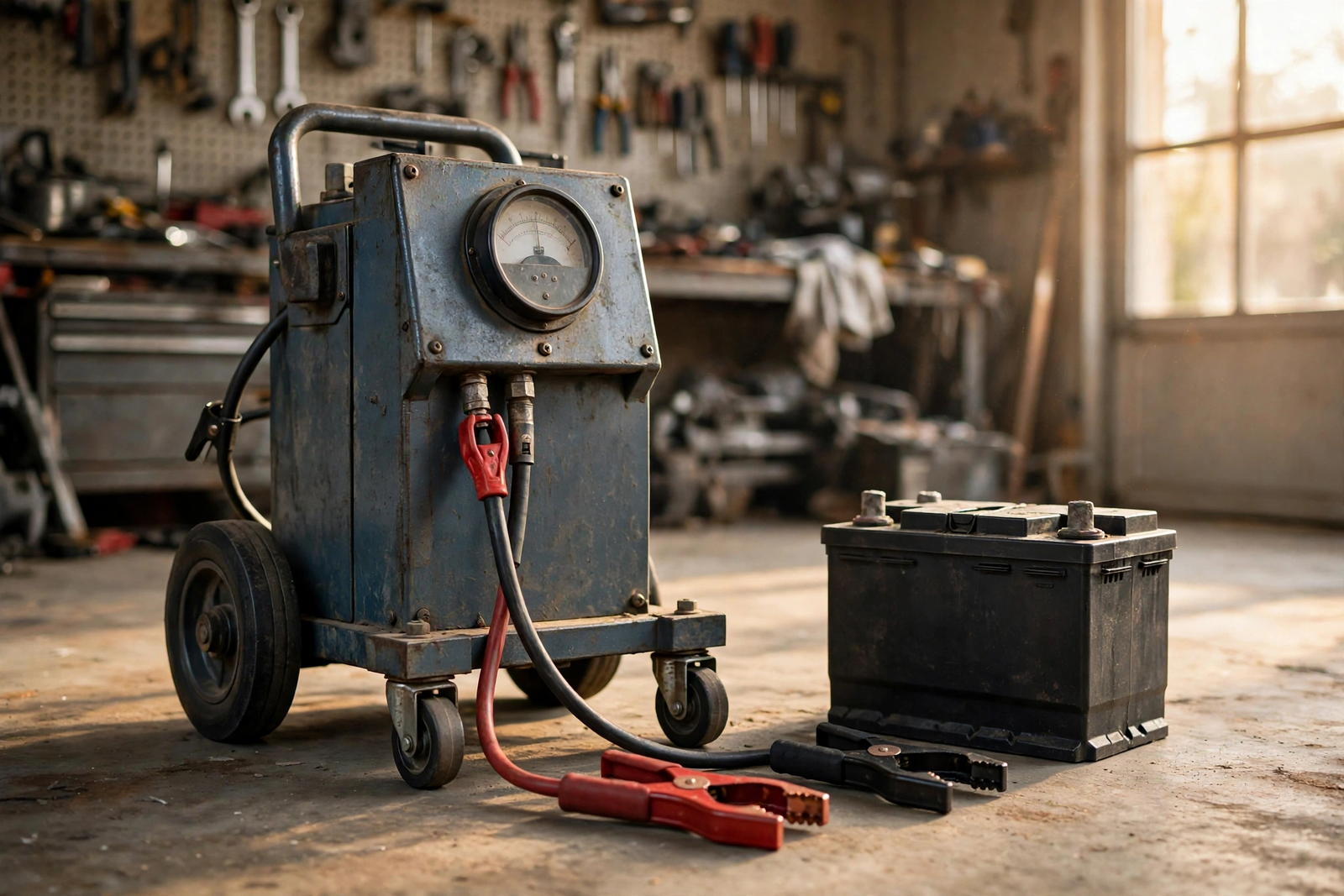
A dead battery does not wait for a convenient morning. A manual battery charger is the old-school answer: a transformer-based charger with a switch, a timer and an analog ammeter, and no microprocessor deciding anything for you. You pick the voltage and the charge rate, watch the needle fall, and switch it off when the battery is full. That control is the whole point — and the whole risk. A manual battery charger will keep charging until you stop it, so it suits the driver who stays with the job, not the one who walks away.
The short answer: the best manual battery charger for most garages is a wheeled 6V/12V unit with a 10-amp charge rate, a strong engine-start setting and a 135-minute timer — the Schumacher SC1446. If every vehicle you own runs on 12 volts, the CRAFTSMAN CMXCESM274 is the simpler 12V-only manual charger. And if you need the most starting power in this roundup, the Schumacher SC1445 gives you a 250-amp engine start. All three are manual in the true sense: no auto-shutoff, no desulfation mode, no maintenance mode. You are the shutoff.
As an Amazon Associate I earn from qualifying purchases.
Quick Pick: Best Manual Battery Charger for Cars and Trucks
| Pick | Product | Best For | Check Price |
|---|---|---|---|
| Overall Winner | Schumacher Electric Wheeled Manual 10A Car Battery Charger and 200A Engine Starter, 2-in-1 Solution, 40A Boost, for 6V/12V Power Sport, Automotive, and Marine Batteries, SC1446 | A manual battery charger, 6V/12V, with a 10A charge rate, 200A engine start and a 135-minute timer | Check Price on Amazon |
| Best for 12V Cars | CRAFTSMAN Wheeled Manual 6A Car Battery Charger and 175A Engine Starter, 2-in-1 Solution, Timer-Controlled, 25A Boost, for 12V Power Sport, Automotive, and Marine Batteries, CMXCESM274 | A manual battery charger, 12V only, with a 6A charge rate, 175A engine start and a 135-minute timer | Check Price on Amazon |
| Premium Pick | Schumacher Electric Wheeled Manual 10A Car Battery Charger and 250A Engine Starter, 2-in-1 Solution, 50A Boost, for 6V/12V Power Sport, Automotive, and Marine Batteries, SC1445 | A manual battery charger, 6V/12V, with a 10A charge rate, 250A engine start and a 135-minute timer | Check Price on Amazon |
The Quick Pick labels describe the chargers’ roles, not checked prices: the SC1446 is the most versatile pick here, the CRAFTSMAN is the 12V-only pick, and the SC1445 is the pick with the most starting power. Check the live listings for current prices before you buy.
Table of Contents
Schumacher SC1446: The Best Manual Battery Charger for Most Garages
The Schumacher SC1446 is the most complete manual battery charger in this roundup: a wheeled 2-in-1 charger and engine starter for 6V and 12V batteries, model SC1446. It charges at 10 amps on 12 volts, boosts at 40 amps on 12 volts and 20 amps on 6 or 12 volts, and delivers a 200-amp engine start when a battery is too flat to crank on its own. A 135-minute timer and an analog ammeter sit on the front panel, and the whole unit rolls on wheels. It works with standard, AGM, gel and deep-cycle batteries.
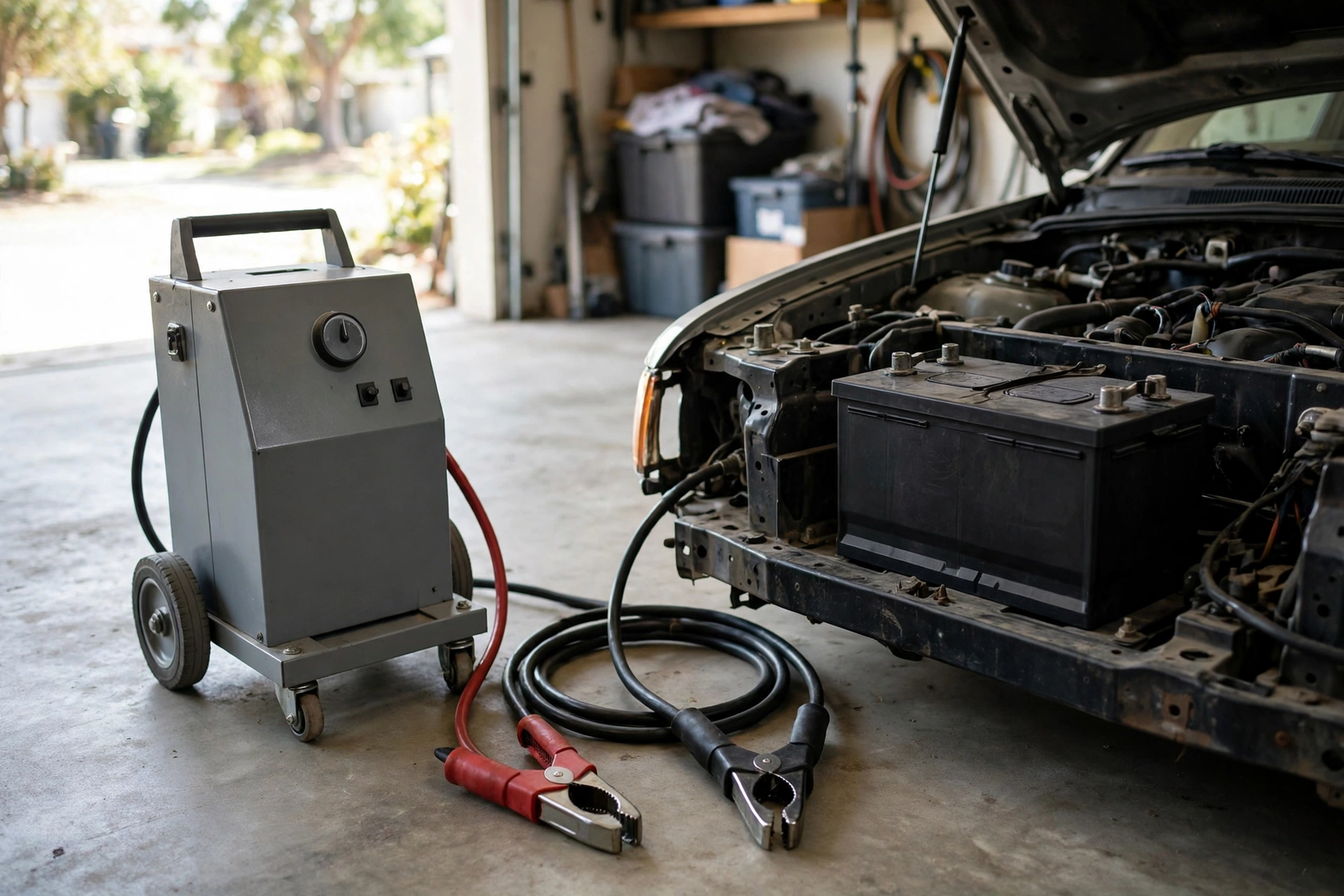
That combination is what makes it the overall winner. The 6V setting covers older vehicles, the 10-amp charge rate is tied for the fastest here, and the 200-amp engine start is the middle starting power of the three here. The timer ends the session after the time you set, and the ammeter shows when the current falls to a low, steady level.
Schumacher Electric Wheeled Manual 10A Car Battery Charger and 200A Engine Starter, 2-in-1 Solution, 40A Boost, for 6V/12V Power Sport, Automotive, and Marine Batteries, SC1446 on Amazon: Manual wheeled charger and engine starter, model SC1446, 10A charge, 200A engine start, 135-minute timer.
Buy the Schumacher SC1446 if: you want the best manual charger for a mixed garage — 6V and 12V, a 10-amp charge rate, a 200-amp engine start, and a timer and ammeter to keep the job under control.
CRAFTSMAN CMXCESM274: The Best Manual Battery Charger for 12V Cars
The CRAFTSMAN CMXCESM274 is the simplest manual battery charger in this roundup: a wheeled 2-in-1 charger and engine starter made for 12-volt batteries only, model CMXCESM274, built by Schumacher Electric. It charges at 6 amps, boosts at 25 amps and delivers a 175-amp engine start, with a 135-minute manual timer on the front panel. It works with 12V standard, AGM, gel and deep-cycle batteries.
That 12V-only design is the point. If every car, truck and boat battery you own is 12 volts, you do not need a 6V setting you will never touch — and this is the manual charger that skips it. The trade-off is speed: its 6-amp charge rate is slower than the 10-amp rate on both Schumacher units here, so a large flat battery takes longer on this charger.
CRAFTSMAN Wheeled Manual 6A Car Battery Charger and 175A Engine Starter, 2-in-1 Solution, Timer-Controlled, 25A Boost, for 12V Power Sport, Automotive, and Marine Batteries, CMXCESM274 on Amazon: Manual wheeled charger and engine starter, model CMXCESM274, 6A charge, 175A engine start, 135-minute timer.
Buy the CRAFTSMAN CMXCESM274 if: every battery you charge is 12 volts and you want the simplest wheeled manual charger here — a 6-amp charge rate, a 175-amp engine start and a timer, with nothing extra to set.
Schumacher SC1445: The Best Manual Battery Charger for Big Engines
The Schumacher SC1445 is the strongest manual battery charger in this roundup: a wheeled 2-in-1 charger and engine starter for 6V and 12V power sport, automotive and marine batteries, model SC1445. It charges at 10 amps on 12 volts, boosts at 50 amps on 12 volts and 25 amps on 6 or 12 volts, and delivers a 250-amp engine start — the most starting power of the three chargers here. A 135-minute timer and an analog ammeter sit on the front panel, and it works with standard, AGM, gel and deep-cycle batteries.
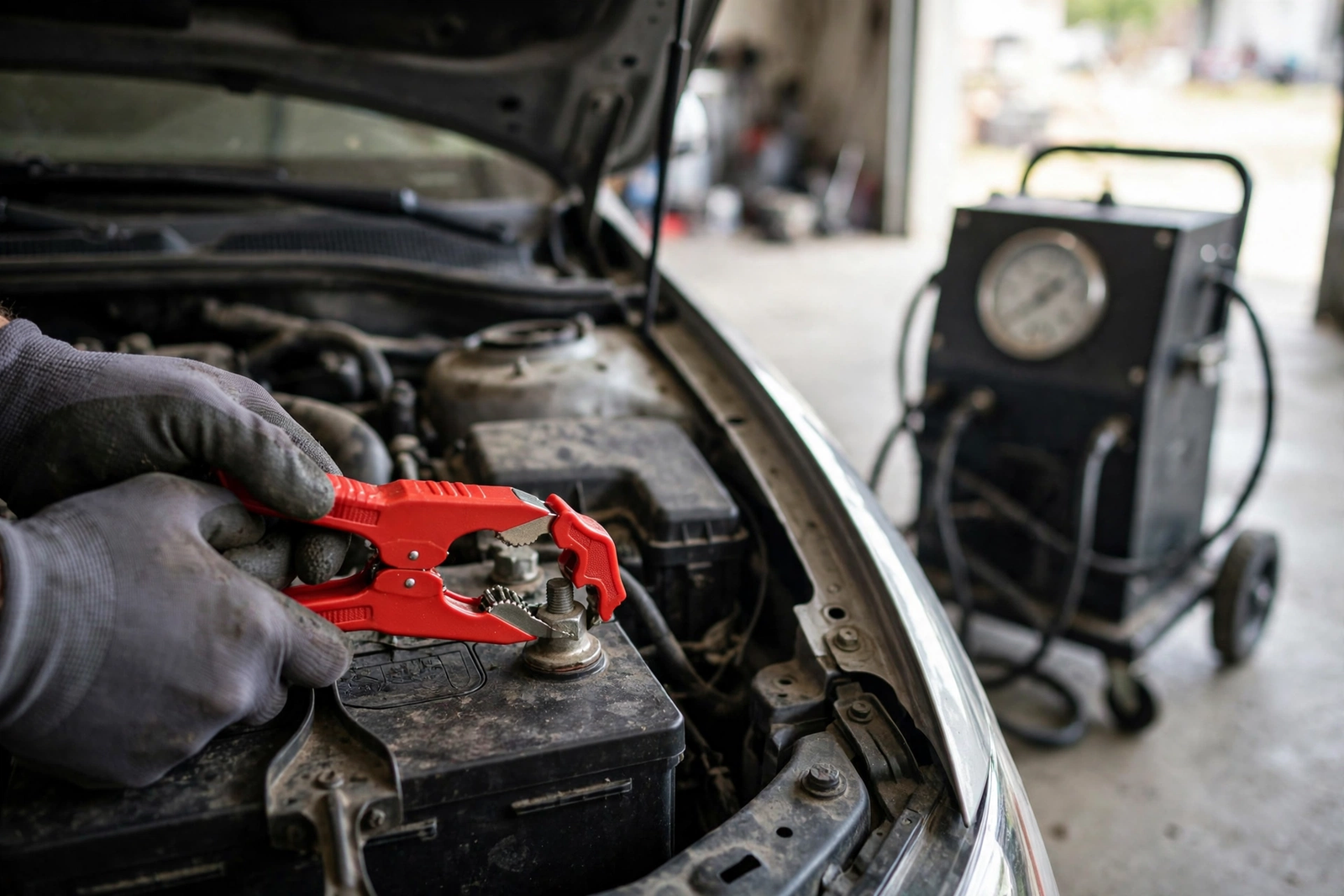
That extra starting power is what makes it the premium pick. The SC1445 is built for the same job as the SC1446, with the same 10-amp charge rate and the same timer and ammeter — the difference is the cranking power: 250 amps against 200, and a 50-amp boost against 40. If your garage holds trucks and SUVs that need a hard crank on a cold morning, that margin matters.
Schumacher Electric Wheeled Manual 10A Car Battery Charger and 250A Engine Starter, 2-in-1 Solution, 50A Boost, for 6V/12V Power Sport, Automotive, and Marine Batteries, SC1445 on Amazon: Manual wheeled charger and engine starter, model SC1445, 10A charge, 250A engine start, 135-minute timer.
Buy the Schumacher SC1445 if: you want the most starting power in this roundup — a manual charger with a 250-amp engine start and a 50-amp boost for big engines.
Manual vs Smart Battery Charger: The Honest Difference
The difference is who is in charge. A smart battery charger has a microprocessor that reads the battery, picks the charge rate, stops when the battery is full and then holds it in a maintenance mode — and many add a desulfation mode. A manual battery charger has none of that: a transformer, a selector switch, a timer and an ammeter. It pushes current at the rate you set until you switch it off or the timer runs out. Our best smart battery charger roundup covers the microprocessor side, with the NOCO GENIUS5.
Neither type is better in every garage. A smart charger suits the driver who wants to connect it and walk away. A manual charger suits the workshop and the older vehicle: it does not need to detect the battery before it starts charging, so a battery too flat for some smart chargers to recognize may still take a charge. What it cannot do is look after itself — leave it connected and it will overcharge the battery. If your car sits for weeks, neither type is right: a maintainer, covered in our best battery maintainers roundup, is built to stay connected safely.
How a Manual Battery Charger Works
A manual battery charger is simple on purpose. Wall power runs through a transformer that steps the voltage down, a rectifier turns it into direct current, and the selector switch sends that current to the battery at the rate you chose — 10 amps, 6 amps, a boost rate, or the engine-start setting. There is no microprocessor reading the battery and no staged charging program: the charger does one thing, at the rate you set, for as long as you leave it on.
The ammeter is your only gauge of progress. It shows how much current the battery is drawing from the charger. A flat battery draws hard at first, and as it takes a charge it draws less and less — the needle falls. When the current stops decreasing, the battery is charged. Schumacher’s own manuals state the rule: keep a visual check on the ammeter, because a manual charger will continue to charge and will not shut off.
How to Use a Manual Battery Charger Without Overcharging It
Start with the settings, not the clamps. Set the voltage selector to match the battery — 6V or 12V — and set the charge rate to the lowest rate first. Connect the red clamp to the positive battery post and the black clamp to the vehicle chassis or engine block, away from the battery, then plug the charger in. Set the timer for the time you plan to watch, and keep the area ventilated, because batteries give off explosive gases while they charge. Our how to charge a car battery guide walks through the connection steps in full.

Then watch the ammeter. Check it every so often while the charger runs: the needle should fall steadily as the battery fills. When the current stops decreasing, the battery is charged — switch the charger off, unplug it, and disconnect the clamps. Do not use the engine-start setting without a battery in the vehicle, and do not use boost as a substitute for a full charge: it adds energy fast so the engine can crank, but the battery still needs a proper charge afterwards. A manual charger rewards attention and punishes forgetfulness, so never start a charge you cannot stay to finish.
How Long Does a Manual Battery Charger Take to Charge a Car Battery?
There is no single number. How long a manual battery charger takes depends on the size of the battery, how flat it is, and which charge rate you set — a 10-amp rate fills a battery faster than a 6-amp rate, and a large truck battery takes longer than a car battery. The honest measure is the ammeter, not the clock: the charge is done when the current stops falling, not when a set number of hours has passed.
One limit is fixed: the timer on all three chargers here runs to 135 minutes, so a single timed session lasts just over two hours. A deeply discharged large battery may need more than one session — set the timer again, keep watching the ammeter, and stop when the current stops falling. Between charges, keep the battery healthy: our how to maintain a car battery guide covers the habits that stop it going flat.
Manual Battery Charger Mistakes to Avoid
The first mistake is walking away. A manual battery charger has no auto-shutoff that senses a full battery, so a charge started and forgotten will overcharge the battery and damage it. Stay with the job, watch the ammeter, and disconnect when the current stops falling. The second mistake is the wrong voltage setting: charging a 12-volt battery on the 6-volt setting, or the other way round, is a fast way to damage a battery — check the setting before you connect the clamps.
The third mistake is starting at the highest rate. Begin at the lowest charge rate, and only use boost or engine start for a quick push before cranking, not as a substitute for charging. The fourth is charging in a closed space: batteries give off explosive gases while they charge, so work in ventilated air and keep sparks and flames away. And the fifth is charging a battery that is beyond saving — one that will not hold a charge after a proper session needs replacing, not another session.
Who Should Buy a Manual Battery Charger — and Who Should Not
Buy a manual battery charger if: you work on older vehicles, keep a workshop, or want full control over the charge. It suits the driver with several vehicles, and anyone who wants a strong engine-start setting in the same unit as the charger. A manual charger is a tool for hands-on owners, not a gadget for the forgetful.
Do not buy one if: you want to connect a charger and walk away — that is a smart charger’s job, with auto-shutoff and a maintenance mode. Do not buy one if your car sits for weeks between drives: a maintainer is built to stay connected safely, and a manual charger is not. And if you will not watch an ammeter and disconnect the charger yourself, a manual charger will overcharge your battery — buy the smart charger instead.
The Verdict
The best manual battery charger for most garages is the Schumacher SC1446: a wheeled 6V/12V unit with a 10-amp charge rate, a 200-amp engine start, a 135-minute timer and an analog ammeter. The CRAFTSMAN CMXCESM274 is the pick for 12V-only garages: simpler, with a 6-amp charge rate and a 175-amp engine start, and nothing to set that you do not need. And the Schumacher SC1445 is the premium pick: the same charging job with the most starting power here, a 250-amp engine start and a 50-amp boost.
Whichever manual charger you choose, remember what it is: a charger that does exactly what you tell it, for as long as you tell it. Set the voltage, set the rate, set the timer, watch the ammeter, and disconnect when the current stops falling. If no charger brings a battery back, the battery is done — see what a car battery replacement costs before you spend another afternoon charging it.
Frequently Asked Questions
Can a manual battery charger overcharge a battery?
Yes. A manual battery charger keeps charging until you switch it off or the timer runs out, so if you leave it connected after the battery is full it can overcharge the battery and damage it. Watch the ammeter and disconnect the charger when the current stops falling.
How do I know when the battery is charged on a manual charger?
Watch the ammeter. As the battery takes a charge it draws less current from the charger, so the needle falls. When the current stops decreasing, the battery is charged — switch the charger off and disconnect it.
Can I leave a manual battery charger connected overnight?
No. A manual battery charger has no maintenance mode and no auto-shutoff that senses a full battery, so leaving it connected overnight can overcharge the battery and damage it. If you want to leave a charger connected, use a smart charger or a maintainer instead.
What does the 135-minute timer do on a manual battery charger?
The timer ends the charging session after the time you set, up to 135 minutes. It is a clock, not a battery sensor: it does not know when the battery is full. Set the timer for the time you plan to watch, and check the ammeter before the time runs out.
Can a manual battery charger charge a lithium battery?
No. The three chargers in this roundup are made for lead-acid batteries — standard, AGM, gel and deep-cycle. Do not use them on a lithium battery, which needs a charger made for its chemistry.
Should I buy a manual or a smart battery charger?
Buy a manual battery charger if you want full control, work on older vehicles, or need strong engine-start power in the workshop. Buy a smart battery charger if you want to connect it and walk away, with auto-shutoff and a maintenance mode that keeps the battery healthy.