A tyre warning light on a truck with 33-inch tyres is a different problem from the same light on a hatchback: small cordless inflators fade on big tyres, and a gas-station pump is no help ten miles away. The VIAIR 88P portable air compressor for tires is built for that job — a 12-volt pump that clips straight to the battery, pushes 1.47 cubic feet per minute at up to 120 PSI, and is rated for tyres up to 33 inches. It has no battery, no digital display and no auto shut-off: just an analog gauge, an on-off switch and a brass twist-on chuck.
In this review of the VIAIR 88P portable air compressor for tires, we cover what the airflow means in practice, how to read the analog gauge, what the 25-minute duty cycle allows, and how it compares with the EPAuto and the cordless Fanttik X9 Pro and Airmoto. Our portable tire inflator roundup already picks the 88P for trucks and SUVs. The Quick Pick table below has the short version.
As an Amazon Associate I earn from qualifying purchases.
| Pick | Product | Why it stands out | Check Price |
|---|---|---|---|
| Overall Winner | VIAIR 88P Portable Air Compressor (00088) | 12V battery-clamp pump, 1.47 CFM at 120 PSI, rated for tyres up to 33 inches | |
| Best Budget | EPAuto 12V DC Portable Air Compressor Pump (AT-010-1Z) | Cheapest corded option — digital preset, auto shut-off and LED light, socket-powered | |
| Premium Pick | Fanttik X9 Pro Portable Tire Inflator | Cordless handheld inflator, 150 PSI max, pocket-size — the step up for drivers who hate cables |
Table of Contents
What the VIAIR 88P Portable Air Compressor for Tires Is — and What It Is Not
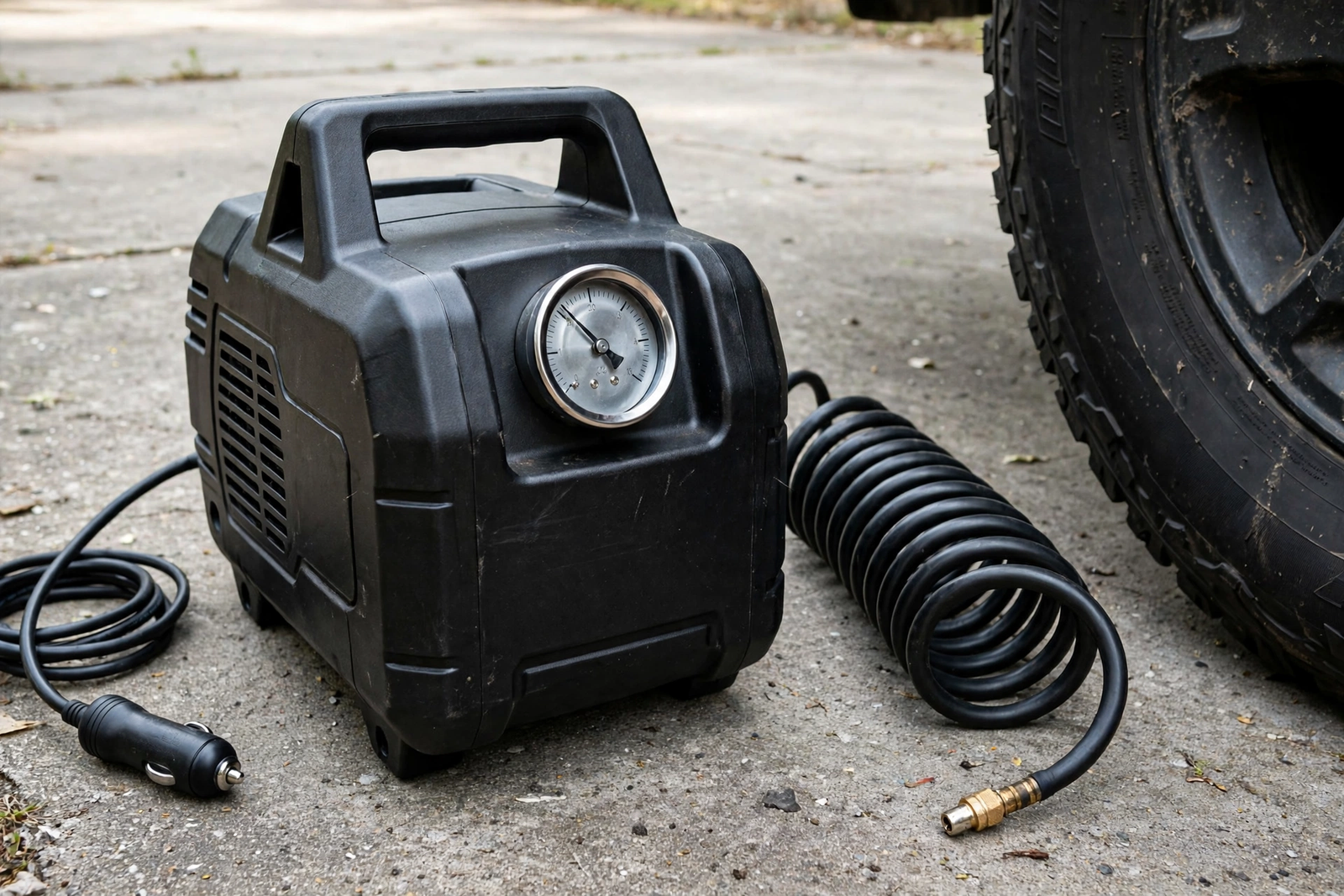
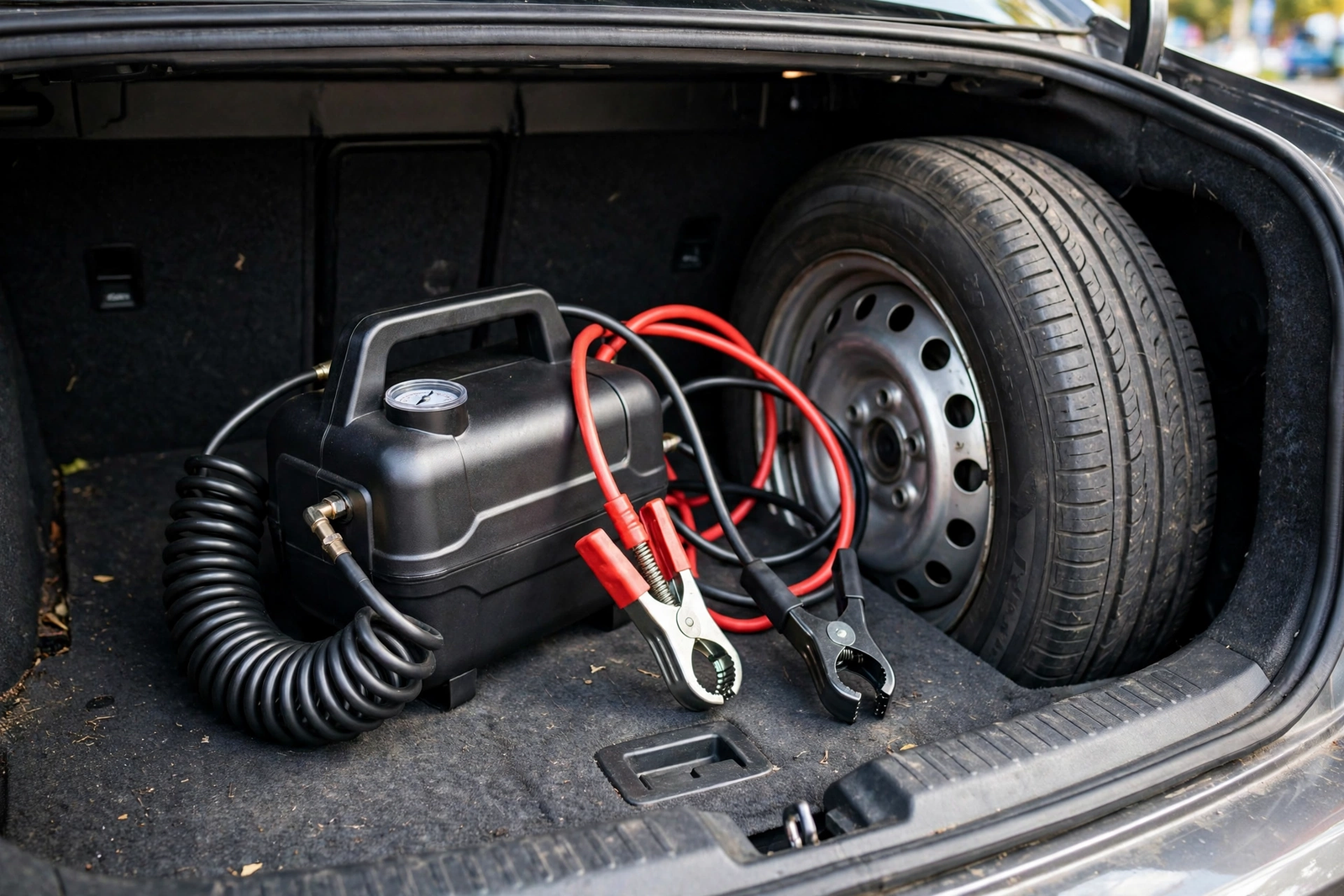
The VIAIR 88P (part number 00088) is a 12-volt DC portable air compressor for tires that runs off the vehicle’s battery — not a cigarette-lighter socket, and not a rechargeable battery of its own. It is a small pump in a rugged housing with a carrying handle, a built-in 120 PSI analog gauge, an on-off switch, an LED power indicator and a brass twist-on tyre chuck. The 10-foot cord ends in dual battery clamps, the 16-foot hose reaches around the vehicle, and VIAIR rates it for cars, trucks, SUVs and RVs, with tyres up to 33 inches.
VIAIR’s own specification sheet lists the headline numbers: 12 volts DC, a maximum draw of 20 amps, a maximum working pressure of 120 PSI, and airflow of 1.47 cubic feet per minute at zero PSI. It weighs 4.75 pounds according to VIAIR, measures 9.8 by 3.2 by 5.6 inches, and is rated to work from minus 4 to 158 degrees Fahrenheit.
What the 88P is not matters too. It is not a cordless inflator — there is no battery inside, so it cannot work away from the vehicle. It is not a set-and-forget inflator either: with no preset and no auto shut-off, you watch the gauge and switch it off yourself. And it is not a workshop compressor: it inflates tyres and small inflatables, not air tools. As an air compressor for car, truck and SUV tyres, it trades the pocket inflators’ convenience for more power and stamina.
Power and Airflow: What 1.47 CFM and 120 PSI Mean in Practice
Airflow decides how long a fill takes, and 1.47 cubic feet per minute is a strong figure for a pump this size. Most portable tire air compressors in this class move well under one cubic foot per minute — the EPAuto manages 1.06 — so the 88P moves roughly forty percent more. That gap shows up on a big tyre, where every extra litre per minute shortens a long job.
VIAIR claims the 88P fills a 225/60/18 tyre in 50 seconds or less — a standard passenger-car tyre size, and a top-up-style fill rather than a rescue from flat, so treat it as a best-case figure. A normal top-up takes well under a minute on a car tyre and a few minutes on a big truck tyre — far faster than the pocket cordless inflators, which measure their fills in minutes per tyre.
The 120 PSI ceiling matters because most car tyres run at 30 to 35 PSI and light-truck tyres at 35 to 45 PSI, so a 120 PSI maximum means the motor never strains at its limit in normal use. Do not buy it for a job that needs pressure near that ceiling — high-pressure jobs belong to a bigger shop compressor.
The Analog Gauge: How to Read It Right
The 88P is the only inflator in this comparison without a digital readout. The built-in gauge is an analog dial reading up to 120 PSI, mounted where you can see it while the pump runs. There is no screen to wash out in bright sun — but there is also no preset to stop the pump for you, and no exact digital number to read off.
The gauge has one behaviour every buyer must know: while the pump is running, it overstates the pressure. VIAIR’s own manual warns that, during inflation, air velocity means the gauge cannot provide an accurate reading, and that you must switch the compressor off to check the real pressure. One independent test measured the gap at 5 to 10 PSI high while running, and found the gauge accurate within about 2 PSI once the pump was off. The routine is simple: run the pump, switch it off, read the gauge, repeat.

Battery Clamps, Cord, and Hose Reach
The most important thing to understand about the 88P is how it gets its power: it does not plug into the cigarette-lighter socket. It draws up to 20 amps, more than a typical 12-volt socket circuit is fused for, so it connects straight to the battery with dual alligator clamps on a 10-foot cord. That is why it can push 1.47 CFM while socket-powered inflators top out lower. If you were expecting a socket plug, catch this detail before you order.
Clamping to the battery means opening the bonnet and clipping red to positive and black to negative, which takes a minute. It also means the pump works whenever the battery has charge — no dead-battery surprise after months in the trunk, no inflator battery to maintain, no charging routine. The trade is that the bonnet must be open; you cannot carry this pump to a bicycle in the garage or a ball at the park.
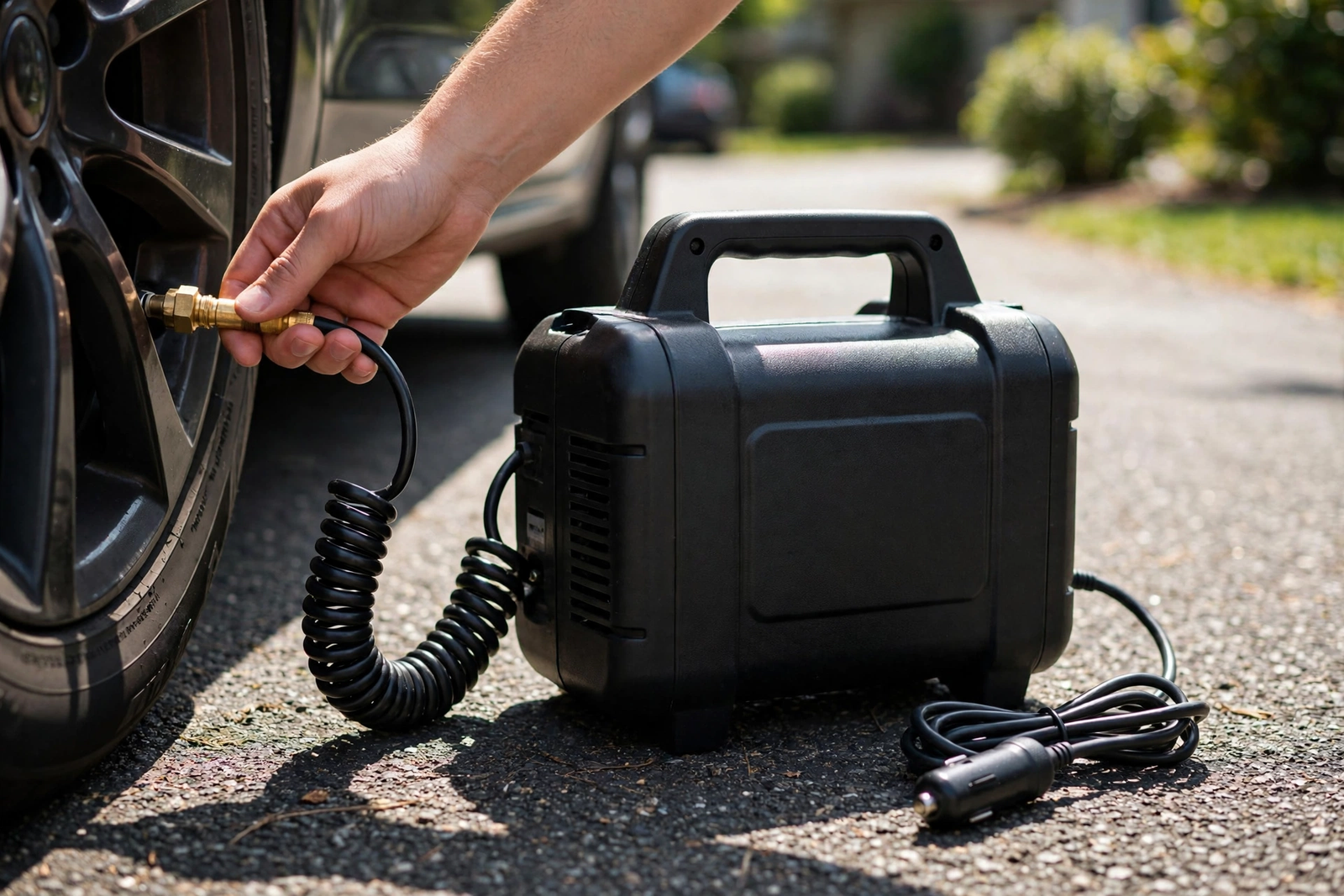
Reach is generous: the 10-foot cord plus the 16-foot hose covers all four tyres on most vehicles without moving the pump, and the brass twist-on chuck screws onto the valve stem and stays put. The hose is coiled, so it packs down small. One caution: the 88P is a 12-volt DC device only — do not connect it to mains power, and do not use it on a 24-volt system.
Duty Cycle and Heat: The 25-Minute Limit
Duty cycle is the hidden limit on every small compressor, and the 88P is unusually honest about it. VIAIR rates it at 25 minutes at 30 PSI in 72-degree air, after which the pump needs a rest to cool down. For monthly top-ups that is plenty: four tyres a few PSI low is a few minutes of work. For airing four big truck tyres back up from trail pressure, it is the number that decides whether you finish in one pass or wait in the cold between tyres.
Two things follow. First, the limit is stated at 30 PSI and 72 degrees — hotter days and higher pressures shorten the safe run, so a summer afternoon airing up four 33-inch tyres is the hardest case. Second, one independent review states 30 minutes instead of 25; this review follows VIAIR’s 25-minute figure, and the safe habit is the same either way — rest the pump between long runs.
VIAIR 88P vs the Alternatives (EPAuto, Fanttik X9 Pro, Airmoto)
The closest corded rival is the EPAuto 12V DC Portable Air Compressor Pump (AT-010-1Z) — the same plug-in idea with a socket plug instead of battery clamps. It runs from the cigarette-lighter socket, reads pressure on a digital display, and stops itself at your set pressure. Its airflow is 1.06 cubic feet per minute against the 88P’s 1.47, its maximum pressure is disputed (100 PSI listing, 60 PSI manual, 70 PSI roundup), and it does not support truck tyres. The EPAuto is the simpler, cheaper tool for a car; the 88P is the stronger one for big tyres.
The cordless alternative is the Fanttik X9 Pro, covered in our Fanttik X9 Pro review — a pocket-size handheld inflator with a rechargeable battery, a 150 PSI maximum, preset modes and auto shut-off, and a gauge an independent test verified at 32.1 PSI against a 32 PSI target. It tops up a compact car tyre from 30 to 35 PSI in about a minute on the listing’s figures, with no cable and no bonnet to open. But its battery holds a limited charge — up to 23 minutes per charge — and you must remember to charge it. Buy the base-model listing, not the Deluxe package variant, which is a different listing. For a truck owner, the best portable air compressor never runs out of charge mid-tyre — the corded 88P. For the quickest pocket top-up, it is the X9 Pro.
The third option is the Airmoto, covered in our Airmoto portable tire inflator review — a pocket-size cordless inflator with a 2000mAh battery. Its listing says 3 to 5 minutes per standard top-up, while one independent test measured 7 to 8 minutes for a larger one — the slowest of the three, but also the smallest. The AstroAI L7, covered in our AstroAI L7 review, adds a bigger battery and a 12-volt DC backup mode. The short version: 88P for the biggest tyres, EPAuto for the cheapest corded tool, X9 Pro for the quickest pocket top-up, Airmoto for the smallest glove-box tool, L7 for the bigger battery and corded fallback.
Who Should Buy It — and Who Should Skip It
Buy the VIAIR 88P if your tyres are big, your top-ups are frequent, or your vehicle goes off-road. It suits the truck and SUV driver airing tyres up and down for trails, the RV owner with large tyres, and anyone who wants a trunk tool that works after months of neglect with no battery to charge — or who distrusts digital presets and prefers watching a needle.
Skip it if you drive a compact car and only ever top up a few PSI: a cordless pocket inflator sets up faster with no bonnet to open, and the 88P is more inflator than you need. Skip it too if you want to inflate away from the car — a bicycle in the garage, a ball at the park — because the battery clamps tether it to the vehicle. And skip it if you want set-and-forget inflation: with no preset and no auto shut-off, this pump needs you watching the gauge. A portable air compressor for car tires that fits in a glove box is a different tool from this one.
Verdict
The VIAIR 88P portable air compressor for tires is the heavy-duty version of the corded inflator idea: a 12-volt battery-clamp pump with 1.47 CFM of airflow, a 120 PSI ceiling, a 25-minute duty cycle and an analog gauge you read with the pump off. Its limits are the honest limits of the category — no battery, no presets, no auto shut-off, a bonnet to open before every use. Accept those facts and it is a strong buy for big tyres and long jobs; if any is a deal-breaker, the EPAuto is the cheaper corded step down, the X9 Pro the cordless one.
Frequently Asked Questions
Can the VIAIR 88P plug into a cigarette lighter socket?
No. The 88P connects to the vehicle battery with dual alligator clamps on a 10-foot cord. It draws up to 20 amps, which is more than a typical 12-volt socket circuit is fused for, so it cannot run from a cigarette lighter socket. If you need a socket-powered inflator, the EPAuto runs from the 12-volt socket instead.
How accurate is the analog gauge on the VIAIR 88P?
One independent test found the gauge accurate within about 2 PSI once the pump was switched off. While the pump is running, the gauge overstates the pressure by 5 to 10 PSI, and VIAIR’s own manual warns that the gauge cannot give an accurate reading during inflation. Always switch the compressor off before trusting the reading.
How long can the VIAIR 88P run before it needs a rest?
VIAIR rates the duty cycle at 25 minutes at 30 PSI in 72-degree air, after which the pump needs a rest to cool down. Hotter days and higher pressures shorten the safe run. One independent review states 30 minutes instead of 25, so rest the pump between long runs either way and let it cool before the next tyre if it feels hot.
Can the VIAIR 88P fill a completely flat tire?
It is the best tool in this comparison for the job: VIAIR claims it fills a 225/60/18 tyre in 50 seconds or less, and its 1.47 CFM airflow and 25-minute duty cycle are sized for big fills. A large truck tyre from flat still takes much longer than a top-up, and a tyre that is flat because of a puncture needs a repair, not just air. A fully flat tyre is a job for a spare tyre or a repair shop if the tyre will not hold air.
What is the maximum pressure of the VIAIR 88P?
The maximum working pressure is 120 PSI, according to VIAIR’s specification sheet and the Amazon listing. Most car tyres run at 30 to 35 PSI and light-truck tyres at 35 to 45 PSI, so normal use sits far below the ceiling. Do not buy it for a job that needs pressure near 120 PSI.
Should I buy the VIAIR 88P or the Fanttik X9 Pro?
Buy the VIAIR 88P if your tyres are large or you air them up and down often: it clips to the battery, never runs out of charge, and pushes 1.47 CFM. Buy the Fanttik X9 Pro if you want cordless convenience: it is a pocket-size handheld with a rechargeable battery, a 150 PSI maximum and auto shut-off, but you must keep it charged and it can pause if it overheats on a hot day. Buy the base-model X9 Pro listing, not the Deluxe package variant, which is a different listing.