
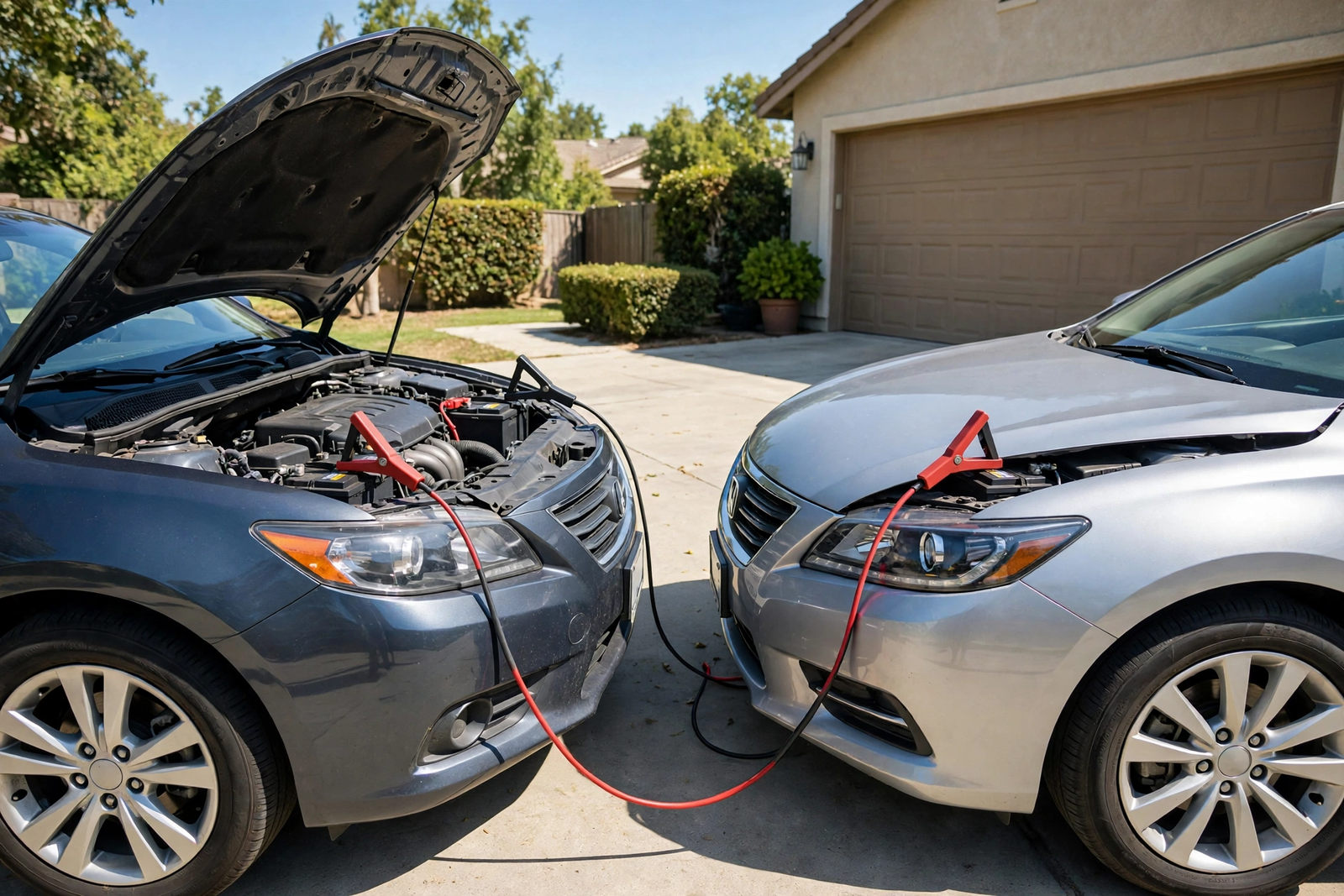
How to Jump Start a Car With Cables: A Step-by-Step Guide
A dead battery never picks a good moment. One turn of the key gives a slow crank or a single click, the dashboard lights fade, and the car that started fine yesterday will not start today. The fix is one of the oldest jobs in car care: learning how to jump start a car with cables takes a second car with a good battery, a set of jumper cables, and a few minutes. If you can tell red from black and follow four connections in sequence, you can do this.
The short answer: to jump start a car with cables, connect red to the dead battery positive terminal, red to the donor battery positive terminal, black to the donor battery negative terminal, and black to an unpainted metal ground on the dead car — never to its negative terminal. Start the donor car, wait a few minutes, start the dead car, then remove the cables in reverse order. The three cable sets below are a 30-foot 1-gauge set for trucks, a 20-foot 4-gauge set for everyday cars, and a 16-foot 6-gauge set for small cars.
As an Amazon Associate I earn from qualifying purchases.
Quick Pick: How to Jump Start a Car With Cables
| Pick | Product | Best For | Check Price |
|---|---|---|---|
| 30-Foot 1-Gauge Heavy Duty | Energizer Jumper Cables, 30 feet, 1 Gauge, 800A, Booster Battery Cables with Permanent Installation kit and Quick Connect Plug | A 30-foot 1-gauge set with a quick-connect plug, for trucks and SUVs with larger engines | Check Price on Amazon |
| 20-Foot 4-Gauge Everyday | CARTMAN 4 Gauge 20 Feet Jumper Cables Automotive Booster Cables with Carry Bag for Car SUV and Pickup Trucks | A 20-foot 4-gauge set with a carry bag, for everyday cars, SUVs and pickup trucks | Check Price on Amazon |
| 16-Foot 6-Gauge Compact | Energizer Jumper Cables for Car Battery, Heavy Duty Automotive Booster Cables for Jump Starting Dead or Weak Batteries with Carrying Bag Included (16-Feet (6-Gauge)) | A 16-foot 6-gauge set with a carry bag, for small and mid-size cars | Check Price on Amazon |
Table of Contents
What You Need Before You Start
You need three things: a set of jumper cables, a second car with a healthy battery, and a driver for that second car. A jump start from battery to battery only works when the donor battery is healthy and the same voltage as yours — both cars here are 12-volt cars, which covers almost every gasoline and diesel car on the road. Check both batteries before you connect anything: if a battery case is cracked, leaking, swollen, or the terminals are caked in heavy corrosion, do not jump it — that battery needs a professional, not a set of cables.
Park the donor car close enough for the cables to reach, nose to nose or side by side, without the cars touching. Switch both cars off, take the keys out, and put both cars in park or neutral with the parking brake on. Work gloves and eye protection are worth wearing: batteries can spark, and a spark near a battery is the one thing this whole job is designed to avoid. Our car maintenance checklist covers the other small jobs worth doing in the same driveway session, so the jump start is rarely a job you do on its own.
Untangle the cables fully before you start and lay them out so the red and black clamps cannot touch each other. Find the positive and negative terminals on both batteries: positive is marked with a plus sign and usually has a red cover, negative with a minus sign. If you cannot find the terminals or your car has a remote jump-start post under the hood, check your owner’s manual first — some cars hide the battery in the trunk or under a seat, and the manual shows where the jump points are.
Energizer ENB130: The 30-Foot 1-Gauge Cables for Trucks and SUVs
The Energizer ENB130 is the heavy-duty pick in this guide: a 30-foot, 1-gauge, 800-amp set, model ENB130, with a permanent installation kit and a quick-connect plug. The listing describes it for SUVs and trucks with up to 8-liter gasoline and 6-liter diesel engines, and the cables are copper-clad aluminum with a thick vinyl coating that the listing describes as all-weather and tangle-free. The 30-foot length is the point of this set: it reaches between cars parked awkwardly or nose to tail, where a 16-foot set would fall short.
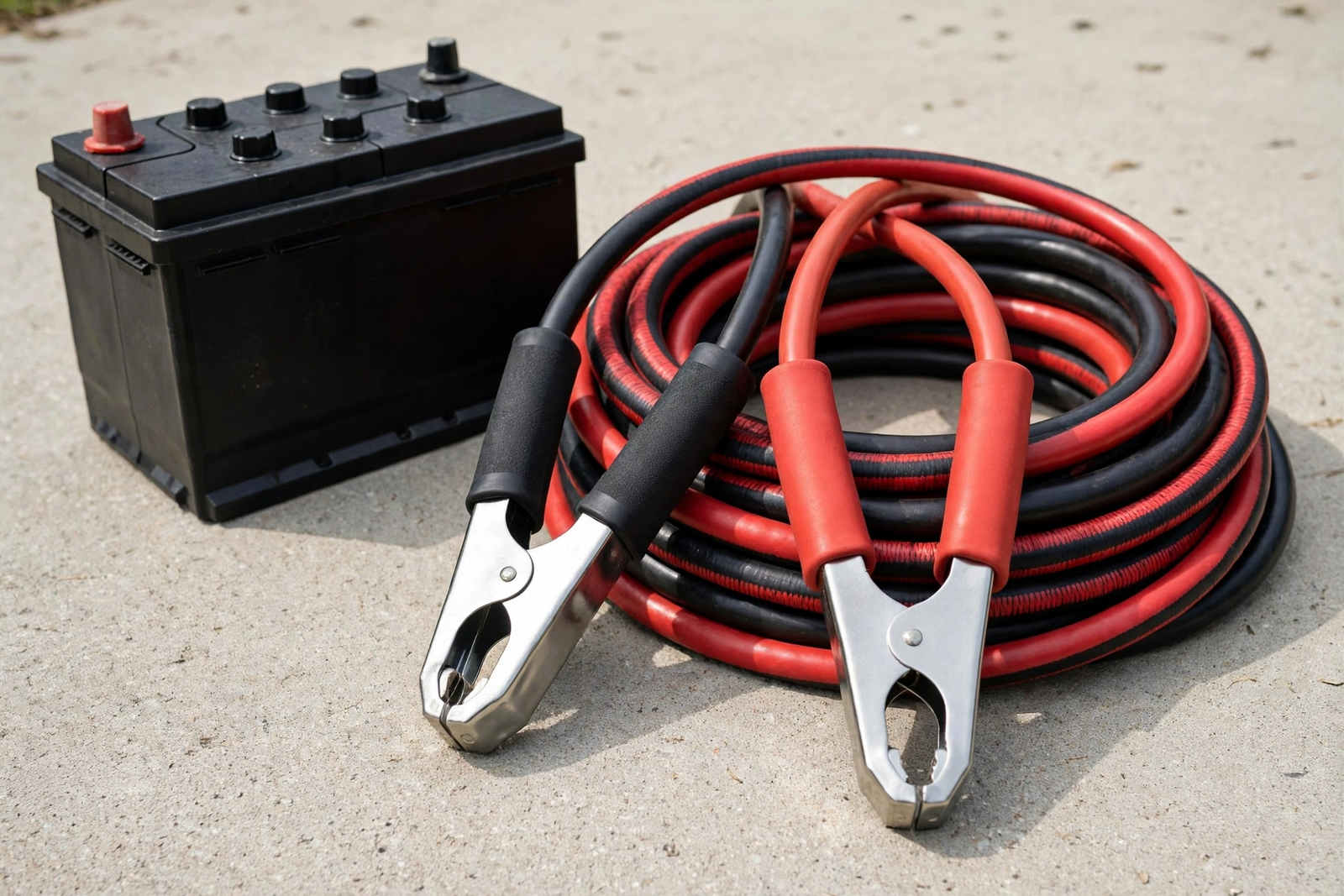
The quick-connect plug lets the cables stay partly installed on the vehicle, so the next jump starts with a plug rather than a full hook-up — that is the permanent installation kit in the box. The set weighs about ten and a half pounds, so it is the heaviest set in this guide and the one to keep in a truck rather than a small hatchback. Energizer backs the set with a two-year warranty, per the manual for the ENB130. A 1-gauge cable is one of the thickest common gauges, so it carries more current than the 4-gauge and 6-gauge sets below — that is what makes it the pick for larger engines and cold mornings.
Energizer Jumper Cables, 30 feet, 1 Gauge, 800A, Booster Battery Cables with Permanent Installation kit and Quick Connect Plug on Amazon: 30 feet, 1 gauge, 800 amps, model ENB130, quick-connect plug with permanent installation kit, copper-clad aluminum, two-year warranty per the manual
Buy the Energizer ENB130 if: you drive a truck or a larger SUV, or you often jump cars parked too far apart for a short set to reach. Confirm the 30-foot length fits your storage space first — it is a long, heavy set.
Cartman 4-Gauge 20-Foot: The Everyday Cables for Cars and SUVs
The Cartman 4-gauge 20-foot set is the everyday pick: model BC0420K, a 20-foot set with a carry bag, sold for cars, SUVs and pickup trucks. Four-gauge wire is the middle of the range — thicker than the 6-gauge set below, thinner than the 1-gauge Energizer above — and 20 feet is long enough to reach between cars parked nose to nose or side by side without the cars having to sit bumper to bumper. The listing describes the cables as resistant to motor oil, rain and chemicals, and the set weighs about five and a half pounds, so it is easy to keep in the trunk.
Roundups of jumper cables describe this set as rated for gasoline engines up to 6.0 liters and flexible down to minus 13 degrees Fahrenheit, which is why it shows up as a best-overall pick in more than one guide. That rating is the roundups’ description, not a test done for this guide — what matters in practice is that 4-gauge wire at 20 feet suits most family cars and mid-size SUVs, and the carry bag keeps the cables from tangling in the trunk. Check the clamp size against your battery terminals before you buy: the clamps need to grip the terminal posts firmly, not sit loosely on top of them.
CARTMAN 4 Gauge 20 Feet Jumper Cables Automotive Booster Cables with Carry Bag for Car SUV and Pickup Trucks on Amazon: 20 feet, 4 gauge, model BC0420K, carry bag included, described as oil, rain and chemical resistant
Buy the Cartman 4-gauge 20-foot set if: you want one set that covers most cars and mid-size SUVs without the weight of a 1-gauge set. Confirm the 20-foot length reaches between your car and a donor car in your usual parking spot first.
Energizer ENB-616U: The Compact 16-Foot Cables for Small Cars
The Energizer ENB-616U is the compact pick: a 16-foot, 6-gauge set, model ENB-616U, with a carry bag, made from copper-clad aluminum wire. Six-gauge is the thinnest wire in this guide, which is why the set is light — under four pounds — and easy to store under a seat or in a small trunk. The manual for the ENB-616U describes the set for trucks, SUVs, full-size cars, mid-size cars and small cars, and Energizer backs it with a two-year warranty.
Sixteen feet is the shortest length in this guide, so this set suits cars parked nose to nose, where the batteries sit close together. It is the set to keep in a small car that rarely needs a jump but should carry cables anyway. The trade-off is honest: a thinner, shorter cable carries less current than the 1-gauge and 4-gauge sets above, so on a larger engine or a very cold morning it may take longer to get the dead car turning, and on a big diesel it may not be enough at all. Match the gauge to your engine, not to your trunk space.
Energizer Jumper Cables for Car Battery, Heavy Duty Automotive Booster Cables for Jump Starting Dead or Weak Batteries with Carrying Bag Included (16-Feet (6-Gauge)) on Amazon: 16 feet, 6 gauge, model ENB-616U, copper-clad aluminum, carry bag included, two-year warranty per the manual
Buy the Energizer ENB-616U if: you drive a small or mid-size car, park nose to nose with the donor car, and want the lightest set in this guide. Confirm your car takes a 16-foot reach and a 6-gauge cable first.
Step-by-Step: How to Jump Start a Car With Cables
How to jump start a car with cables, step by step, comes down to four connections in a fixed order and four disconnections in reverse. First, connect one red clamp to the positive terminal of the dead battery — the terminal marked with a plus sign. Second, connect the other red clamp to the positive terminal of the donor battery. Third, connect one black clamp to the negative terminal of the donor battery. Fourth, connect the other black clamp to an unpainted metal surface on the dead car, away from the battery — a bare bolt on the engine block or a metal bracket works — and never to the negative terminal of the dead battery.
That fourth connection is the whole safety idea of the job: the last connection is the one that can spark, so it goes to bare metal away from the battery, not to the battery itself. Check that none of the clamps touch each other and that no clamp touches painted bodywork or moving parts. Start the donor car and let it run for a few minutes, then try the dead car. If it starts, leave both cars running for a few minutes more, then remove the cables in the exact reverse order: black from the dead car ground, black from the donor negative, red from the donor positive, red from the dead positive.
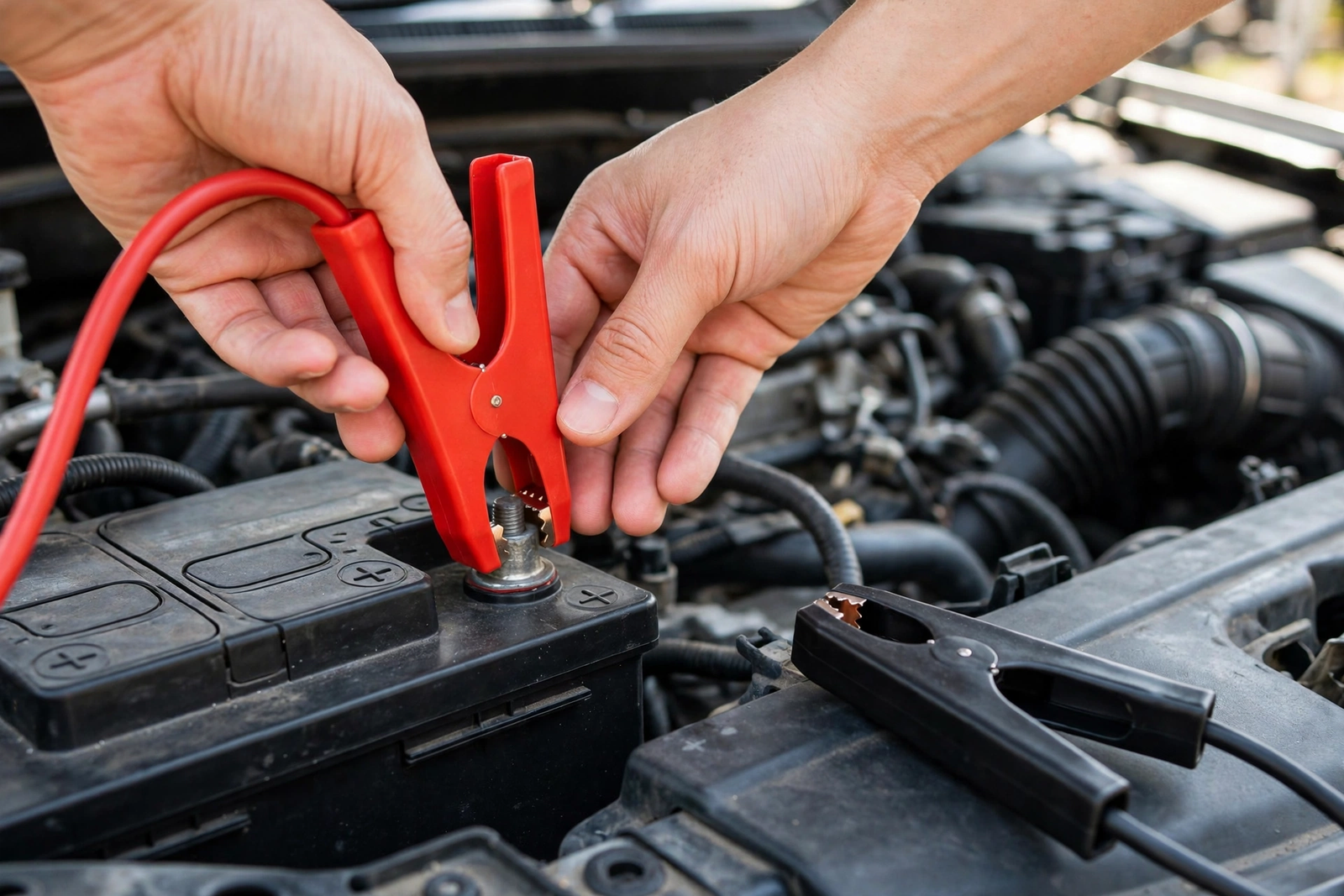
Keep the cars running while you remove the cables, and do not let the clamps touch each other as they come off. Once the cables are off, drive the jumped car for a good run — a jump start is not a recharge, and a short trip to the store may leave the battery flat again by morning. If the car was jump-started because the battery is old or weak, get the battery and the charging system tested rather than assuming the jump fixed it.
Cables vs a Portable Jump Starter vs a Battery Charger: Three Different Jobs
Jumper cables, portable jump starters and battery chargers all deal with a flat battery, but they are three different jobs, and this guide covers only the first. Cables borrow power from a second car: no donor car, no jump. A portable jump starter is a battery pack you carry instead of a second car — it is the answer when you drive alone or park where no other car can reach you. Our DeWalt jump starter review covers one of those packs, and our best portable car jump starter roundup compares several more.
A battery charger is different again: it plugs into mains power and restores charge to the battery over hours, which is a different job from jump-starting with cables. Jump-starting gets the car running now, with the alternator doing the charging afterwards; charging a battery with a charger is a slow refill done with the car parked and switched off, and it is the right job when the car can sit for hours. Our best battery maintainers roundup covers the slow-charge end of the job. Do not confuse the two: a jump start will not revive a battery that can no longer hold a charge, and a charger will not help a car that needs to move in five minutes.
What to Do If the Car Will Not Start
If the car will not start after the cables have been on for a few minutes with the donor car running, do not keep cranking it. First, check the clamps: a clamp that looks connected but sits loosely on a corroded terminal will not pass enough current. Wiggle each clamp, check it bites the metal, and scrape heavy corrosion off the terminals with a wire brush if you have one. Then wait a few minutes longer with the donor car running and try again — a very flat battery sometimes needs a longer soak before it will turn the engine.
If the engine turns slowly but will not catch, the battery may be too far gone for a jump, or the problem may not be the battery at all: a failed starter motor, a bad alternator, or a fuel or ignition fault all look like a flat battery from the driver’s seat. Listen to what the car does: a single loud click usually points at the starter or a bad connection, rapid clicking usually points at a battery too weak to hold the starter, and silence with no dashboard lights points at a connection or a completely dead battery. Our car battery replacement cost guide covers what a new battery involves when the old one will not hold a charge.
Two failed attempts with good clamps and a healthy donor battery is enough: stop, disconnect the cables in reverse order, and get help. Keep jump-starting a car that will not start, and you risk draining the donor battery too — then you have two dead cars instead of one. A car that needs a jump every morning has a battery or charging fault, not a jump-start problem, and that fault needs testing, not another set of cables.
Safety: Sparks, Hydrogen and What Never to Connect
A car battery gives off hydrogen gas while it charges, and hydrogen plus a spark is the risk this whole procedure is built around. That is why the last black clamp goes to bare metal away from the dead battery, never to the dead battery’s negative terminal: the final connection is the one most likely to spark, and a spark right at the battery is the one to avoid. Never let the red and black clamps touch each other while the other ends are connected, and never let a clamp rest on painted bodywork or a moving part.
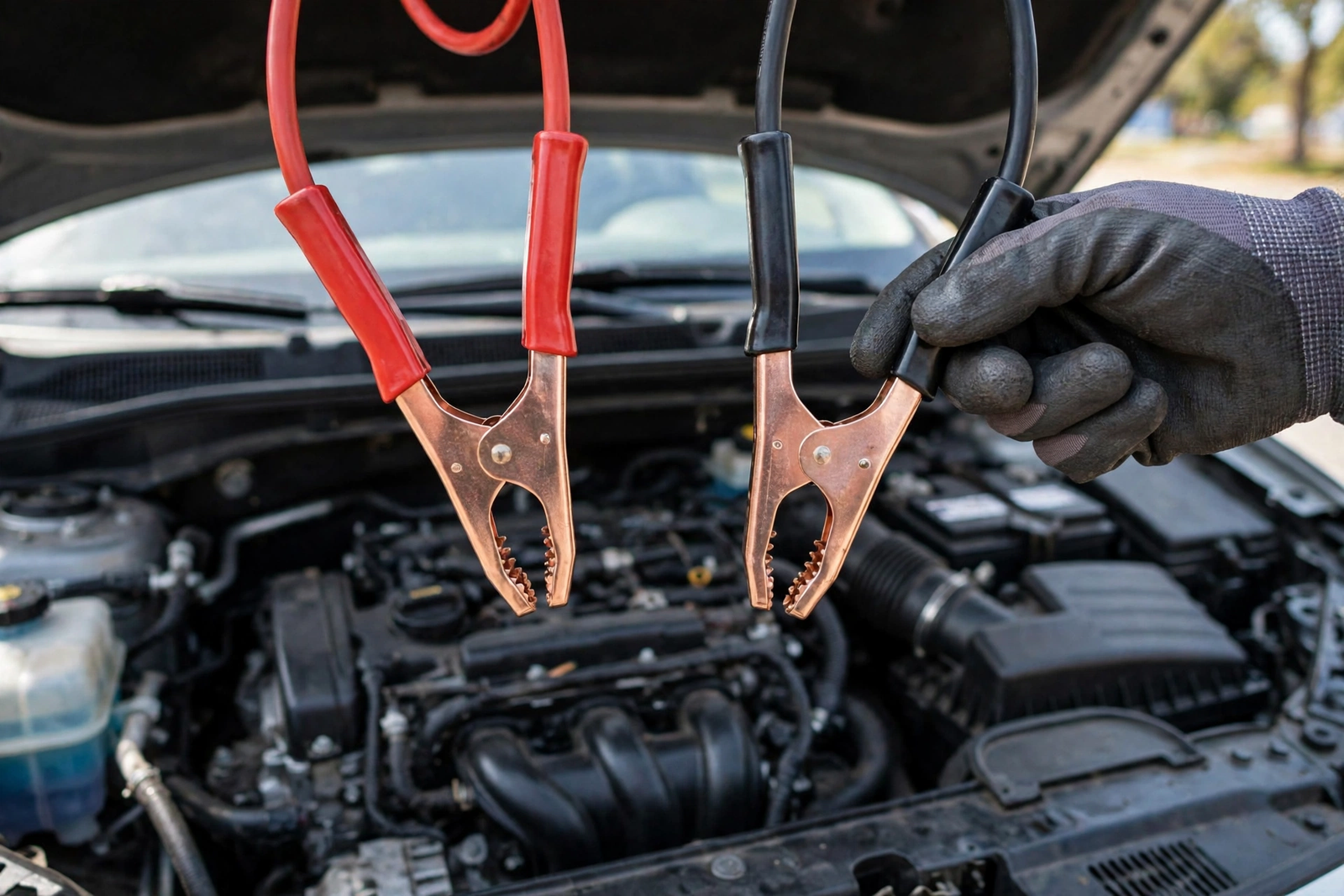
Never jump a battery that is cracked, leaking, swollen, or frozen solid — a damaged battery can rupture, and a frozen battery can burst when current flows through it. If the battery case is bulging or you can smell rotten eggs around it, step away and get professional help. Do not smoke or use a naked flame anywhere near either battery, keep your face away from the battery while you connect the clamps, and wear eye protection if you have it. Jump only 12-volt cars with 12-volt cars: never use a 24-volt truck battery to jump a car, and check your owner’s manual before jumping a hybrid, which may have a different jump procedure and a different jump point.
Common Mistakes When You Jump Start a Car With Cables
The most common mistake when you jump start a car with cables is connecting the cables in the wrong order — or worse, reversed, red to negative and black to positive. Reversed cables can spark, blow fuses, damage electronics, and damage both batteries, so if you realize the cables are reversed, stop, disconnect them, and check the terminal markings before you start again. The second mistake is connecting the last black clamp to the dead battery’s negative terminal instead of to bare metal away from the battery, which puts the spark exactly where the hydrogen is.
The third mistake is buying cables too thin or too short for the car: a 6-gauge 16-foot set on a big diesel is a mismatch, and a short set between cars parked too far apart is no use at all. The fourth is driving off two minutes after the jump and switching off again — the battery needs a good run to recover, and a jump start is not a recharge. The fifth is treating a jump start as a repair: a car that needs jumping every morning has a dying battery or a charging fault, and cables will not fix either. The sixth is letting the clamps touch while the cables are live, which shorts the donor battery and can weld the clamps together.
The Verdict
The best way to learn how to jump start a car with cables is to do it once, slowly, in the order in this guide: red to dead positive, red to donor positive, black to donor negative, black to bare metal on the dead car — never to its negative terminal. The Energizer ENB130 is the heavy-duty 30-foot set for trucks and larger SUVs, the Cartman 4-gauge 20-foot set is the everyday set for most cars, and the Energizer ENB-616U is the compact 16-foot set for small cars. The cables matter less than the order and the gauge, because the right cables connected wrong are worse than no cables at all.
Keep a set in the trunk, know where your battery terminals are before the morning it goes flat, and remember what a jump start is not: it is not a recharge, and it is not a repair for a battery that can no longer hold a charge. Get the battery tested after a jump, drive the car for a good run, and if it needs jumping again, find the fault instead of reaching for the cables.
Frequently Asked Questions
Can I jump start a car with cables on my own?
Yes, if a second car and a driver are there to help — the job needs a donor car with a healthy battery. If you are alone, or no other car can reach yours, a portable jump starter is the better tool, because it carries its own battery and needs no donor car. Do not try to jump a car from a battery you have removed from another car unless you know exactly what you are doing.
How long should I leave the cables on before starting the dead car?
Start the donor car and let it run for a few minutes with the cables connected, then try the dead car. If it will not start, wait a few minutes longer and try again — a very flat battery sometimes needs a longer soak before it will turn the engine. Two failed attempts with good clamps and a healthy donor battery is enough: stop and get help rather than draining the donor battery too.
What happens if I connect the jumper cables backwards?
Reversed cables — red to negative and black to positive — can spark, blow fuses, damage the car’s electronics, and damage both batteries. If you realize the cables are reversed, stop straight away, disconnect them in reverse order, and check the terminal markings before you start again. If the car shows warning lights or will not start after a reversed connection, get it checked before you drive it.
Can I jump start a car with cables in the rain?
Yes, with care: jumper cables and batteries are used in wet weather, but keep the connections as dry as you can, keep the clamps from touching each other, and do not work in standing water or during a lightning storm. If the engine bay is soaked and you cannot see the terminal markings clearly, wipe the terminals and check the plus and minus marks before you connect anything.
How long should I drive after a jump start?
Drive the car for a good run — at least twenty minutes or so of steady driving is a reasonable guide — and do not switch the engine off again two minutes after the jump. A jump start is not a recharge: the alternator needs time to put charge back into the battery, and a short trip may leave it flat again by morning. Get the battery tested if the car needed a jump at all.
Is it safe to jump start a modern car with cables?
Yes, for most 12-volt gasoline and diesel cars, when the cable order in this guide is followed — red to dead positive, red to donor positive, black to donor negative, black to bare metal on the dead car. Check your owner’s manual first if you drive a hybrid or an electric car, because some have a different jump procedure and a different jump point, and never jump a 12-volt car from a 24-volt truck battery.