How to Charge a Car Battery: A Step-by-Step Guide
A flat battery is one of the most common car problems, and one of the easiest to fix at home. A charger plugs into the wall, clips onto the battery terminals, and puts charge back into the battery over a few hours — no garage visit, no tow, and no new battery in most cases. Learning how to charge a car battery takes one careful setup and then mostly waiting, and the steps below cover the safety checks, the charger settings, and the order the clamps go on.
The short answer: to learn how to charge a car battery, park in a ventilated space with the engine off, set the charger to 12 volts for your battery type, connect the red clamp to the positive terminal and the black clamp to the negative terminal or a ground point, plug the charger in, and let it run until it shows a full charge. The three chargers below are a 1-amp smart charger, a 1.25-amp maintainer, and a 4.3-amp 8-step charger — pick by how flat the battery is and how fast you need it back.
As an Amazon Associate I earn from qualifying purchases.
Quick Pick: How to Charge a Car Battery
| Pick | Product | Best For | Check Price |
|---|---|---|---|
| 1-Amp Smart Charger | NOCO GENIUS1: 1A 6V/12V Smart Battery Charger | A 1-amp smart charger and maintainer for 6-volt and 12-volt batteries, with desulfation | Check Price on Amazon |
| 1.25-Amp Maintainer | Battery Tender Plus 12V 1.25 AMP Battery Charger and Maintainer | A 1.25-amp charger and maintainer for 12-volt batteries, with float charging | Check Price on Amazon |
| 4.3-Amp 8-Step Charger | CTEK MXS 5.0 Fully Automatic 4.3 amp Battery Charger and Maintainer 12V | A 4.3-amp charger with 8-step charging and a recondition mode, for 12-volt batteries | Check Price on Amazon |
Table of Contents
Before You Start: Safety First
A car battery stores a large amount of energy and the acid inside it can burn skin and eyes, so the safety steps come before the charging steps. Wear eye protection and gloves. Work in a ventilated space — a garage with the door open or outdoors — because charging can release hydrogen gas, and hydrogen builds up in a closed space. Never smoke near the battery, and never make a spark near it: no lighters, no grinding, and no connecting or disconnecting clamps while the charger is plugged into the wall. Keep the charger itself away from water and off the ground if the floor is wet.
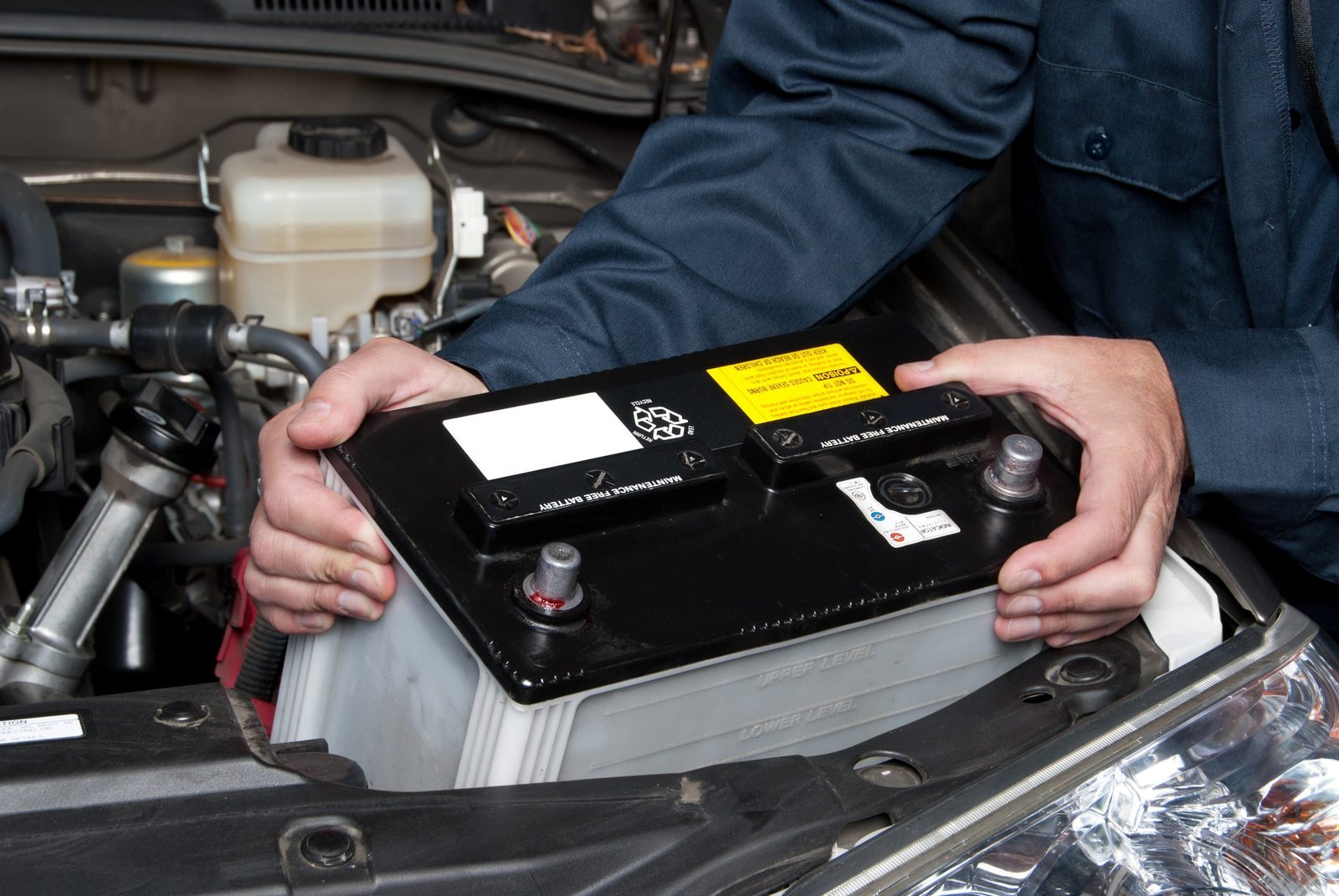
Check the battery before you connect anything. Look for a cracked case, a swollen side, leaking fluid, or terminals caked in white or blue corrosion. A cracked, swollen or leaking battery should not be charged — it needs replacing. A frozen battery should not be charged either: if the car has sat through a hard freeze and the battery feels like a block of ice, let it thaw slowly indoors and have it checked before you charge it, and if the case is bulged, replace it. Clean heavy corrosion off the terminals with a wire brush before you clip the clamps on, because a clamp on corrosion is a clamp that does not connect. If the battery is damaged in any of these ways, stop and get it checked rather than charging it.
What You Need to Charge a Car Battery
You need a charger, and very little else. A smart charger is the right tool for this job: it watches the battery voltage and switches itself off or to a maintain mode when the battery is full, so it cannot overcharge the battery the way an old manual charger can. The three chargers in this guide are all smart chargers — a 1-amp, a 1.25-amp and a 4.3-amp — and any of them will charge a standard 12-volt car battery. You also need eye protection, gloves, and a wire brush or terminal cleaner if the terminals are corroded. A voltmeter is useful for checking the result, but it is not required: the charger tells you when the battery is full.
The other thing to know before you start is your battery type. Most cars use a standard 12-volt lead-acid battery, either flooded or AGM, and the chargers below cover both. Some chargers also cover 6-volt batteries and lithium batteries — the NOCO GENIUS1 does — but a car battery is 12 volts, so set the charger to 12 volts for this job. Check the label on top of the battery if you are unsure: it states the voltage and the type. If the label is unreadable, your owner’s manual states what the car takes.
NOCO GENIUS1: The 1-Amp Smart Charger
The NOCO GENIUS1 is the 1-amp smart charger in this guide: model GENIUS1, UPC 046221190021, a 1-amp charger for 6-volt and 12-volt batteries, listed as a charger, maintainer, trickle charger and desulfator with overcharge protection and temperature compensation. It is a direct wall plug-in unit with a 110-inch DC cable, battery clamps and integrated eyelet terminals in the box, and NOCO lists a three-year warranty. The charger is designed for 6-volt and 12-volt lead-acid batteries — AGM, gel, flooded and deep-cycle — and lithium-ion batteries up to 30 amp-hours, and it can charge batteries from as low as 1 volt, with a force mode for batteries that read near zero.
One amp is slow, and that is the trade-off to understand. A 1-amp charger is right for topping up a battery that is only partly flat, or for maintaining a battery on a car that sits for weeks — it is not the fast way back from a fully dead battery. What it gives you instead is a small, simple unit that you plug in and leave: it watches the battery and switches itself to maintain mode when the battery is full. If your battery is only a little flat and you are not in a hurry, the GENIUS1 is the right size. If the battery is fully dead and you need the car tomorrow, the 4.3-amp CTEK below is the faster choice.
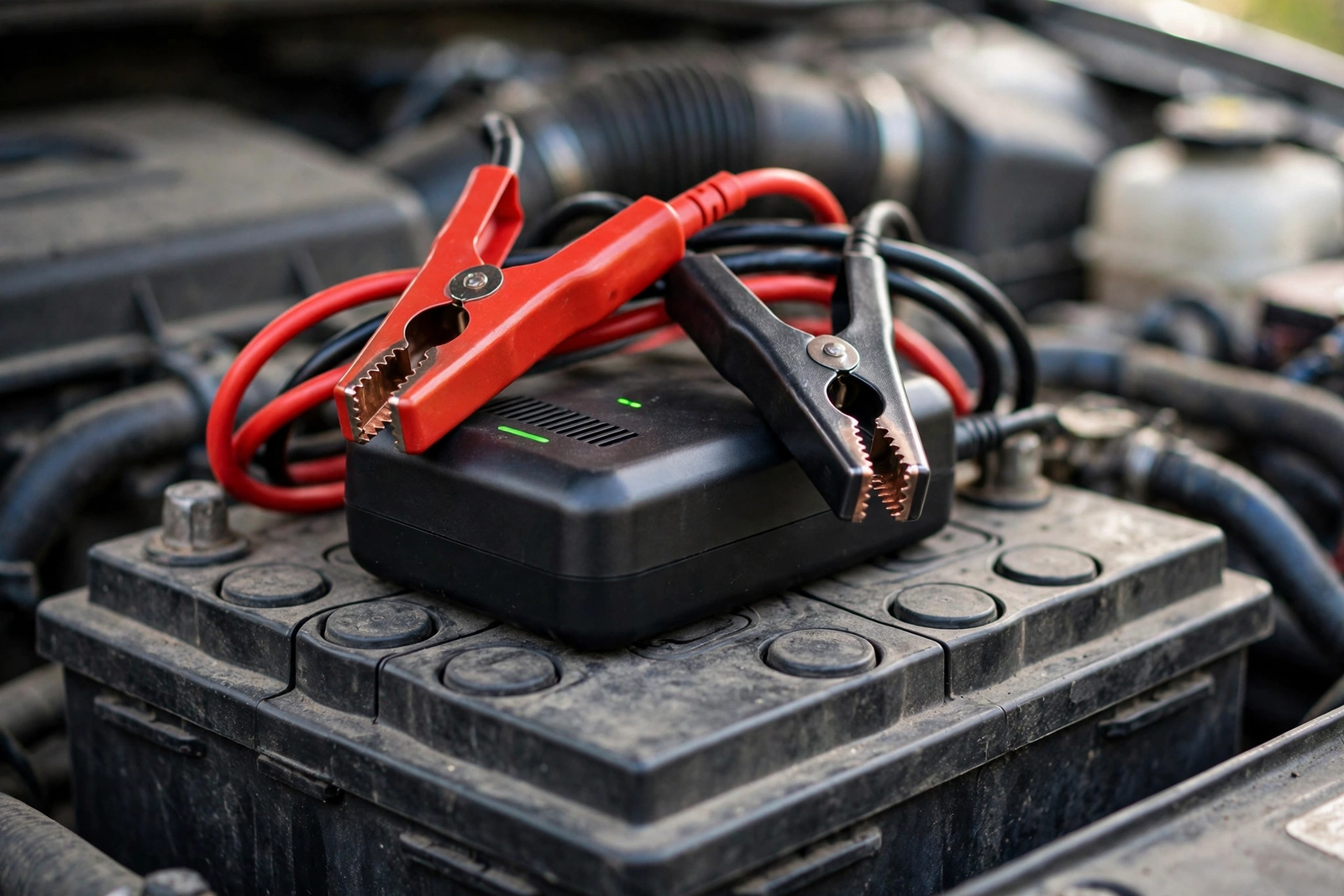
NOCO GENIUS1: 1A 6V/12V Smart Battery Charger on Amazon: 1-amp smart charger and maintainer, 6-volt and 12-volt, desulfator, temperature compensation
Buy the NOCO GENIUS1 if: your battery is only partly flat or the car sits for weeks, and you want a small smart charger you can plug in and leave. Confirm the 6-volt and 12-volt rating covers your battery first.
Battery Tender Plus: The 1.25-Amp Maintainer
The Battery Tender Plus is the 1.25-amp charger and maintainer in this guide: model 021-0128, a 12-volt, 1.25-amp unit that the maker describes as smarter than a trickle charger. It is a four-step charger — it brings the battery to a full charge, then switches to a float charge that holds the battery at storage voltage without overcharging it. The listing states a 10-year warranty, and the unit ships with a quick-connect harness for batteries that are hard to reach, plus fused ring terminals. It is made for all lead-acid batteries: flooded, sealed maintenance-free, AGM and gel cell.
At 1.25 amps it sits between the NOCO and the CTEK on speed, and its real strength is long-term maintenance. A car that sits for a month — a second car, a classic, a car stored for winter — is exactly what the Battery Tender Plus is built for: connect it, let it charge the battery fully, and leave it on float while the car waits. The float mode is the difference from a plain trickle charger, which keeps pushing current and can dry a battery out over time. If your problem is a car that goes flat between uses rather than a battery that died once, this is the charger to pick.
Battery Tender Plus 12V 1.25 AMP Battery Charger and Maintainer on Amazon: 1.25-amp charger and maintainer, 12-volt, float charging, quick-connect harness
Buy the Battery Tender Plus if: your car sits for weeks at a time and you want a maintainer that holds the battery at full charge on float. Confirm the 12-volt rating covers your battery first.
CTEK MXS 5.0: The 4.3-Amp 8-Step Charger
The CTEK MXS 5.0 is the 4.3-amp charger in this guide: model 40-206, a fully automatic 12-volt charger and maintainer with 8-step charging, automatic temperature compensation, a dedicated AGM mode and a recondition mode. CTEK describes it as a microprocessor-controlled charger for lead-acid batteries from 1.2 to 110 amp-hours, with float and pulse maintenance for batteries up to 160 amp-hours, and an IP65 rating against dust and water jets. It is the most capable charger of the three, and the one to pick when the battery is fully flat or the car needs to be back on the road soon.
Four amps is roughly four times faster than the 1-amp NOCO, so a flat battery that would take a day on the GENIUS1 can be usable in a few hours on the MXS 5.0 — the charger still decides the exact time, because it watches the battery and works through its eight steps. The recondition mode is for a battery that has sat flat for a long time: it runs a controlled charge designed to recover capacity, and the listing warns that it should not be used on AGM batteries. Set the mode for your battery type before you connect the clamps, and let the charger run its steps without interrupting it.
CTEK MXS 5.0 Fully Automatic 4.3 amp Battery Charger and Maintainer 12V on Amazon: 4.3-amp charger, 8-step charging, AGM mode, recondition mode, temperature compensation
Buy the CTEK MXS 5.0 if: your battery is fully flat and you need it back soon, or you want the 8-step charge and recondition mode. Confirm the 12-volt rating covers your battery first.
Step-by-Step: How to Charge a Car Battery
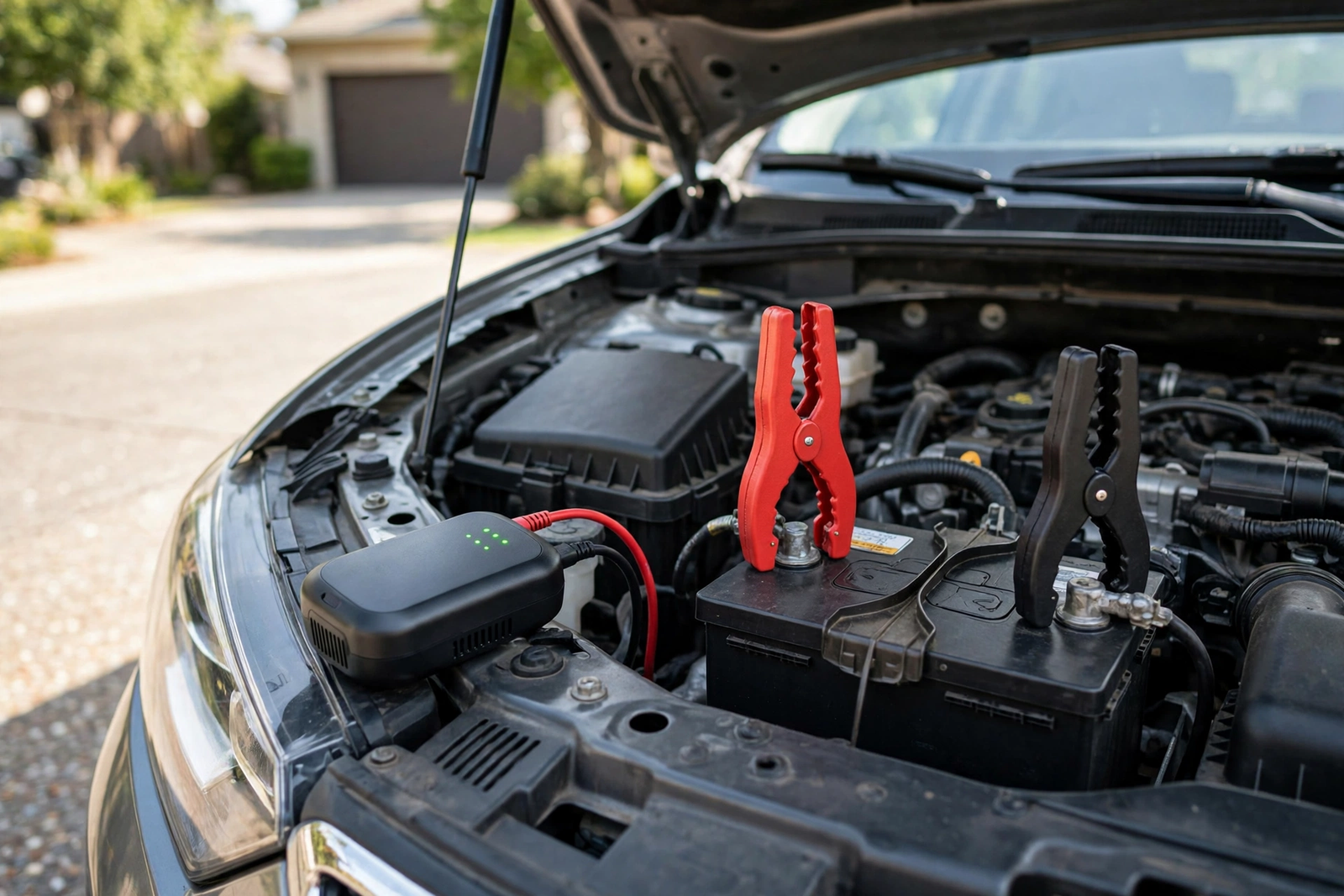
How to charge a car battery, step by step, starts with the car parked, the engine off and the keys out. Open the hood and find the battery — on most cars it is in the engine bay, on some it is in the trunk or under a seat, and your owner’s manual shows where. Check the battery for damage first, as the safety section above describes, and clean the terminals if they are corroded. Set the charger to 12 volts and to your battery type if it has a setting for it, and keep the charger unplugged from the wall while you connect the clamps.
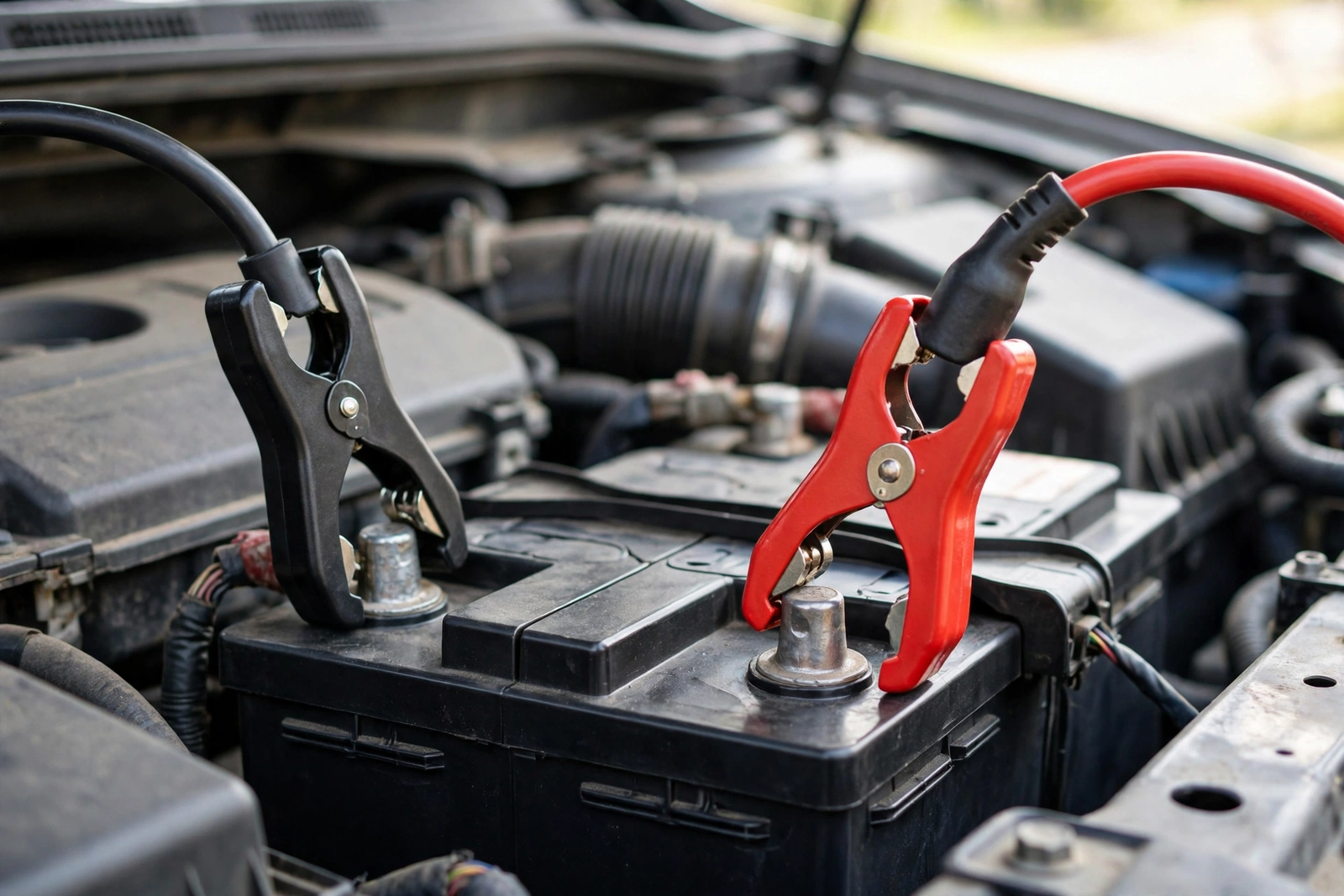
Connect the red clamp to the positive terminal first — the one marked with a plus sign and usually covered by a red cap. Then connect the black clamp to the negative terminal, marked with a minus sign, or to a bare metal ground point on the engine block or body if the charger instructions say to. Make sure both clamps bite firmly on clean metal: a loose clamp is the most common reason a charge does not start. Only now plug the charger into the wall and switch it on. The charger will start its cycle and show that it is charging — leave it alone and let it work.
While it charges, leave the hood open for ventilation and do not start the car. Check on the charger now and then, but do not disconnect the clamps to test the battery halfway through — interrupting the cycle does not help. When the charger shows a full charge or switches to maintain or float mode, the battery is done. Unplug the charger from the wall first, then remove the black clamp, then the red clamp — the reverse of the connection order. Close the hood, start the car, and let it run for a few minutes. If it starts cleanly and the charger reached a full state, the job is done.

How Long to Charge a Car Battery
How long to charge a car battery is a question with a range, not a single number. The two things that decide it are how flat the battery is and how many amps the charger delivers. A battery that is only partly flat — the car turns over slowly but still starts — can be usable after a few hours on a 4-amp charger. A fully flat battery on a 1-amp charger can need a full day, and sometimes longer, because a 1-amp charger puts back only one amp-hour per hour into a battery that holds 50 amp-hours or more. The charger is the authority on timing, not the clock: a smart charger shows when the battery is full, and that is when to stop.
Do not rush the charge by turning up the amps on a charger that does not belong to the battery. A small battery charged too fast can overheat, and a battery that is hot to the touch while charging should be disconnected and left to cool. If the charger never reaches a full state after a long charge — the lights stay on charging for a day or more — the battery is probably no longer holding a charge, and no amount of extra time will fix it. That is the point to stop charging and have the battery tested, or replace it. Our car battery replacement cost guide covers what a new battery costs when charging will not save the old one.
Charging a Dead Battery vs Maintaining One
Charging a dead battery and maintaining a healthy one are two different jobs, and the charger you pick depends on which one you are doing. A dead battery — lights left on, car left standing for months, a battery that reads near zero — needs a charger that can recover it: the CTEK MXS 5.0 with its recondition mode, or the NOCO GENIUS1 with its force mode, are built for that. The job is to put a large amount of charge back in, and it takes hours. A jump starter is the other tool for a dead battery: it does not charge the battery, it gives the starter motor a burst of power so the engine can start and the alternator can take over. Our DEWALT jump starter review covers that tool — use a jump starter to get going now, and a charger to refill the battery properly afterwards.
Maintaining a battery is the opposite job: the battery is healthy, but the car sits. A car that is parked for weeks loses charge slowly to the alarm, the clock and the computers that never fully sleep, and after a month it may not start. A maintainer — the Battery Tender Plus or the NOCO GENIUS1 on maintain mode — stays connected and holds the battery at full charge for as long as the car waits, switching to float when the battery is full so it never overcharges. Our best battery maintainers roundup compares maintainers for cars that sit, if that is your situation. The rule is simple: a dead battery needs a charger with recovery ability, a sitting car needs a maintainer left connected.
Common Mistakes When You Charge a Car Battery
The most common mistake when you charge a car battery is connecting the clamps the wrong way round. Red goes to positive, black goes to negative or ground — and if you reverse them, the charger may spark, blow a fuse, or damage the charger and the battery. Check the plus and minus marks on the battery before you clip anything on, and if the marks are hidden under corrosion, clean the terminals first so you can read them. The second mistake is plugging the charger into the wall before the clamps are on: connect the clamps first, plug in second, and unplug before you remove the clamps.
The third mistake is charging a battery that should not be charged — cracked, swollen, leaking or frozen — and the fourth is charging in a closed space with no ventilation, where hydrogen gas can build up. The fifth is using the wrong voltage setting: a 6-volt setting on a 12-volt battery will not charge it, and a higher setting than the battery takes can damage it. The sixth is leaving the charger connected for days after it has finished, on a charger with no maintain mode — a smart charger switches itself to float, but a manual charger keeps pushing current. And the seventh is assuming the battery is the problem when the charger says the battery is full but the car still will not start: that can be a bad starter, a loose cable, or a failed alternator, and no charger will fix those.
The Verdict
The best way to learn how to charge a car battery is to do it once, carefully: park with the engine off, check the battery for damage, set the charger to 12 volts for your battery type, connect red to positive and black to negative or ground, plug in, and let the charger finish. The NOCO GENIUS1 is the small smart charger for top-ups and maintenance, the Battery Tender Plus is the maintainer for cars that sit, and the CTEK MXS 5.0 is the faster charger for a fully flat battery. Pick by how flat the battery is and how soon you need the car — and if the battery will not hold a charge after a full cycle, it is time for a new one, not another charge. If you want a tool that gets the car started right now rather than after hours of charging, our best portable car jump starter guide covers the jump-starter side of a flat battery.
Frequently Asked Questions
How long does it take to charge a car battery?
It depends on how flat the battery is and how many amps the charger delivers. A partly flat battery on a 4-amp charger can be usable in a few hours, while a fully flat battery on a 1-amp charger can need a full day or longer. The charger itself is the guide: a smart charger shows when the battery is full, and that is the time to stop. Do not guess the time from the clock alone.
How do you charge a car battery without removing it from the car?
You can charge most car batteries in place, with the battery still connected to the car. Park with the engine off, open the hood, connect the red clamp to the positive terminal and the black clamp to the negative terminal or a bare metal ground point, then plug the charger in. Leave the hood open for ventilation while it charges. If the battery is damaged, swollen, leaking or frozen, do not charge it in the car — have it checked first.
Can I charge a completely dead car battery?
Often, yes — a smart charger can recover a battery that has gone flat from lights left on or a car left standing. Some smart chargers can charge from as low as 1 volt, and some have a force mode for batteries that read near zero. But a battery that will not hold a charge after a full charge, or one that is swollen, cracked or leaking, is finished and needs replacing, not another charge.
What charger setting should I use for my car battery?
Set the charger to 12 volts for a standard car battery, and match the battery type — standard flooded, AGM or gel — if the charger has a setting for it. Some smart chargers detect the voltage themselves, but most still need you to set the battery type by hand, so check the setting before you connect the clamps. Never use the 6-volt setting on a 12-volt battery, and never use a charger made for a different battery chemistry than the one you have.
Is it safe to charge a car battery indoors?
Charge in a ventilated space, with the hood open if the battery is in the car. Charging can release hydrogen gas, which builds up in a closed space, so never charge in a sealed room and never smoke or make sparks near the battery. Wear eye protection and gloves, keep the charger away from water, and keep children and pets away from the work area while the charger is connected.
How do I know when my car battery is fully charged?
A smart charger tells you: it switches to a maintain or float mode, or its lights change to show a full charge. On a charger with a meter, the charge current drops close to zero when the battery is full. A voltmeter reading across the terminals is another check — a rested 12-volt battery reads around 12.6 volts or higher when full. If the charger never reaches a full state after a long charge, the battery may no longer hold a charge.