Car Battery Replacement Cost: What You Will Actually Pay
A dead battery is one of the cheapest car problems to fix and one of the easiest to overpay for. The car battery replacement cost for most drivers lands between the price of the battery alone and a few hundred dollars installed, and the gap between those two numbers is where shops, battery types, and your car’s design all take their cut. Knowing the ranges before you call a shop — or open the hood yourself — keeps a $150 job from becoming a $450 surprise.
This guide gives you the car battery replacement cost as published estimates, not as a single fixed price. Every figure is attributed to its source — Kelley Blue Book for battery-only prices, RepairPal for installed averages, AutoZone’s battery pricing guide for the flooded-versus-AGM split — and every range comes with the reason it varies: your vehicle, the battery type it needs, and where you live.
As an Amazon Associate I earn from qualifying purchases.
Quick Picks: Tools and Parts for a Battery Swap
| Pick | Product | Best For | Check Price |
|---|---|---|---|
| Premium AGM Pick | OPTIMA RedTop 34/78 Sealed AGM Battery, 800 CCA | An AGM upgrade for cars and trucks that take group 34/78; sealed, maintenance-free, dual terminals | Check Price on Amazon |
| Best Budget | NOCO NCP2 M401 Battery Terminal Cleaning Kit | Cleaning corroded terminals before the swap: cleaner spray, brush, and anti-corrosion washers in one kit | Check Price on Amazon |
| Memory Saver | Schumacher OBD-L Memory Saver | Keeping radio presets, seat memory, and settings alive while the battery is out (needs a separate 12V power source) | Check Price on Amazon |
| Test Before You Replace | FOXWELL BT705 Battery Tester, 100–2000 CCA | Confirming the battery is actually dead before spending on a new one; tests 12V and 24V systems | Check Price on Amazon |
Table of Contents
Car Battery Replacement Cost at a Glance
Each range is tied to the source that published it. Treat every number as an estimate for a typical US car, not a quote for your car.
| Scenario | Estimated cost | Source |
|---|---|---|
| Battery alone (DIY, you install it) | About $45–$250 | Kelley Blue Book — varies by power, size, and quality |
| Shop-installed replacement, national average | $456–$493 before tax | RepairPal estimator, September 2026 — parts $394–$403, labor $61–$90 |
| Installation labor only | $60–$88 | RepairPal, August–September 2026 |
| Flooded battery, part only | $90–$225 | AutoZone battery pricing guide |
| AGM battery, part only | $230–$450 or more | AutoZone battery pricing guide |
Two things stand out. First, the battery is most of the bill: RepairPal’s September 2026 estimate puts parts at $394–$403 of the $456–$493 total, labor only $61–$90. Second, the spread between sources is real — Kelley Blue Book’s $45–$250 covers the battery alone across all sizes and tiers, while RepairPal’s installed average reflects shop-supplied batteries with a parts markup.
What Drives the Car Battery Replacement Cost
Five things feed into the cost, and each can move the total by $50 or more.
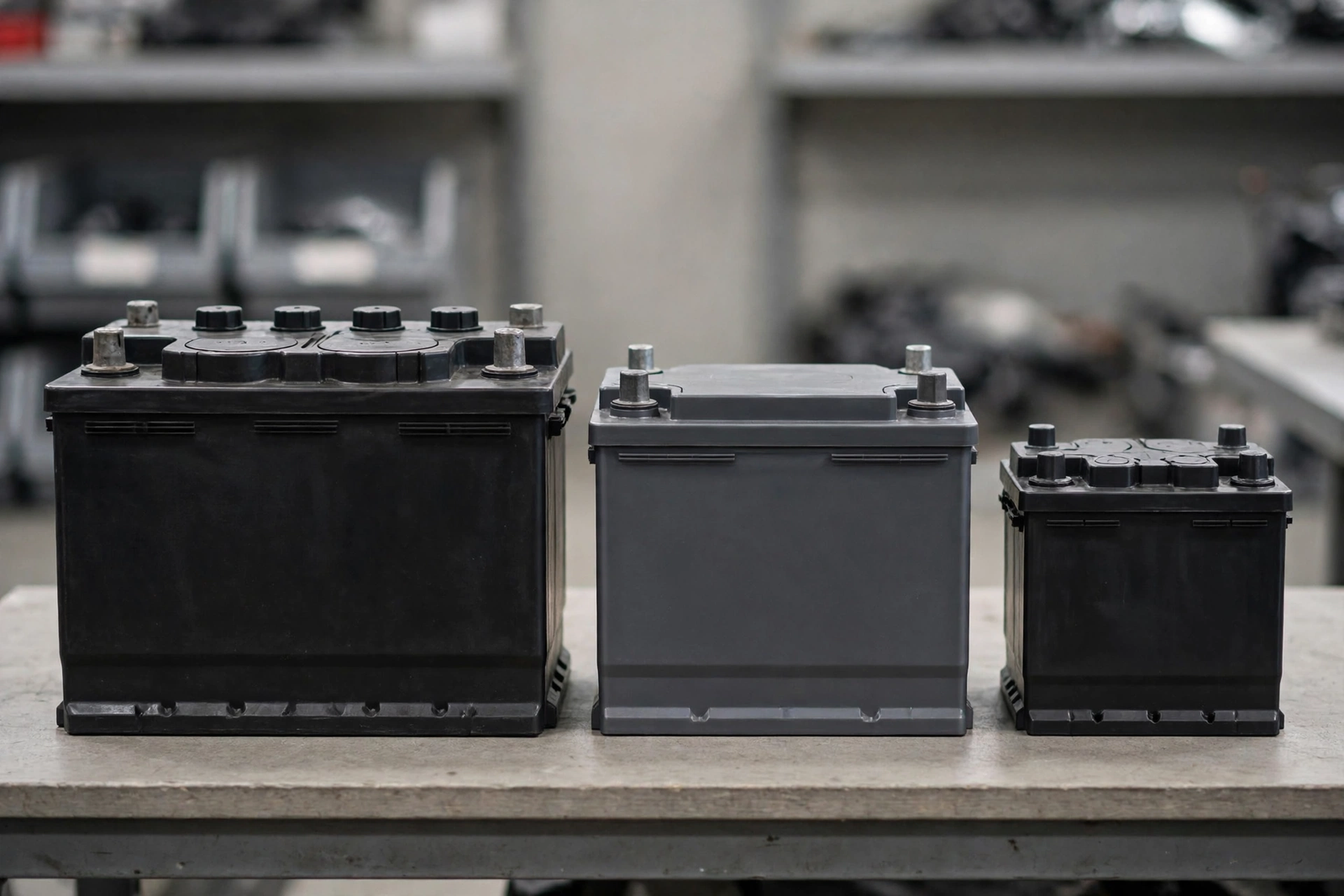
Battery group size. Group size is the battery’s physical size and terminal layout — group 24, 35, 65, 34/78, and others. A bigger group size usually means more lead, more capacity, and a higher price, and the wrong one will not fit the tray or reach the cables.
Battery type: flooded, EFB, or AGM. The single biggest price lever. A standard flooded battery is cheapest and suits older cars without start-stop. An EFB (enhanced flooded battery) sits in the middle and serves some entry-level start-stop cars. An AGM (absorbed glass mat) battery is sealed, maintenance-free, handles deep cycling better, and costs the most — and it is the type most newer cars with start-stop require. Fitting a flooded battery where the car was built for AGM is a false saving: the charging system will wear it out early.
Labor, location, and registration. An accessible under-hood battery is a quick job; one buried under a seat, in the trunk, or behind panels takes longer and costs more. Dealers typically run 20–30% higher than independent shops, according to RepairPal-based comparisons, while many parts stores install free with purchase on straightforward vehicles. Rates vary by city, so get a quote for your ZIP code — and note that some vehicles, many European models in particular, need the new battery registered to the car’s computer after installation.
Car Battery Replacement Cost by Battery Type
The battery type decides the floor of your bill before labor is added. These part-only ranges come from AutoZone’s battery pricing guide, as reported in October 2026.
| Battery type | Part only (estimate) | Who gets it |
|---|---|---|
| Flooded (standard lead-acid) | $90–$225 | Most older cars and basic trims without start-stop |
| EFB (enhanced flooded) | Between flooded and AGM | Entry-level start-stop vehicles |
| AGM (absorbed glass mat) | $230–$450 or more | Start-stop cars, cars with heavy electronics, most newer European cars |
Kelley Blue Book’s broader battery-only range — about $45–$250 depending on power, size, and quality — sits lower because it includes budget flooded batteries in small group sizes. The shape of the market is the same in both sources: flooded is cheapest, AGM costs roughly double, and premium AGM climbs past $400 for large group sizes. A quote far below these ranges for an AGM car deserves a second look at what is actually being fitted.
Car Battery Replacement Cost by Vehicle Type
Bigger vehicles take bigger, pricier batteries, and some designs hide the battery where labor climbs. Kelley Blue Book’s Fair Repair Range estimator prices parts and labor for a specific year, make, and model — the examples below are KBB estimates for the named vehicles, not prices for your car.
| Vehicle (KBB example) | Fair Repair Range (parts + labor) | Parts / Labor split |
|---|---|---|
| 2005 Toyota Avalon | $274–$343 | Parts $164–$192; labor $109–$128 |
| 2013 Chevrolet Cruze | $373–$506 | Parts $280–$329; labor $150–$176 |
| 2010 Dodge Ram 1500 | $428–$523 | Parts $350–$395; labor $108–$127 |
The pattern is consistent: sedans with accessible flooded batteries sit at the low end, trucks and harder-access cars sit higher, and luxury and European vehicles usually land at or above the top of these ranges. One surprise: hybrid and electric cars still have a small 12-volt battery like a gas car, and replacing it costs roughly what a gas car’s does. The big traction battery is a different part — Kelley Blue Book (2025) puts a new hybrid traction battery at about $2,000–$8,000 — and it is not what this guide is pricing.
DIY vs Shop: What You Save and What You Risk
Doing it yourself saves the labor portion — RepairPal puts that at roughly $60–$88 — plus any parts markup a shop adds. On a flooded battery that can cut the total nearly in half; on an AGM car the saving is smaller because the battery dominates the bill. Many parts stores split the difference: buy there and they install it free on straightforward vehicles.
DIY is the right call when the battery sits under the hood with clear access and your car does not need battery registration. It is the wrong call when the battery is under a seat or in the trunk, when the manual calls for registration, or when the cables are damaged or badly corroded. A shop’s price also buys a labor warranty and a charging-system test; a DIY swap risks lost presets and warning lights that need a scan tool to clear. A memory saver, connected before you disconnect the old battery, prevents most of that — the Schumacher OBD-L in the Quick Picks plugs into the OBD-II port and keeps the car’s settings alive, though it needs a separate 12-volt power source.
How to Replace a Car Battery Safely, Step by Step
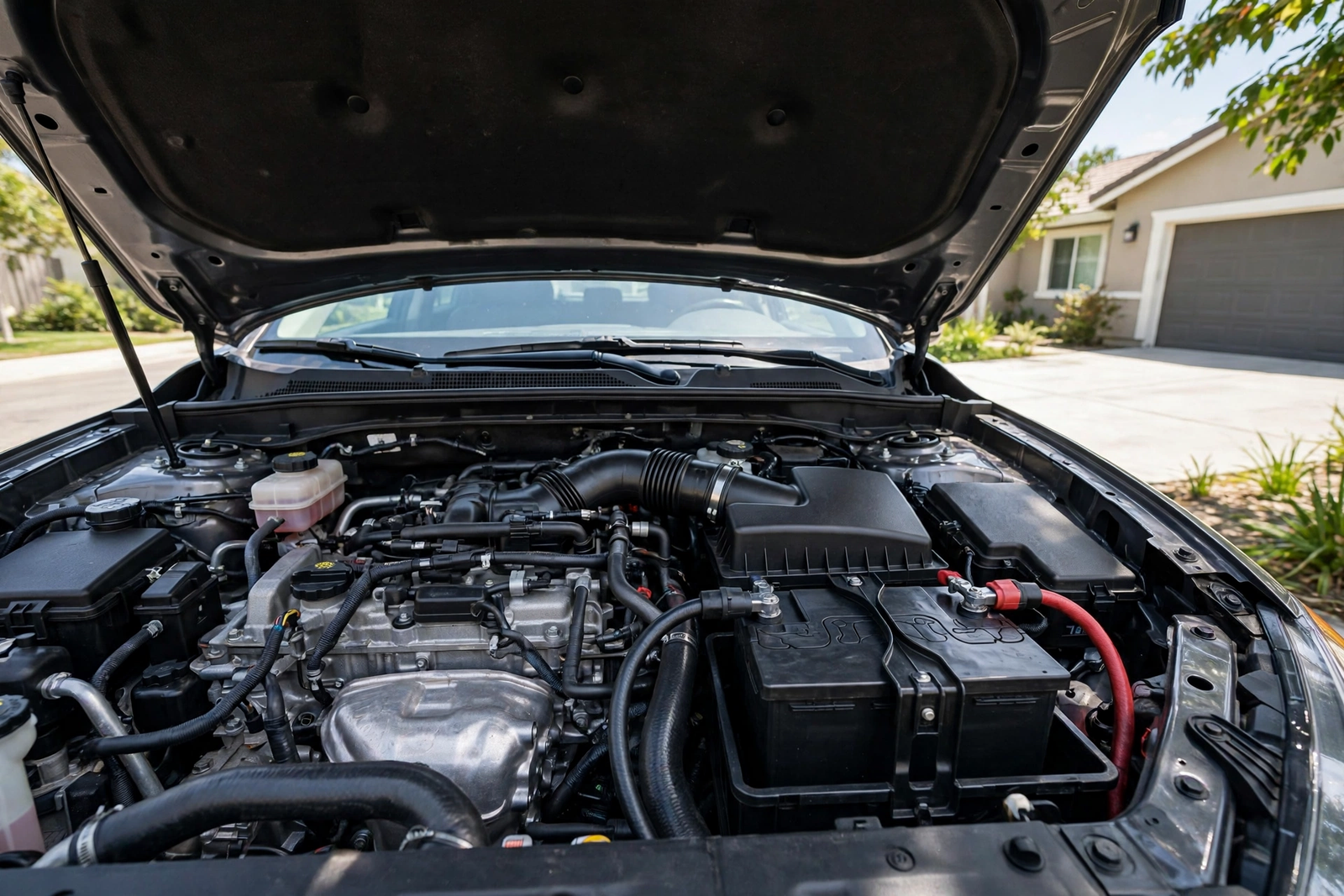
Read your owner’s manual first — it names the group size, the battery type, and any registration steps specific to your car. What follows is the standard sequence for an accessible under-hood battery.
What you need
A socket wrench for the terminal bolts and hold-down, gloves and eye protection, a terminal cleaner and brush, and the new battery — matched to your group size and type. A battery tester earns its place too: test first, so you do not replace a good battery while a failing alternator goes unnoticed.
OPTIMA RedTop 34/78 Sealed AGM Battery on Amazon: 800 CCA, sealed AGM, dual SAE and GM terminals, part number 8004-003. Check that group 34/78 matches your car before ordering.
Schumacher OBD-L Memory Saver on Amazon: OBD-II memory saver that preserves radio presets and settings during a swap; connect it to a separate 12-volt power source first, then to the OBD-II port.
The swap, step by step
1. Park safe, switch everything off. Flat ground, parking brake on, ignition off, gloves and eye protection on.
2. Connect the memory saver, if you have one. Schumacher OBD-L into its power source, then into the OBD-II port — before touching the terminals.
3. Disconnect the negative terminal first. Black cable, minus sign: loosen the clamp and lift it clear.
4. Disconnect the positive terminal. Red cable, plus sign — loosen and lift it clear. Never let a tool touch both terminals at once.
5. Remove the hold-down and lift the old battery out. Unbolt the clamp, lift straight up with both hands, keep it upright — a dropped battery spills acid.
6. Clean the tray and terminals. Brush corrosion off the cable ends and tray, and use a terminal cleaner on the posts and clamps. A cracked or green-through cable end is a shop job.
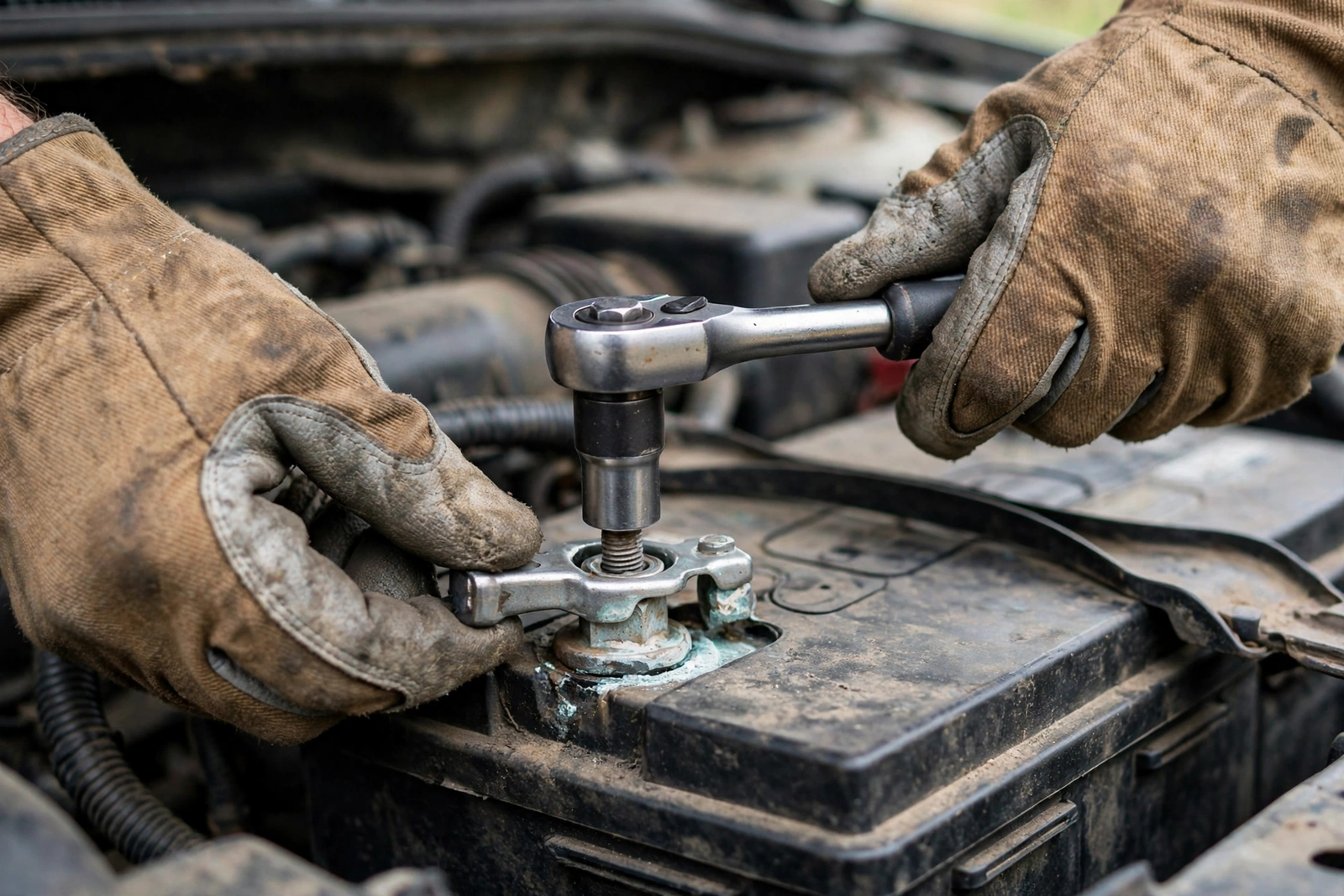
7. Set the new battery in and secure it. Same way round as the old one, terminals on the correct sides, hold-down refitted and tight.
8. Connect positive first, then negative. Positive on and tightened, then the negative — the mirror image of removal.
9. Start the car and check. Confirm normal cranking and no warning light. Remove the memory saver, refit the covers, and return the old battery for the core-charge refund and recycling. Slow cranking or warning lights mean a charging-system test.
Signs Your Battery Needs Replacing
Batteries rarely die without warning. Most last about three to five years, according to AAA — closer to five years in cooler climates and about three years in hot ones, because heat speeds up the chemical breakdown inside the battery.
Slow cranking is the classic sign: the starter turns over sluggishly, especially on a cold morning. Dim headlights at idle that brighten when you rev the engine, a clicking sound with no crank, and electronics that reset themselves all point the same way. A swollen or cracked case, a rotten-egg smell, or heavy terminal corrosion are signs to act on now. Past its third year, AAA advises testing the battery every year — a conductance test at a parts store is usually free. A car battery maintainer can keep a healthy battery charged through long storage, but it cannot revive a battery that will no longer hold a charge.
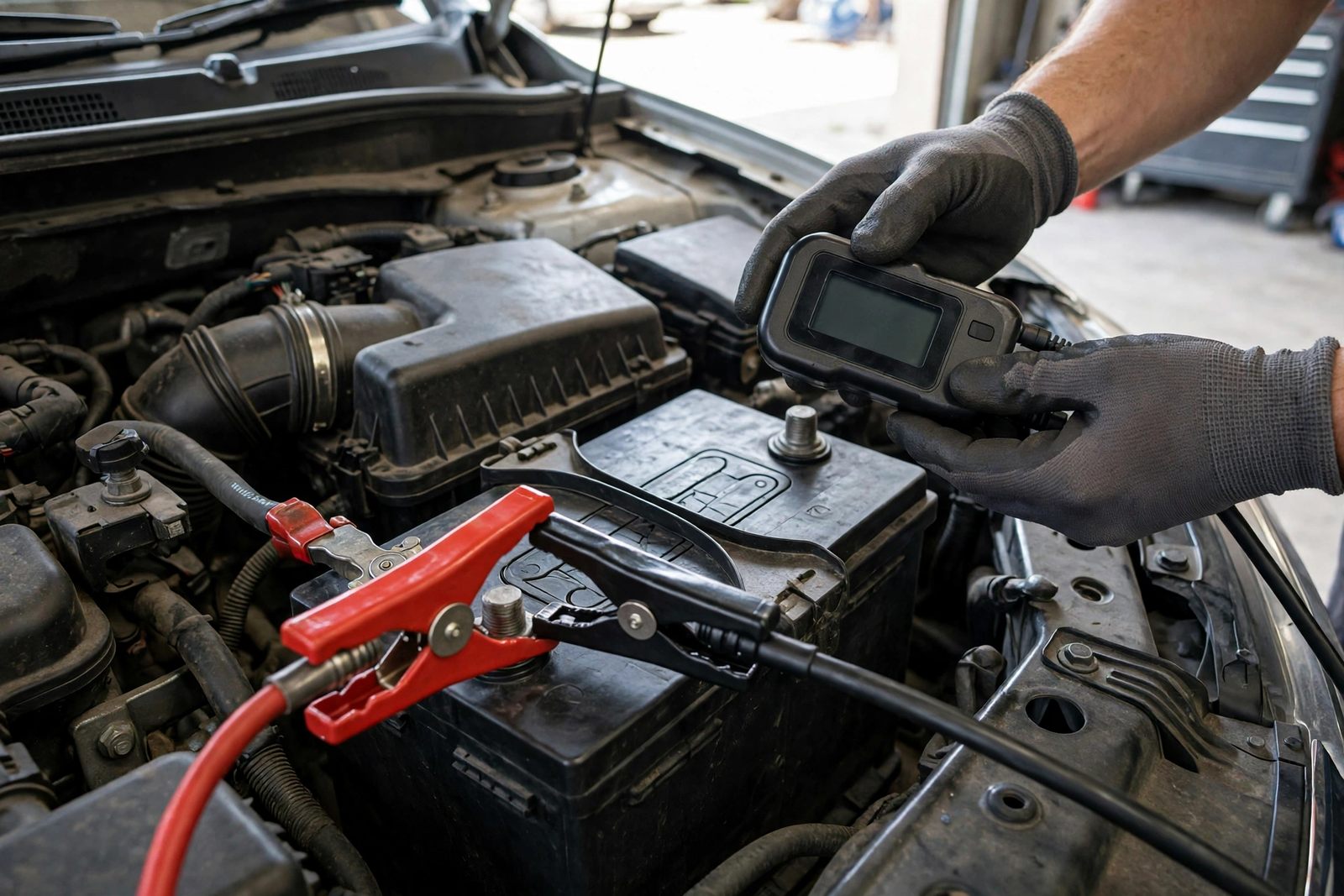
One caution: a jump start that works once does not mean the battery is fine — a battery that needs jumping more than once in a season can no longer hold a charge. Our best portable car jump starter guide covers what to keep in the trunk for the emergency, but no jump starter can fix a battery with a dead cell.
How to Pick the Right Battery: Group Size, CCA, and Warranty
Group size first. Check the owner’s manual or the label on the old battery: the group size (24, 35, 65, 34/78, and so on) fixes the physical dimensions and terminal layout. A battery that does not match will not sit in the tray or reach the cables.
CCA second, type third. Cold cranking amps measure how much current the battery can deliver in cold weather. Match or exceed the CCA your manual calls for, and go higher if you live where winters bite. Then buy the type your car was built for: flooded for older cars without start-stop, AGM for start-stop cars. Downgrading from AGM to flooded to save money is the most common expensive mistake in this job — the charging system will cycle the flooded battery to an early death.
Warranty last. Replacement batteries are generally sold with a free-replacement period followed by a prorated period, and the length varies by brand and tier — a longer free-replacement period is worth paying for, but read the label. Keep the receipt: warranty claims need proof of purchase and the date, and most retailers will test the battery first. Check delivery terms before ordering a battery online, and confirm the listing has live offers at checkout.
For the routine that keeps a new battery healthy, our car maintenance checklist covers the battery alongside the other eight checks any owner can do in half an hour.
The Verdict: What to Budget
Budget for the car battery replacement cost in two parts: the battery and the labor. For a standard flooded battery fitted at home or free at a parts store, the honest budget is the battery-only range — about $45–$250 per Kelley Blue Book, more typically $90–$225 per AutoZone’s guide. For an AGM car, budget $230–$450 or more for the battery alone; if a shop does the work, RepairPal’s September 2026 national average of $456–$493 before tax is the number to plan around, with dealers higher and independent shops often lower. The cheapest total is usually a correctly sized battery bought at a parts store with free installation, or a DIY swap when the battery is accessible and no registration is needed. The most expensive mistake is the wrong battery type, a skipped registration, or a dead-cell battery jumped for months instead of replaced.
Frequently Asked Questions
How much does a car battery replacement cost?
RepairPal’s September 2026 national estimate puts a shop-installed car battery replacement at $456 to $493 before tax, with parts at $394 to $403 and labor at $61 to $90. The battery alone costs about $45 to $250 according to Kelley Blue Book, depending on power, size, and quality. Flooded batteries run $90 to $225 and AGM batteries $230 to $450 or more for the part alone, per AutoZone’s battery pricing guide. Your exact total depends on your vehicle, the battery type it needs, and local labor rates.
How much is labor to replace a car battery?
RepairPal’s August to September 2026 estimates put the labor portion of a car battery replacement at $60 to $88. Many auto parts stores install a battery free with purchase on straightforward vehicles, and dealers typically charge 20 to 30 percent more than independent shops on the same job, according to RepairPal-based comparisons. Labor rises when the battery is hard to reach — under a seat, in the trunk, or behind panels — or when the car needs battery registration after installation.
Can I replace a car battery myself?
Yes, if the battery sits under the hood with clear access to both terminals and your car does not need battery registration. Disconnect the negative terminal first and reconnect it last, wear gloves and eye protection, and use a memory saver to keep your radio presets and settings. Hand the job to a shop if the battery is under a seat or in the trunk, if the manual calls for registration, or if the cables are damaged or badly corroded.
How long does a car battery last?
Most car batteries last about three to five years, according to AAA. A battery may last five years or longer in cooler northern climates and typically about three years in hot southern ones, because heat speeds up the battery’s chemical breakdown. AAA advises testing the battery every year once it passes three years old, and slow cranking, dim lights, or repeated jump starts are signs it is near the end.
Does my car need an AGM battery?
Probably, if your car has a start-stop system that shuts the engine off at traffic lights — most start-stop cars were built for AGM batteries, which handle repeated cycling far better than flooded batteries. Check your owner’s manual: it states the battery type your car was built for. Fitting a flooded battery where AGM is specified is a false saving, because the charging system will wear the flooded battery out early.
What is a core charge, and what do I do with the old battery?
A core charge is a refundable deposit most retailers add when you buy a new battery, credited back when you return the old one. The amount varies by retailer and state. Return the old battery to the retailer or a recycling point — never put it in household trash, since it contains lead and acid. Returning it is also how the core charge comes back to you, so keep the receipt until the refund is confirmed.