ROVE R2-4K vs VIOFO A119 Mini 2 Dash Cam: Upscaled 4K or Native 2K 60fps?
Two of the most-shopped single-channel dash cams both promise 4K-class footage from a small black box behind the mirror — and only one of them is honest about what its sensor actually captures. This rove r2-4k vs viofo a119 mini 2 dash cam comparison puts them head to head on the things that decide a purchase: what the sensor really records, night vision, screens, parking mode, and what you still have to buy after the camera. The ROVE R2-4K records a 2160p image upscaled from a smaller native sensor, with a big 2.4-inch screen. The viofo a119 mini 2 dash cam records native 2K at 60 frames per second from a Sony STARVIS 2 sensor.
The short answer: the VIOFO A119 Mini 2 is the more honest camera: native 2K at 60fps from a STARVIS 2 sensor, with no upscaling in the headline number. The ROVE R2-4K is the easier camera to live with: a bigger screen, voice guidance, and a front-and-rear Dual version with a card in the box. The rest of this comparison shows where each one earns its place.
As an Amazon Associate I earn from qualifying purchases.
Quick Pick: ROVE R2-4K vs VIOFO A119 Mini 2 Dash Cam
| Pick | Product | Best For | Check Price |
|---|---|---|---|
| Overall Winner | VIOFO A119 Mini 2 Dash Cam — 2K 60fps, STARVIS 2, GPS, 5GHz Wi-Fi | Native 2K at 60fps from a STARVIS 2 sensor: the honest front-only image | Check Price on Amazon |
| Screen Pick | ROVE R2-4K PRO Dash Cam — 2160p, 2.4-inch IPS Screen, GPS, 5G Wi-Fi | The big-screen ROVE: 2.5K at 60fps mode plus upscaled 4K, with GPS and voice guidance | Check Price on Amazon |
| Complete Package Pick | ROVE R2-4K Dual Dash Cam — 4K Front + 1080p Rear, 128GB Card Included | Front-and-rear coverage in one box: the only pick here with a rear camera and a card included | Check Price on Amazon |
Table of Contents
ROVE R2-4K vs VIOFO A119 Mini 2 Dash Cam: Side-by-Side Specs
All figures below come from the two cameras’ Amazon listings and the live RoadHubs reviews of each family, checked the same day this article was written. The rove r2-4k dash cam in this table is the single-channel front-only listing (ASIN B074JT3698); the viofo a119 mini 2 dash cam is the standalone listing (ASIN B0C5MVB7NX). Our VIOFO A119 Mini 2 dash cam review covers the VIOFO side in full, and our ROVE R2-4K Dual review covers the two-channel ROVE.
| Spec | ROVE R2-4K (single) | VIOFO A119 Mini 2 |
|---|---|---|
| Front resolution | 2160p output, upscaled from a native 2.5K-class sensor | 2K 2560×1440 @ 60fps; max 2.7K 2592×1944 @ 30fps |
| Sensor | Sony IMX335, 5MP, per the listing (see sensor note below) | Sony STARVIS 2 IMX675, 5MP, 1/2.8-inch |
| HDR | WDR | Yes, DOL-HDR (30fps) |
| Field of view | 150° | 140° |
| Aperture | F1.8 per the listing description (one tracker lists F1.5) | F1.6 |
| Screen | 2.4-inch LCD | 1.5-inch LCD (per the listing) |
| Wi-Fi | Wi-Fi 6 | 5GHz + 2.4GHz dual band |
| GPS | Yes, built-in | Yes, built-in logger in the mount |
| Voice | Voice guidance and alerts | Yes, 10 voice commands |
| Parking mode | Yes; hardwire kit required, sold separately | 3 modes; HK4 hardwire kit required |
| Max card size | 512GB | 512GB |
| Card included | No | No |
| CPL filter | Not stated as included | Sold separately |
| Power | Supercapacitor | Supercapacitor |
| Warranty | 1 year, per a tracker of the listing | Not verified |
Sensor note: the R2-4K listing names a Sony IMX335 sensor, while some roundups describe newer R2-4K units with an IMX675 STARVIS 2 sensor — the same sensor the R2-4K Dual uses up front. Treat the sensor as the listing’s IMX335 unless the live listing for the unit you buy says otherwise.
Video Quality: Upscaled 4K vs Native 2K 60fps
The headline difference is resolution, and it needs a footnote before anything else. The ROVE R2-4K records a 2160p image, but its 5MP sensor captures natively at around 2.5K and the camera upscales the output to 4K. The PRO version states this plainly in its own listing: a 5MP Sony IMX335 sensor with a native resolution of 2592×1944, capturing in 2.5K and upscaling to 4K UHD.
The viofo a119 mini 2 dash cam does the opposite: it records native 2K (2560×1440) at 60 frames per second from a 5MP Sony STARVIS 2 IMX675 sensor, with a maximum 2.7K mode at 30 frames per second. Every pixel in the 2K frame is captured, not stretched, and the 60fps recording halves the motion blur of a 30fps recording, which helps with fast-moving plates. For a parked or slow-moving scene, the ROVE’s bigger frame holds more detail when you zoom in; for a fast pass at speed, the VIOFO’s 60fps closes much of the gap. For a true native 4K front camera, see our VIOFO A119 Mini 2 vs Vantrue E1 Pro comparison.
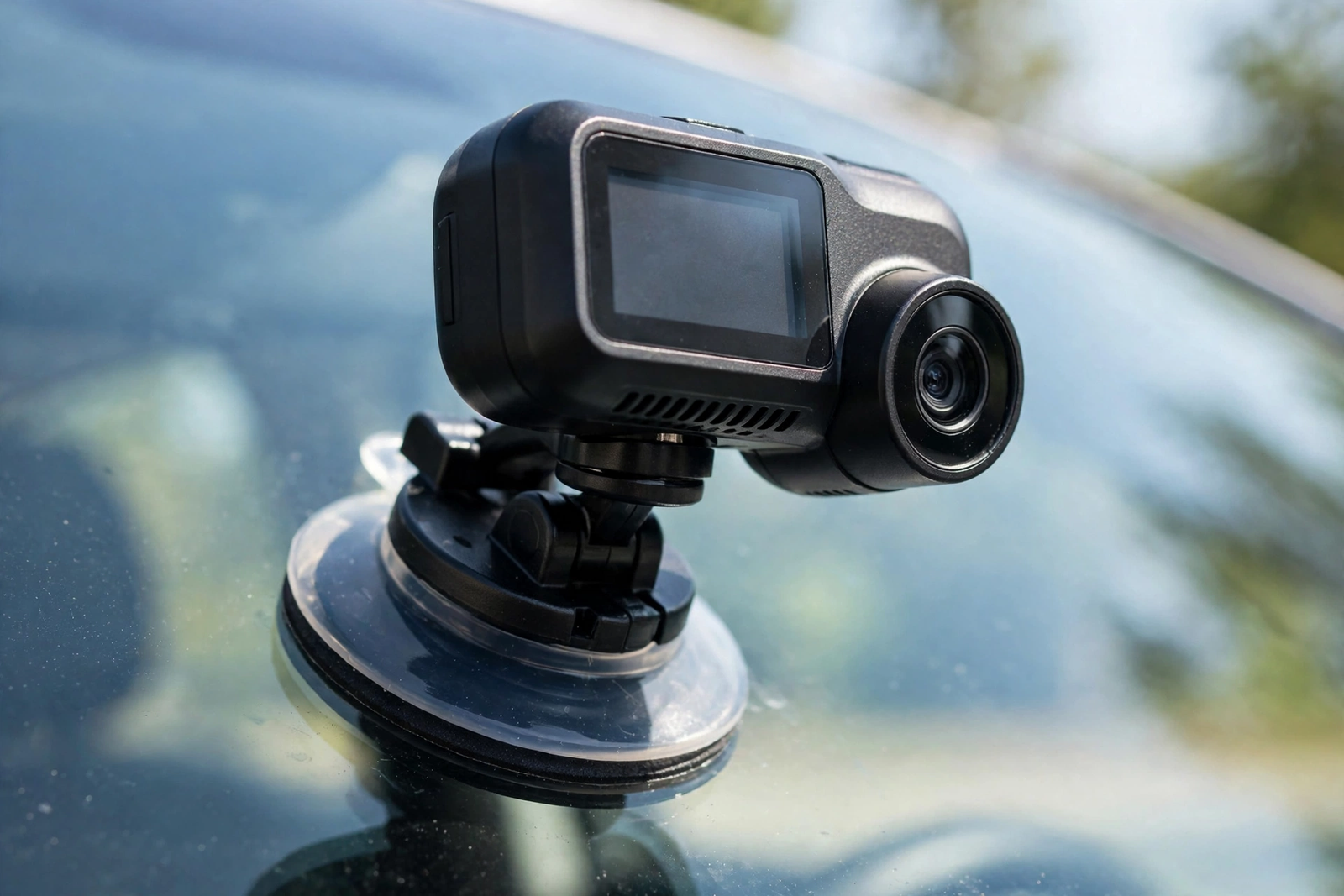
ROVE R2-4K Dash Cam on Amazon: single-channel front-only, 2160p, 2.4-inch LCD, 150-degree lens, built-in Wi-Fi 6 and GPS, supercapacitor, card not included.
Night Vision: STARVIS 2 vs Super Night Vision
Night driving is where a dash cam earns its keep, and the two cameras start from different sensor generations. The VIOFO uses a Sony STARVIS 2 IMX675, a back-illuminated sensor built for low light, with DOL-HDR and Night Vision 2.0 processing. The ROVE uses its Super Night Vision processing on the older IMX335 sensor, with WDR instead of HDR. Both help with the classic dash-cam failure — a bright headlight blowing out the plate behind it — but the VIOFO’s newer sensor and HDR give it the stronger night story on paper.
There is one catch to the VIOFO’s night mode, and the listing states it plainly: with HDR enabled, the frame rate drops from 60fps to 30fps. So the camera records 2K at 60fps with HDR off, or 2K at 30fps with HDR on. No dash cam guarantees plate readability on a fast-moving car at night. If most of your driving is after dark, the VIOFO’s STARVIS 2 sensor is the tiebreaker.
Screens and Size: 2.4 Inches vs 1.5 Inches
The screens will not decide this for you, but the gap between them is the biggest physical difference in the comparison. The ROVE R2-4K has a 2.4-inch LCD — large enough to frame a shot and check a setting without your phone. The VIOFO has a small 1.5-inch screen, per its listing — just big enough to frame a shot and change a setting without your phone.
The listing describes a 1.5-inch HD LCD screen with a screen saver; an earlier brief claimed this camera had no screen, so treat the 1.5-inch screen as the listing’s claim until the live listing is checked. The VIOFO’s wedge sits flatter against the glass; the ROVE’s boxier body suits a driver who wants to see settings at a glance.
Parking Mode and the Hardwire Kit
Both cameras advertise parking mode, and both need a hardwire kit to use it — neither works as a parked-car guard out of the box. The camera in the box records while you drive; parked protection costs extra, plus installation.
The VIOFO offers three parking modes — Auto Event Detection with buffering, Time Lapse, and Low Bitrate recording — and needs the VIOFO HK4 hardwire kit, wired to the fuse box. The HK4 cuts power before it drains the car battery, but the base kit does not include fuse taps, which you need for the installation.
The ROVE offers 24-hour parking mode with motion detection and time-lapse video, and needs ROVE’s hardwire kit (B0B7235VLX) wired to the fuse box, sold separately — the PRO’s listing names its hardwire kit, and the single-channel R2-4K uses ROVE’s USB-C hardwire kit for the R2-4K family. Check the listing for the kit ROVE specifies for your exact model before you buy, because the kit is model-specific.
VIOFO HK4 Hardwire Kit on Amazon: USB-C hardwire cable for the A119 Mini 2, low voltage protection, automatic parking mode switching, fuse taps not included.
App, Wi-Fi, and GPS
Both cameras move footage to your phone over Wi-Fi, which is how you will use them day to day: pull a clip at the roadside after an incident without removing the memory card. The ROVE uses Wi-Fi 6 on the single-channel camera and dual-band 5GHz and 2.4GHz Wi-Fi on the PRO. The VIOFO uses dual-band 5GHz and 2.4GHz Wi-Fi with the VIOFO app. The Wi-Fi range is short on both — inside or next to the car only.
GPS is built into both cameras, recording your route and location with the footage. Voice control is hands-free on the VIOFO — the listing describes 10 voice commands, including locking a video and taking a photo, so you can lock a clip the moment something happens. The ROVE answers with voice guidance and alerts instead: it talks to you about settings and card errors, but it does not take voice commands the way the VIOFO does.
Storage: Cards and What Is in the Box
Neither single-channel camera is a complete box. The viofo a119 mini 2 dash cam ships with no memory card — its listing title says so — and supports cards up to 512GB; the listing recommends a Class 10 or UHS-I card, and a high-endurance card is the right call. The rove r2-4k dash cam also ships with no card in the box, per its listing, and supports cards up to 512GB.
Neither box includes a hardwire kit. The ROVE PRO’s card inclusion is unclear across sources — check the live listing before you count on it. The ROVE Dual includes a 128GB card, per our ROVE R2-4K Dual review.
Trade-Offs: What Each Camera Gives Up
Every pick in this comparison gives something up, and the honest version names it. The ROVE R2-4K gives up native resolution: its 2160p headline is upscaled from a 2.5K-class sensor, so a cropped plate holds less real detail than the number suggests, and its night processing is WDR on an older sensor rather than HDR on a STARVIS 2.
The viofo a119 mini 2 dash cam gives up screen size and convenience: a 1.5-inch screen against the ROVE’s 2.4-inch display, no card in the box, no CPL filter in the box, and parking mode that needs the HK4 kit. And both cameras give up the same thing — a rear view. Neither single-channel camera records behind you, and neither can add a rear camera later. If a rear-end collision is the footage you most need, the step up is a two-channel kit, not a better single-channel camera.
Who Should Buy Which
Buy the VIOFO A119 Mini 2 if: you want the most honest front-only image — native 2K at a smooth 60fps from a STARVIS 2 sensor — and you value HDR night processing, voice commands, and a supercapacitor build for hot summers.
Buy the ROVE R2-4K if: you want the bigger 2.4-inch screen, voice guidance, Wi-Fi 6 transfers, and a camera that is easier to set up and check without your phone. Buy the PRO if you want the 2.5K at 60fps mode for smoother motion. Buy the Dual if you want front-and-rear coverage with a 128GB card already in the box.
Either works if: you just want a discreet front camera that records reliably and hides behind the mirror.
If you need more than a front view, neither camera is the answer. See our VIOFO A229 Pro review (two-channel), our Vantrue N4 Pro S review (three-channel), and our ROVE R2-4K Dual review.
VIOFO A119 Mini 2 Dash Cam Bundle with Bluetooth Remote Control on Amazon: the same camera plus a Bluetooth remote for one-press clip locking.
The Verdict
The rove r2-4k vs viofo a119 mini 2 dash cam decision comes down to what you want the footage for. The VIOFO A119 Mini 2 is the stronger camera for evidence: native 2K at 60fps from the bigger-generation STARVIS 2 IMX675 sensor, DOL-HDR for night driving, voice commands, and a supercapacitor built for heat. Its limits are honest — 2K detail, a small screen, no card, and parking mode needs the HK4 kit. The ROVE R2-4K is the easier camera to live with: a 2.4-inch screen, voice guidance, Wi-Fi 6, and a Dual version that covers the rear and includes the card. Its limits are honest too — the 2160p headline is upscaled, and parking mode needs the hardwire kit.
If honest native resolution and night footage matter most, buy the VIOFO A119 Mini 2. If the big screen, easy setup, and the front-and-rear Dual upgrade path matter most, buy the ROVE R2-4K.
ROVE R2-4K Dash Cam on Amazon: single-channel front-only, 2160p, 2.4-inch LCD, 150-degree lens, built-in Wi-Fi 6 and GPS, supercapacitor, card not included.
VIOFO A119 Mini 2 Dash Cam on Amazon: STARVIS 2 IMX675 sensor, 2K 60fps and 2.7K 30fps recording, GPS, 5GHz Wi-Fi, voice control, supercapacitor, no card included.
ROVE R2-4K Dual Dash Cam on Amazon: 4K front (upscaled) + 1080p rear, STARVIS 2 sensor, GPS and a 128GB card included.
Frequently Asked Questions
Is the ROVE R2-4K a true 4K dash cam?
No — not in the native sense. The ROVE R2-4K records a 2160p image, but its 5MP sensor captures natively at around 2.5K and the camera upscales the output to 4K. The PRO version states this in its own listing: a 5MP Sony IMX335 sensor with a native resolution of 2592×1944, capturing in 2.5K and upscaling to 4K UHD. Upscaling stretches a smaller image to a bigger frame; it does not add detail the sensor never captured. Only the ROVE R2-4K Dual PRO, a different model, records true native 4K from an 8MP sensor.
Is 4K always better than 2K in a dash cam?
No. Resolution is one ingredient: the sensor behind it, the HDR processing, and the frame rate matter just as much. The ROVE’s upscaled 2160p holds more detail when you zoom into a still frame, but the viofo a119 mini 2 dash cam records at 60 frames per second, which captures fast-moving plates with less motion blur than 30fps. For slow or parked scenes the bigger frame wins; for fast traffic, 60fps closes much of the gap.
Does the ROVE R2-4K record the rear view?
No. The ROVE R2-4K is a single-channel front dash cam only. It has no rear camera and does not support adding one. If you need rear coverage, the ROVE R2-4K Dual is the step up in the same family — a front camera plus a 1080p rear camera with a 128GB card in the box — or the VIOFO A229 Pro two-channel kit.
Does parking mode work out of the box on either camera?
No. Both cameras need a hardwire kit wired to the fuse box before parking mode works. The VIOFO A119 Mini 2 needs the HK4 hardwire kit (ASIN B09MRVP2PX), and the ROVE R2-4K needs ROVE’s hardwire kit (B0B7235VLX) for the R2-4K family, sold separately. Without the kit, either camera starts when the car starts and stops when the car stops.
Do either of these dash cams come with a memory card?
No. Neither single-channel camera includes a card: the VIOFO A119 Mini 2 does not — its listing states the card is not included, and it supports cards up to 512GB — and the ROVE R2-4K does not either, supporting cards up to 512GB. The ROVE PRO’s card inclusion is unclear across sources, so check the live listing. The ROVE Dual is the exception: a 128GB card is included in the box. Buy a high-endurance card with either single camera, since standard cards wear out faster under constant recording.
Which should I buy, the ROVE R2-4K or the VIOFO A119 Mini 2?
Buy the VIOFO A119 Mini 2 if honest native resolution and night footage matter most: native 2K at 60fps, the STARVIS 2 sensor, and HDR night processing. Buy the ROVE R2-4K if the big 2.4-inch screen, voice guidance, and easy setup matter most — or the Dual if you want front-and-rear coverage with a card in the box. If you only need a discreet front camera and neither of those decides it for you, both record reliably — let night driving point you to the VIOFO and the screen point you to the ROVE.