Dyson Car Vacuum Cleaner vs Shark: Which Wins?
A car collects crumbs, dust, sand and pet hair, and a full-size vacuum never quite reaches the gaps between the seats. A Dyson car vacuum cleaner is the cordless stick that converts to a handheld, built for exactly that job — and the Shark UltraCyclone Pet Pro+ is the dedicated handheld built for the same job from the other direction. Both are cordless, both run on their own battery, and both promise a clean car without dragging a cord across the driveway. The question is which one fits the way you actually clean a car.
The short answer: if you want one vacuum for the car and the house, the Dyson V8 is the pick — it converts from a stick to a handheld, lists 115 air watts of suction, and runs for up to 40 minutes in standard mode. The V8 Plus is the same Dyson car vacuum cleaner with a wider tool set. And if pet hair is the main problem, the Shark UltraCyclone Pet Pro+ is the dedicated handheld, with a pet power brush and an XL dust cup made for the job.
As an Amazon Associate I earn from qualifying purchases.
Quick Pick: Dyson vs Shark Car Vacuums
| Pick | Product | Best For | Check Price |
|---|---|---|---|
| Stick-to-Handheld All-Rounder | Dyson V8 Cordless Vacuum | A Dyson car vacuum cleaner that converts from stick to handheld, for whole-car cleans and the house too | Check Price on Amazon |
| Step-Up Dyson With More Tools | Dyson V8 Plus Cordless Vacuum | The same Dyson car vacuum cleaner platform with a wider tool set, for pet hair and hard floors as well as the car | Check Price on Amazon |
| Dedicated Pet-Hair Handheld | Shark UltraCyclone Pet Pro Plus Cordless Hand Vacuum, CH951 | A purpose-built handheld for cars and pets, with a pet power brush and an XL dust cup | Check Price on Amazon |
Table of Contents
Dyson V8: The Dyson Car Vacuum Cleaner That Converts to Handheld
The Dyson V8 is a cordless stick vacuum first and a handheld second — and that is the whole point of it as a car vacuum. The listing says it converts to a handheld vacuum for cleaning cars, stairs and upholstery, and it lists car use among its recommended uses, alongside bare floors, carpet, hard floors and stairs. The model in this roundup is 626423-01, and the listing gives its form factor as handheld once the stick is off. You clean the house with the stick on, then take the stick off, click the crevice tool on, and clean the car with the same machine.
The numbers the listing gives for this Dyson car vacuum cleaner are 115 air watts of suction from the Dyson Digital Motor V8, with up to 40 minutes of runtime in standard mode and two power modes. Max mode runs for about 7 minutes, so it is a short burst for a stubborn patch, not a mode to clean a whole car in. The 40-minute figure is the standard-mode claim without a motorised head attached, and independent testing puts the real-world figure with the motorised head closer to 31 to 36 minutes — still enough for a car and a set of stairs on one charge, but worth knowing before you plan a whole-house clean around it.
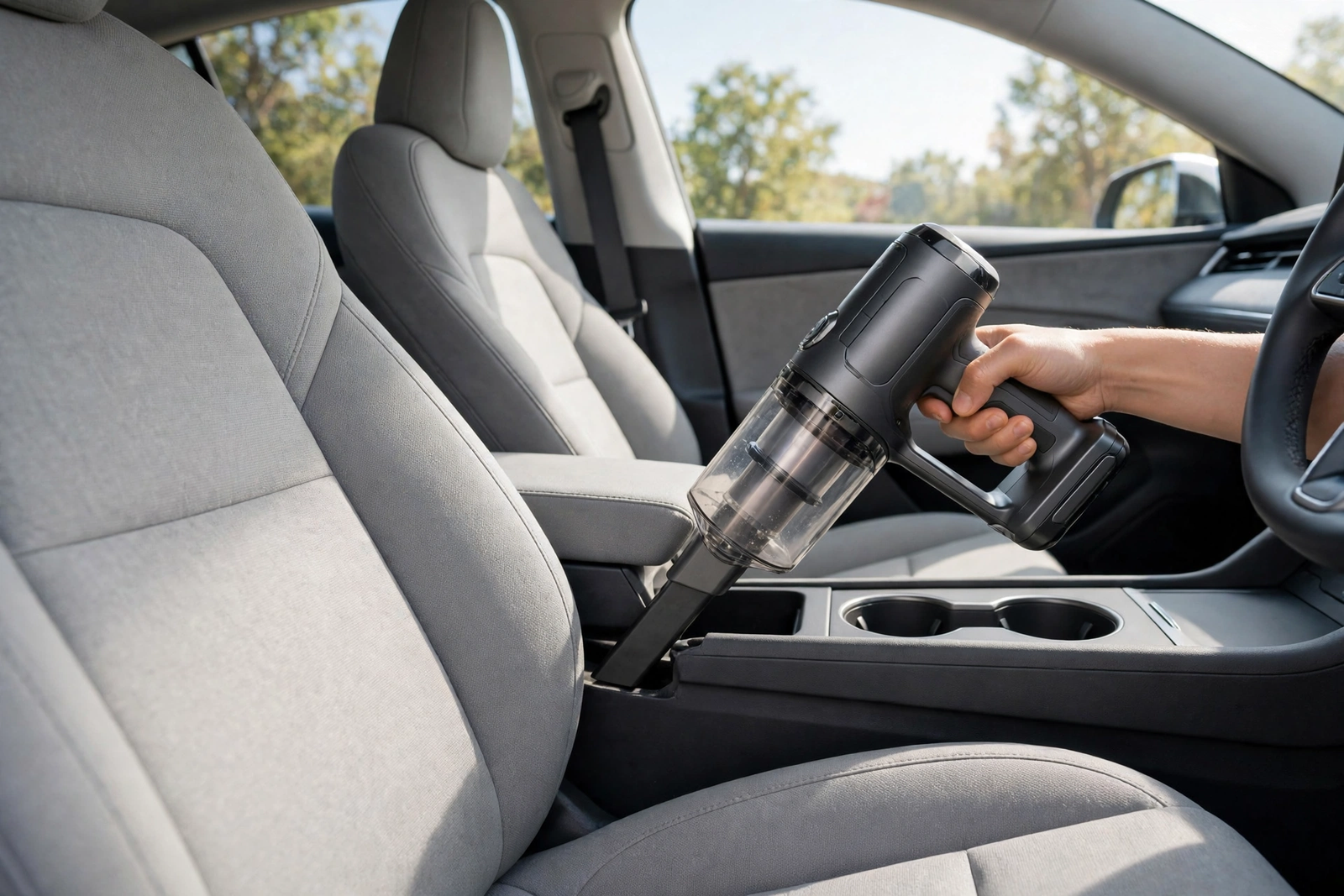
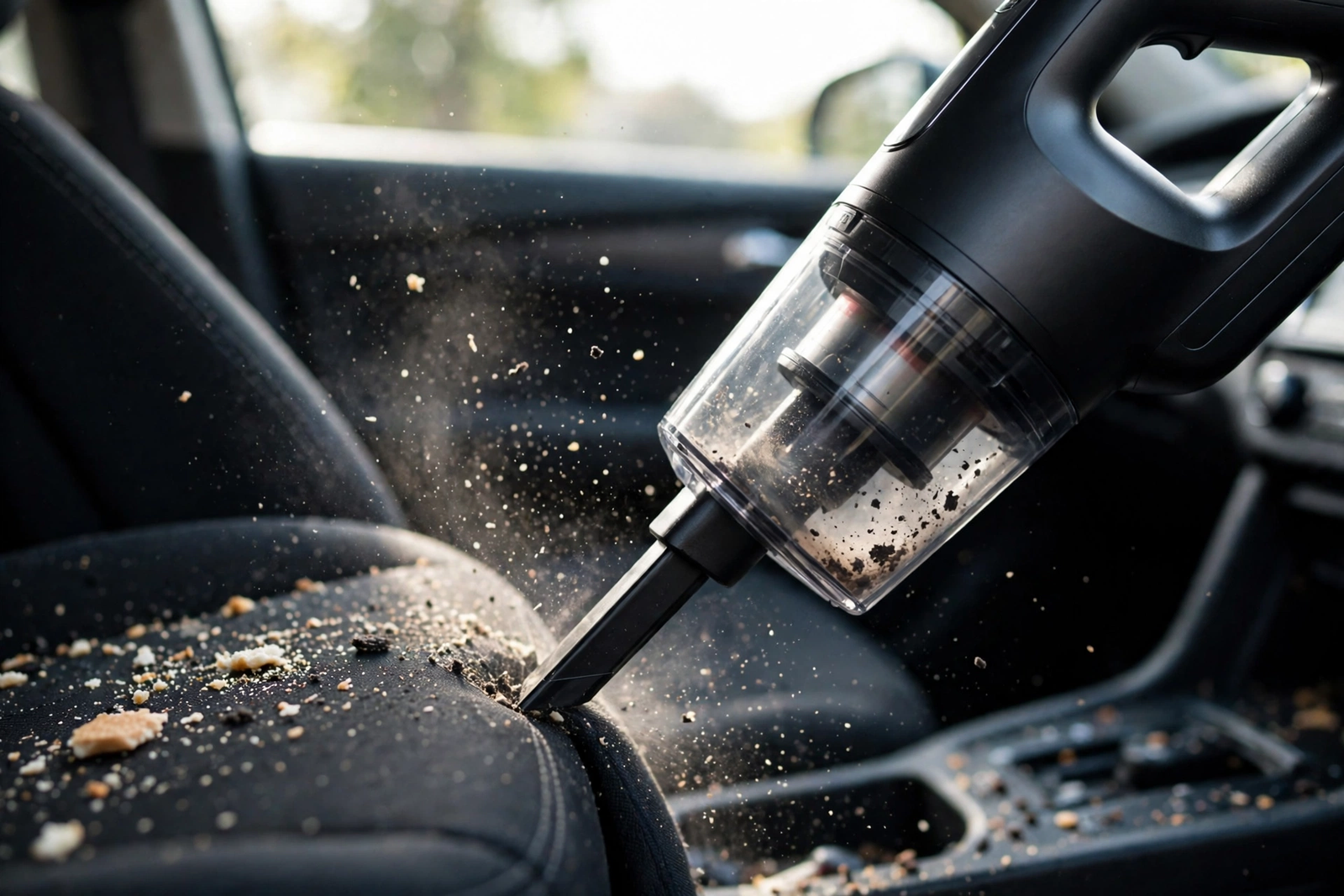
What makes this Dyson car vacuum cleaner work in a car is the shape once it converts. A stick vacuum cannot reach under a seat; a handheld with a crevice tool can reach the gap between the seat and the centre console, under the pedals, and into the door pockets. The bin empties with a hygienic dirt ejector, so you do not have to put your hand into the dust to empty it. And because it is the same vacuum you use in the house, it lives on a wall dock and charges there — there is no second charger to find when you want to clean the car.
Dyson V8 Cordless Vacuum on Amazon: converts to a handheld for cars, stairs and upholstery, 115 air watts, up to 40 minutes in standard mode, two power modes, model 626423-01.
Buy if: you want one vacuum for the car and the house, and you want it to convert from a stick to a handheld. Check the listing for the current tool set before you buy.
Dyson V8 Plus: The Step-Up Dyson Car Vacuum Cleaner
The Dyson V8 Plus is the same V8 platform with a wider tool set, and the listing gives it the same headline numbers: 115 air watts, up to 40 minutes of runtime, and two power modes. The listing says it transforms to a handheld with one click, and that it is powerful and long-lasting enough to clean a whole car too. The model number in the listing is V8 Absolute, and the included tools are the Dyson V8 cordless vacuum, a wall docking station, a charger, a mini soft dusting brush, a Motorbar cleaner head, a crevice tool and a Hair Screw Tool.
The difference from the base V8 is the bundle, not the motor. The Plus kit includes the mini soft dusting brush, and the listing frames it as the pet-friendly version of the V8, built for homes with pets. If the car is the main job and the house is a bonus, the base V8 covers it; if you also want the dusting brush for shelves and dashboards and the fuller home kit, the Plus is the one to look at. Either way, the car clean is the same: stick off, crevice tool on, and the same 115 air watts in handheld form from this Dyson car vacuum cleaner.
One thing to know before you choose between the two Dysons is that neither is a dedicated car vacuum. Both are house vacuums that convert, so both carry a stick, a wall dock and a floor head you will never use in the car. That is the trade for getting a whole-house machine: you pay for the house half of the tool even if the car is where you use it most. The Shark below takes the opposite approach, and the comparison sections below weigh the two against each other.
Dyson V8 Plus Cordless Vacuum on Amazon: 115 air watts, up to 40 minutes, two power modes, converts to handheld, Motorbar cleaner head, crevice tool, Hair Screw Tool, mini soft dusting brush, model V8 Absolute.
Buy if: you want the V8 platform with the wider tool set, including the mini soft dusting brush for dashboards and shelves. Check the listing for the current tool set before you buy.
Shark UltraCyclone Pet Pro+: The Shark Handheld for Cars and Pets
The Shark UltraCyclone Pet Pro+ is the opposite idea to the Dyson: a handheld first, built for cars and pets, with no stick and no floor head at all. The listing calls it a cordless hand vacuum for car and home, and the model is CH951, made by SharkNinja. The included tools are the Pet Power Brush, a crevice tool and a scrubbing brush, and the dust cup is the XL size — the listing makes the bigger cup a headline feature, because a handheld that fills up halfway through a car clean is no use to anyone.
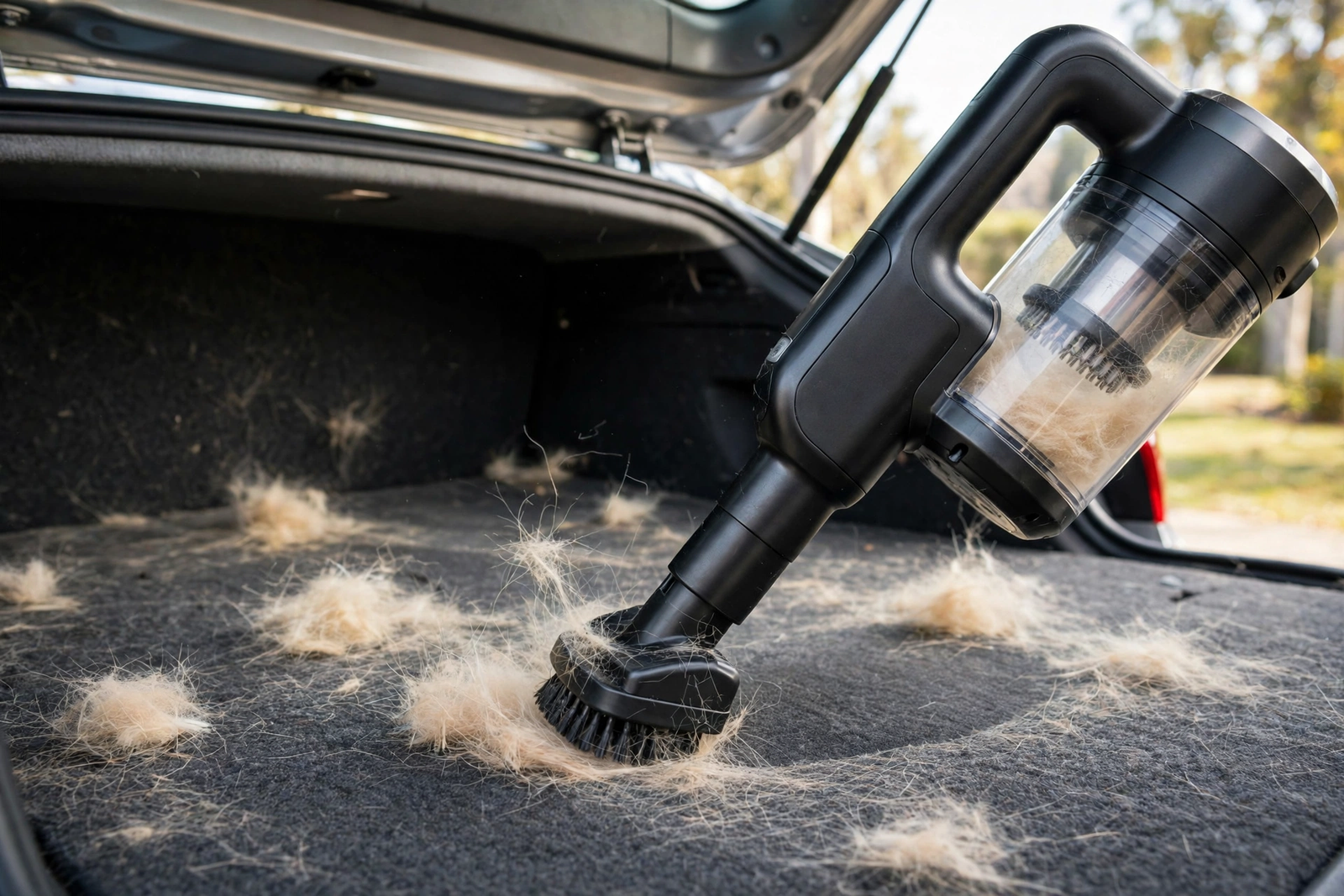
Review sites put the Shark at 2.8 lb with a 420 ml dust cup and a 3-hour full charge, which fits what the listing promises: a light handheld you can hold overhead to reach the headliner and under the seats without your arm tiring. The Pet Power Brush is the tool that sets it apart for pet owners — a small motorised brush that lifts hair out of carpet and upholstery where a plain nozzle slides over it. Our Shark UltraCyclone Pet Pro+ review covers this same model on its own, with the full tool set and the dust-cup details.
The trade for the dedicated design is range. The Shark does not convert to a stick, so it will not clean a hallway or a staircase the way the Dyson does — it is a car-and-spot-clean machine, and the listing is honest about that by calling it a hand vacuum for car and home. If the car is the job and pet hair is the problem, that is the right shape. If you want one vacuum for the whole house, the Dyson car vacuum cleaner side of this comparison is the better fit.
Shark UltraCyclone Pet Pro Plus Cordless Hand Vacuum on Amazon: cordless handheld for car and home, Pet Power Brush, crevice tool, scrubbing brush, XL dust cup, model CH951.
Buy if: pet hair is the main problem in your car, and you want a dedicated handheld with a pet brush and a big dust cup. Check the listing for the current tool set before you buy.
Dyson vs Shark: Suction and Runtime Compared
On suction, only the Dyson car vacuum cleaner gives a number. Dyson lists the V8 and the V8 Plus at 115 air watts, and both list up to 40 minutes of runtime in standard mode with about 7 minutes in Max mode. The Shark listing gives no air-watt figure and no runtime figure at all — it describes the suction as powerful and leaves it there. That is not a trick; handheld makers rarely publish comparable suction numbers, and air watts are a Dyson figure that cannot be compared with the figures other brands publish. So the honest comparison is the Dyson number against the Shark design: a measured 115 air watts on the Dyson side, and a purpose-built handheld with a pet brush on the Shark side.
On runtime, the Dyson car vacuum cleaner gives you a number you can plan around: up to 40 minutes in standard mode, less with the motorised head, about 7 minutes in Max. A car clean takes far less than that — most cars take well under half that time in actual vacuuming — so either Dyson has runtime to spare for the car, and the spare goes to the stairs and the upholstery. The Shark gives no runtime number in its listing, and review sites report a 3-hour full charge; treat that as the figure to check on the listing before you buy, and plan on charging it after each car clean rather than expecting it to run all afternoon.
The practical difference is what happens when the battery runs low. The Dyson car vacuum cleaner tells you the limit up front, in minutes, so you know a Max-mode burst is a seven-minute tool. The Shark asks you to trust the design instead. For a car clean, that rarely matters — a car is a small job, and either machine finishes it on one charge. It matters more if you want the same machine to clean the house afterwards, where the Dyson number tells you exactly how far it will go.
Dyson vs Shark: Dust Cup, Weight and Emptying
A car vacuum fills its dust cup fast, because car dirt is dense — sand, crumbs and hair pack tight. The Shark answers that with the XL dust cup, which the listing makes a headline feature: a bigger cup means fewer trips to the bin halfway through a car clean. Review sites put the Shark cup at 420 ml, and the same sites put the whole machine at 2.8 lb, which is light enough to hold overhead for the headliner and under the seats without your arm tiring.
The Dyson car vacuum cleaner answers the same problem differently. The V8 bin is smaller than the Shark XL cup, because the V8 is a stick vacuum that converts — its bin is sized for the house, not for a car boot full of sand. What it has instead is the hygienic dirt ejector, which pushes the dirt out of the bin so you do not have to reach in and pull it out. That matters more than it sounds: car dirt includes things you do not want on your hands, and a bin you can empty without touching the contents is worth having.
On weight, the comparison is close but not equal. The Shark is a dedicated handheld at a review-site 2.8 lb, built to be held in one hand for the whole clean. The Dyson car vacuum cleaner in handheld form can feel heavier, because it carries the stick-vacuum motor and bin on the same body — it is still a one-hand machine for a car clean, but you may feel the difference by the time you reach the second row. If you clean the car often and your arms tire easily, the lighter dedicated handheld has a real edge; if you clean the car once a week, the Dyson weight is a non-issue.
Dyson vs Shark: Tools and Attachments for Car Cleaning
The tool that matters most in a car is the crevice tool, and all three vacuums in this roundup have one. The Dyson V8 and V8 Plus both list a crevice tool in the box, and the Shark lists one too. It is the tool that reaches the gap between the seat and the centre console, under the pedals, and into the door pockets — the places where crumbs and dust actually live. If a vacuum has no crevice tool, it cannot clean a car properly, whatever its suction figure says.
After the crevice tool, the tools split by job. The Dyson V8 Plus adds the mini soft dusting brush, which is the tool for the dashboard and the vents, and the Hair Screw Tool, which is the tool for hair wrapped around a brush bar. The Shark adds the Pet Power Brush, a small motorised brush that lifts pet hair out of carpet and upholstery, and a scrubbing brush for ground-in dirt on mats. The base V8 has the crevice tool, which covers the middle ground. That spread is what makes a Dyson car vacuum cleaner a whole-house machine as well as a car vacuum.
If you carry a dog, the Shark tool set is the better match — the Pet Power Brush is made for exactly that job, and our best car vacuum for pet hair roundup covers the wider pet-hair kit worth pairing with it. If you carry children, the Dyson dusting brush and combination tool cover the dashboard, the vents and the crumbs in the seat gaps. Either way, check the listing before you buy: tool sets change between listings, and the tools in the box are the tools you get.
Dyson vs Shark: Which Fits Your Car Cleaning Routine
The right vacuum depends on how you clean, not just on the spec sheet. If you clean the car once a week as part of the house clean — vacuum the stairs, then take the same machine out to the car — the Dyson car vacuum cleaner is the natural pick, because it is already in your hand and already charged on its wall dock. The stick-to-handheld conversion is the feature you use every time, and the house half of the machine is not wasted.
If you clean the car on its own, in short bursts between trips — a quick pass over the seats after the school run, the boot after the dog — the Shark is the natural pick, because it is already a handheld. There is nothing to convert and nothing to assemble: pick it up, run it over the seats, put it back. A dedicated handheld rewards the quick clean in a way a convertible stick never quite does, because every second of setup is a reason to skip the job.
The third routine is the deep clean, and both machines handle it differently. The Dyson car vacuum cleaner gives you the runtime number to plan around and the dusting brush for the dashboard; the Shark gives you the bigger dust cup and the pet brush for the mats. Pair either one with a proper interior clean — our best car cleaning kit covers the Chemical Guys kits for the wipe-down afterwards — and the vacuum is the first half of the job, not the whole job.
Car Vacuum Mistakes to Avoid
The most common car vacuum mistake is cleaning with a full dust cup. Suction falls as the cup fills, and a full cup blows fine dust back out of the machine. Empty the cup before you start, not when it stops picking up — and on the Shark, the XL cup is not a reason to skip emptying it, it is a reason you can finish the car before it needs emptying.
The second mistake is using Max mode for the whole clean. The Dyson car vacuum cleaner Max mode runs for about 7 minutes, and it is made for a stubborn patch, not for a whole car. Run the clean in standard mode and save Max for the ground-in dirt on the mats. The third mistake is skipping the crevice tool and trying to clean the seat gaps with the main nozzle — the nozzle cannot reach, so the crumbs stay, and the clean looks done when it is not.
The fourth mistake is vacuuming a wet car. A household cordless vacuum is not a wet-and-dry machine, and wet dirt clogs the filter and the bin. Dry the car first, then vacuum. And the fifth is storing the vacuum with a dirty filter: a clogged filter cuts suction on the next clean, so tap the filter clean after each use and wash it only if the listing says it is washable.
Who Should Buy a Dyson Car Vacuum Cleaner — and Who Should Buy a Shark
Buy a Dyson car vacuum cleaner if: you want one vacuum for the car and the house. The V8 converts from a stick to a handheld, lists 115 air watts with up to 40 minutes in standard mode, and lives on a wall dock ready to go. Buy the V8 Plus if you also want the wider tool set, including the mini soft dusting brush for the dashboard.
Buy a Shark if: pet hair is the main problem in your car, or you want a dedicated handheld that is ready in one grab. The UltraCyclone Pet Pro+ is built for cars and pets, with a pet power brush, a crevice tool, a scrubbing brush and an XL dust cup, and at a review-site 2.8 lb it is the lighter machine to hold for a whole car clean.
Buy neither if: you only ever clean the car at a petrol station with a coin vacuum, or your car never gets dirty enough to need a vacuum at all. A cordless vacuum earns its place by being used — if it will sit in a cupboard, the money is better spent elsewhere. And if your car is a daily work vehicle with heavy dirt, a mains-powered wet-and-dry vacuum is the stronger tool for that job.
The Verdict
The best Dyson car vacuum cleaner for most drivers is the V8: it converts from a stick to a handheld, lists 115 air watts with up to 40 minutes in standard mode, and does the car and the house with one machine. The V8 Plus is the same platform with a wider tool set, and it is the pick if the dusting brush and the fuller home kit matter to you.
The Shark UltraCyclone Pet Pro+ is the pick if the car is the job and pet hair is the problem. It is a dedicated handheld with a pet power brush, an XL dust cup and a light 2.8 lb body, and it does one thing — clean the car — without the stick, the dock and the floor head you will never use in the car. Whichever side you choose, check the listing for a live offer before you order, and check the tool set in the box — the tools are what clean the car, not the headline number. For the wider kit, our best car accessories for road trips covers the rest of the road-trip gear.
Frequently Asked Questions
Is a Dyson car vacuum cleaner good for cars?
Yes — the Dyson V8 is listed for car use, and it converts to a handheld vacuum for cleaning cars, stairs and upholstery. In handheld form with the crevice tool on, it reaches the gaps between the seats, under the pedals and into the door pockets. It lists 115 air watts of suction with up to 40 minutes of runtime in standard mode. It is a house vacuum that converts, not a dedicated car vacuum, so you also get the stick, the wall dock and the floor head for the house.
Is the Shark UltraCyclone Pet Pro+ good for pet hair in a car?
Yes — it is built for exactly that job. The listing calls it a cordless hand vacuum for car and home, and it ships with a Pet Power Brush, a crevice tool and a scrubbing brush, plus an XL dust cup. The Pet Power Brush is a small motorised brush that lifts hair out of carpet and upholstery, and the bigger cup means fewer trips to the bin halfway through a car clean. Review sites put the machine at 2.8 lb with a 420 ml dust cup.
How long does the Dyson V8 battery last in a car clean?
Dyson lists up to 40 minutes of runtime in standard mode, with about 7 minutes in Max mode. The 40-minute figure is the standard-mode claim without a motorised head attached, and independent testing puts the real-world figure with the motorised head closer to 31 to 36 minutes. A car clean takes far less than that — most cars take well under half that time in actual vacuuming — so either Dyson finishes a car on one charge with runtime to spare.
Dyson V8 or V8 Plus — which one is better for a car?
For the car clean itself, they are the same: both list 115 air watts, up to 40 minutes in standard mode, and two power modes, and both convert to a handheld. The V8 Plus adds to the tool set, including the mini soft dusting brush for dashboards and shelves, and the listing frames it as the pet-friendly version of the V8. Pick the base V8 if the car is the main job; pick the Plus if you also want the wider tool set for the house.
Do I need a cordless vacuum, or will a 12-volt car vacuum do?
A cordless vacuum is the more flexible pick for most drivers. A 12-volt car vacuum plugs into the car socket, so it only works with the car switched on and the cord limits how far you can reach. A cordless handheld runs on its own battery, so you can clean the car, the stairs and the upholstery with the same machine, anywhere. The trade is the battery: a cordless vacuum needs charging, and its runtime is limited to one charge.
How do I clean crumbs from between car seats?
Use the crevice tool, and move the seat forward first so you can reach the gap. Run the crevice tool along the gap between the seat and the centre console, then along the seat rails and under the pedals. Empty the dust cup before you start, run the clean in standard mode, and save Max mode for ground-in dirt on the mats. A quick pass with the crevice tool after every trip stops crumbs building up into a job that needs a deep clean.