A tyre pressure warning light never picks a good moment: before a long drive, in a dark car park, or twenty miles from the nearest petrol station air pump. A portable air compressor for car tyres solves that problem in the driveway, and the EPAuto 12V DC Portable Air Compressor Pump (model AT-010-1Z) is a plug-in digital inflator with a preset gauge, auto shut-off, and an LED flashlight, built to live in the trunk. In this review of the EPAuto portable air compressor for car use, we cover what it does, how fast it inflates, its disputed pressure ceiling, and how it compares with the corded AstroAI AIRUN H and the cordless Fanttik X9 Pro and Airmoto. The Quick Pick table below has the short version.
As a car air compressor, the EPAuto is deliberately simple: no battery to charge, no app, no mains plug. It draws power from the car’s 12-volt socket, reads the pressure on a digital display, and stops itself at the pressure you set. That simplicity is the whole pitch — and also the whole limit.
As an Amazon Associate I earn from qualifying purchases.
| Pick | Product | Why it stands out | Check Price |
|---|---|---|---|
| Overall Winner | EPAuto 12V DC Portable Air Compressor Pump (AT-010-1Z) | 12V plug-in inflator, digital preset with auto shut-off, LED light, no battery to maintain | |
| Best Budget | AstroAI AIRUN H 12V Tire Inflator | Same corded idea with faster airflow (35 L/min) and a 9.8 ft cord — the budget corded rival | |
| Premium Pick | Fanttik X9 Pro Portable Tire Inflator | Cordless handheld inflator, 150 PSI max, pocket-size — the step up for drivers who hate cables |
Table of Contents
What the EPAuto Portable Air Compressor for Car Is — and What It Is Not
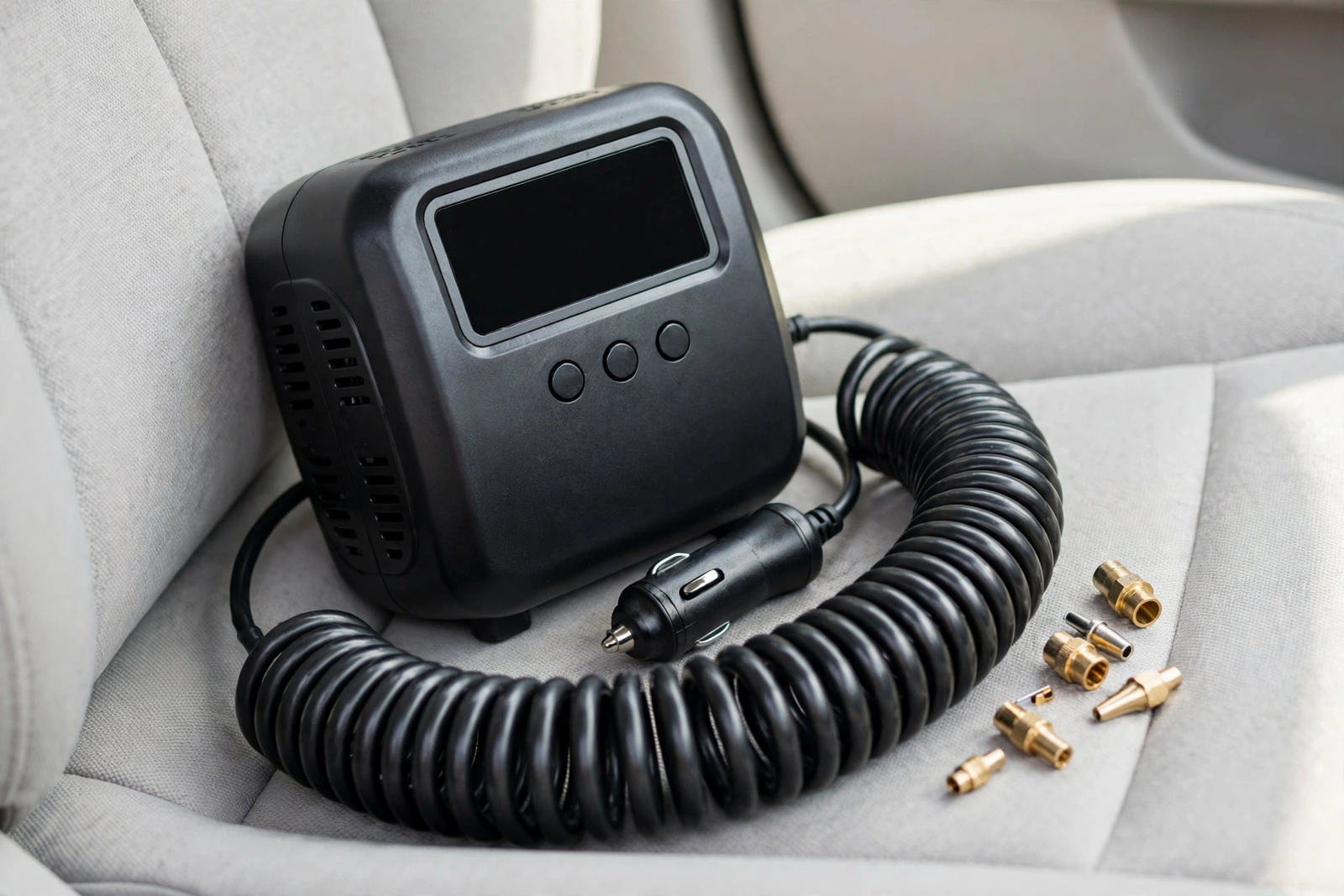
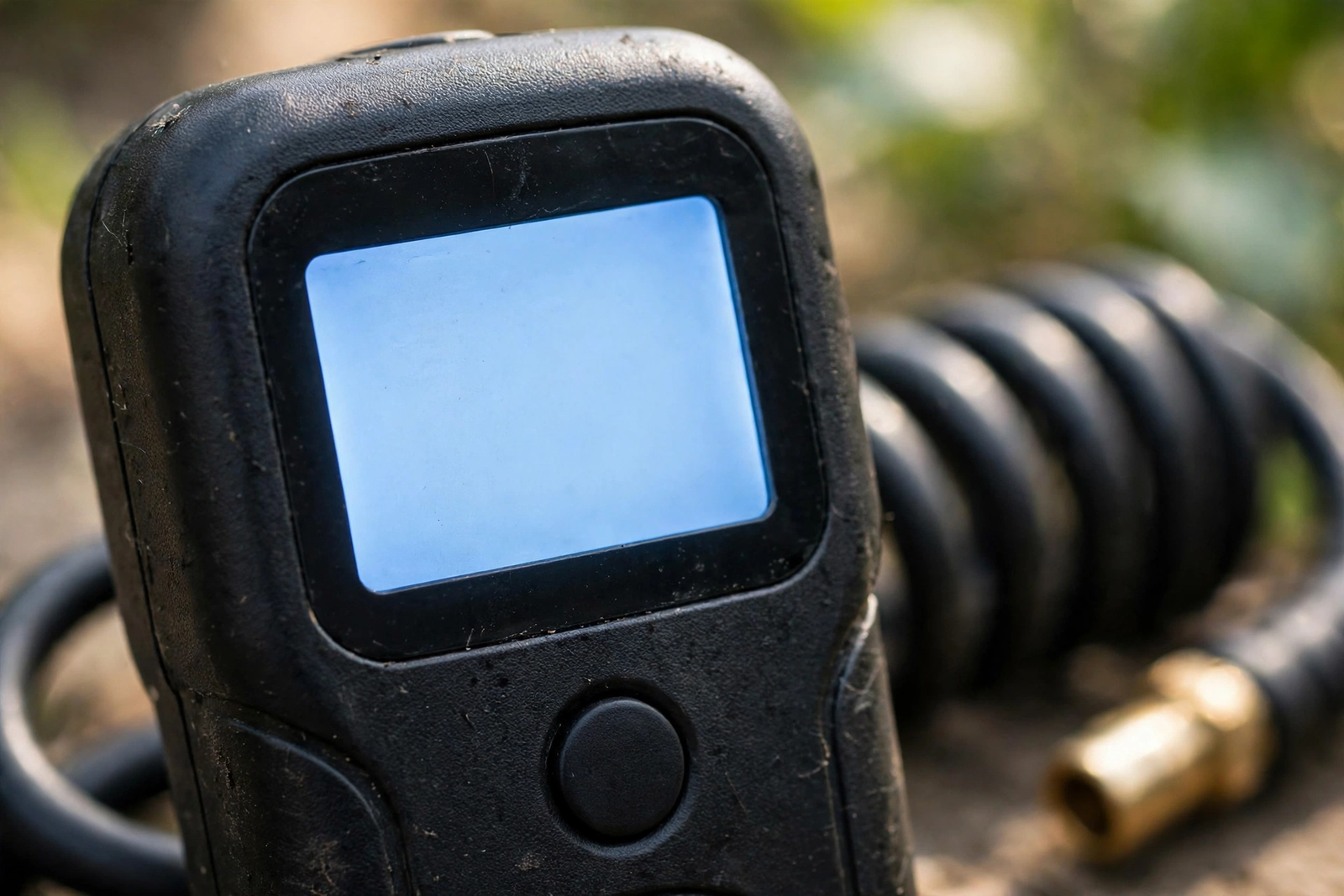
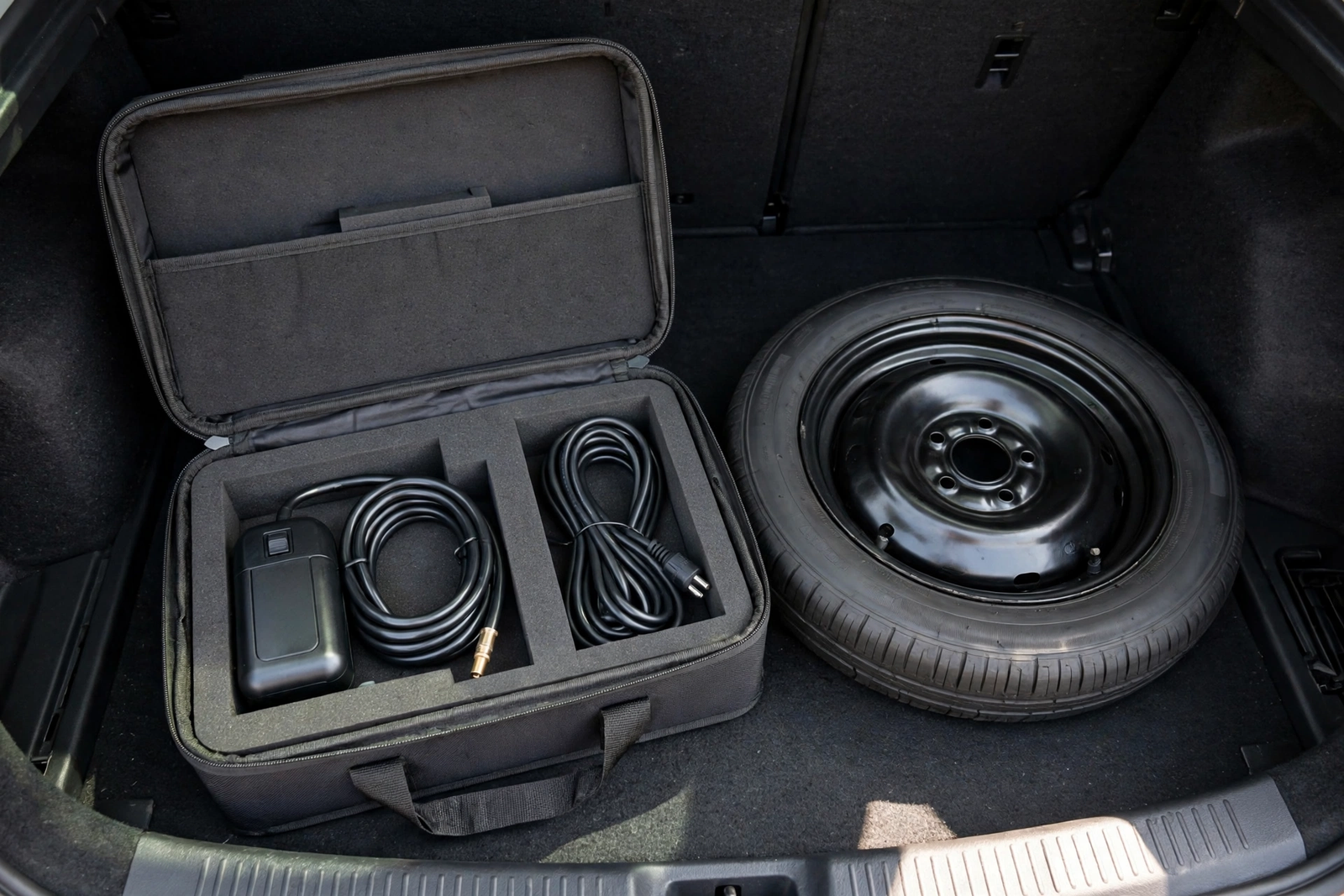
The EPAuto AT-010-1Z is a compact 12-volt DC tyre inflator that plugs into the car’s cigarette-lighter socket: a small pump with a digital pressure display, a preset target you set yourself, automatic shut-off when it reaches that target, overheat protection, and a built-in LED flashlight. A carrying case is included, with adapters for sports balls and small inflatables. The universal valve connector fits a standard Schrader valve.
The listing is specific about what it is for: tyres on cars, bikes, sedans and midsize SUVs, with engines under 3.5 litres. Rated power is 120 watts, drawing 10 to 15 amps from the 12-volt socket, and airflow is rated at 1.06 cubic feet per minute. The display reads in four units — PSI, KPA, BAR and KG/CM².
It is not a cordless inflator — there is no battery inside, so it cannot work away from the car. It is not a workshop compressor: it inflates tyres and small inflatables, not air tools, and it will not fill large-volume items quickly. And it is not a truck-tyre tool: the listing is explicit that it does not support truck tyres, including light-truck tyres.
How It Works: Set the Pressure, Plug In, Walk Away
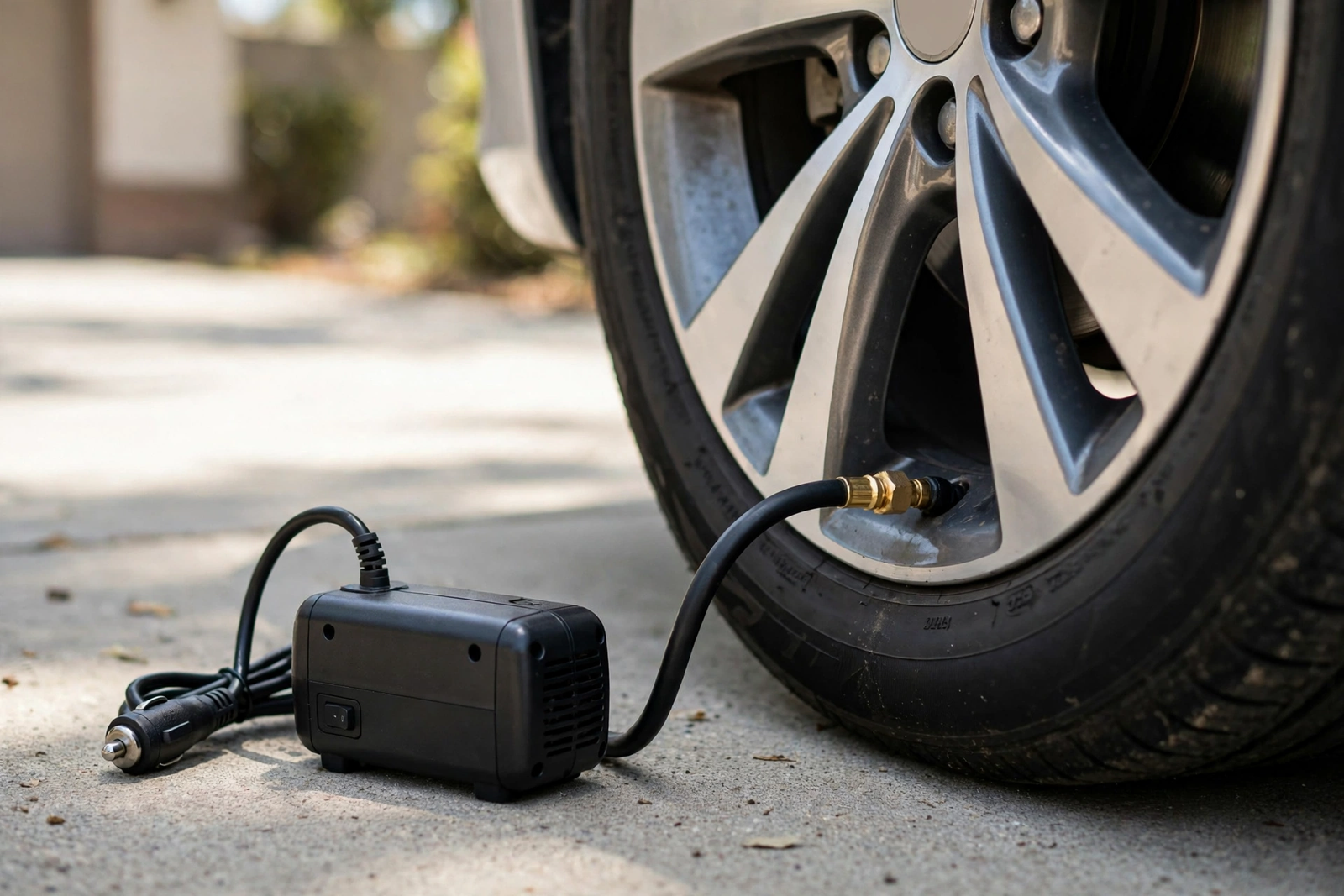
Using the EPAuto takes about a minute to learn. Plug it into the car’s 12-volt socket, screw the valve connector onto the tyre valve, and the display shows the tyre’s current pressure. Set the pressure you want, press start, and the pump runs until it reaches the number you set, then shuts off by itself. No standing there watching the gauge, and no risk of over-inflating the tyre while you look away.
That set-and-forget behaviour matters most on a small inflator: the classic mistakes are overshooting the target and standing in the cold babysitting a gauge. Before you set the target, check the driver’s door placard — not the maximum number moulded into the tyre sidewall, which is a limit, not a target. Check pressure cold — first thing in the morning, or at least three hours after driving — because a hot tyre reads high.
The extras are practical. The LED flashlight covers a low tyre found after dark, when finding the valve stem is half the job. The adapters cover a bicycle tyre, a sports ball or a small inflatable, and the carrying case keeps pump, hose and adapters together in the trunk.
Inflation Speed: What 1.06 CFM Means in Practice
Speed is where a small plug-in inflator shows its size. The EPAuto is rated at 1.06 cubic feet per minute of airflow — a modest figure next to a workshop compressor. One independent roundup’s testing reported roughly 4–5 PSI per minute for passenger car tyres: a small top-up takes a couple of minutes; a bigger one takes longer.
As a portable tyre air compressor, the EPAuto is built for the monthly top-up and the slow leak, not for speed records. A tyre a few PSI low is its home ground; a bigger top-up takes longer. A completely flat tyre is the hardest case of all, because going from zero to full pressure means moving many times more air than a top-up. We state no flat-from-zero time here — no source we could verify publishes one — and a fully flat tyre is a job for a spare tyre or a repair.
Two habits follow from the speed. Use it for the monthly pressure check our portable tire inflator roundup recommends — tyres lose roughly 1 PSI a month, and a small regular top-up is a two-minute job. Respect the overheat protection: the unit shuts itself off when overloaded, so rest it between long runs.
Display, Presets, and Auto Shut-Off
The display is the EPAuto’s best feature: a digital gauge reading in PSI, KPA, BAR and KG/CM², so there is no squinting at a dial needle. You set the target pressure, the pump runs to it, and the auto shut-off stops the pump when the desired pressure is reached — exactly how a monthly top-up should feel.
One number needs an honest note: sources disagree about the maximum pressure. The listing states a maximum working pressure of 100 PSI, while the user manual frames the maximum as up to 60 PSI for passenger vehicles, and one third-party roundup lists 70 PSI. The disagreement does not matter for a car tyre: every figure sits far above the 30–35 PSI a normal car tyre needs. But do not buy this pump for a job that needs pressure near any of those ceilings.
Two small details are worth knowing. The power cable carries a 15-amp fuse, with a backup fuse included in the package — sensible for a device drawing up to 15 amps through the socket. And the manual lists the noise level at 92 dB: expect compressor noise for a few minutes in the driveway, not a silent job.
Power, Cord, and the 12V-Only Rule
The EPAuto runs on 12 volts DC only, from the car’s cigarette-lighter socket. It is not a mains device — do not connect it to a 110-volt AC outlet — and it does not support 24-volt systems. The rated power is 120 watts, with the listing giving a 120–180 watt range at 10 to 15 amps, so the fuse is doing genuine work.
As a portable auto air compressor, the corded design is both the feature and the catch. The feature is readiness: no battery to charge, no dead-battery surprise after months in the trunk. It works whenever the car is there and the socket is live. The catch is the tether: the car must be there, the socket must work, and you are working around the car. If your 12-volt socket is dead, so is the inflator.
That trade is the entire buying decision for this class of pump. Drivers who like cordless convenience will be happier with a battery inflator. Drivers who want a trunk tool that works after months of neglect — no charging routine, no battery to babysit — should buy corded, and the EPAuto is the simplest version of that choice.
EPAuto vs the Alternatives (AIRUN H, Fanttik X9 Pro, Airmoto)
The closest rival is the AstroAI AIRUN H, covered in our AstroAI AIRUN H review — the same corded idea with more airflow. The AIRUN H runs a 120-watt motor at 35 litres per minute against the EPAuto’s 1.06 cubic feet per minute (about 30 litres per minute), reaches 150 PSI per the listing, and has a 9.8-foot power cord that reaches all four tyres. It has a 15-minute thermal limit and a 10-minute cooldown. Between the two, the AIRUN H is the faster, longer-reach tool; the EPAuto is the simpler, smaller one. If you want a tyre air compressor portable enough to live in the trunk, either works — the AIRUN H wins on speed, the EPAuto on simplicity.
The cordless alternative is the Fanttik X9 Pro, covered in our Fanttik X9 Pro review — a pocket-size handheld inflator with a rechargeable battery, a 150 PSI maximum, preset modes and auto shut-off, and a gauge an independent test verified at 32.1 PSI against a 32 PSI target. It works anywhere, with no cable and no car socket needed — but its battery holds a limited charge, it can pause if it overheats on a hot day, and you must remember to charge it. Buy the base-model listing, not the Deluxe package variant — a different listing.
The third option is the Airmoto, covered in our Airmoto portable tire inflator review — a pocket-size cordless inflator with a 2000mAh battery, a 120 PSI maximum and 20 litres per minute of airflow. Its listing says 3–5 minutes per standard tyre top-up, while one independent test measured around 7–8 minutes for a larger top-up, so it is the slowest of the three, but also the smallest — the one most likely to be in the glove box when the warning light comes on. The AstroAI L7, covered in our AstroAI L7 review, sits between the cordless options: it matches the X9 Pro’s 150 PSI and 17 litres per minute, with a bigger 4000mAh battery and a 12-volt DC backup mode, so a dead battery does not strand you. The short version: EPAuto for the cheapest always-ready corded tool, AIRUN H for the faster corded tool, X9 Pro for the quickest pocket top-up, Airmoto for the smallest glove-box tool, L7 for the bigger battery and corded fallback.
Who Should Buy It — and Who Should Skip It
Buy the EPAuto if you want a tyre inflator that is always ready with zero maintenance. It suits the driver who tops up tyres every few weeks, the household that wants one cheap inflator in every car, and anyone who likes set-and-forget auto shut-off but will rarely use cordless convenience.
Skip it if your tyres are truck tyres or large and heavy-load, if you regularly inflate high-volume items, or if you want to inflate away from the car — a cordless inflator is the right tool for that job. Skip it too if you want the fastest fill on a big tyre: the AIRUN H moves more air, the X9 Pro is faster still. Skip it too if you expect a silent job: at a manual-listed 92 dB, this is a loud little pump.
Verdict
The EPAuto portable air compressor for car use is the budget version of the corded inflator idea: a 12-volt plug-in pump with a digital gauge, preset target and auto shut-off, an LED light, and no battery to maintain. Its limits are the honest limits of the category — a modest 1.06 CFM airflow, a tether to the car’s 12-volt socket, no use for truck tyres, and a maximum-pressure figure that sources disagree about. Accept those facts and it is a strong buy for the driver who wants the cheapest always-ready trunk tool; if any is a deal-breaker, the AIRUN H is the faster corded step up and the X9 Pro is the cordless one.
Frequently Asked Questions
How fast does the EPAuto inflate a car tyre?
The EPAuto is rated at 1.06 cubic feet per minute of airflow. One independent roundup’s hands-on testing reported roughly 4–5 PSI per minute for passenger car tyres, so a small top-up of a few PSI takes a couple of minutes and a bigger top-up takes longer. No verified flat-from-zero time is published for this model, so we state none here.
What is the maximum pressure of the EPAuto air compressor?
Sources disagree. The Amazon listing states a maximum working pressure of 100 PSI, the user manual frames the maximum as up to 60 PSI for passenger vehicles, and one third-party roundup lists 70 PSI. Every one of those figures is far above the 30–35 PSI a normal car tyre needs, so the disagreement does not affect car-tyre use — but do not buy this pump for a job that needs pressure near any of those ceilings.
Can the EPAuto inflate truck tyres?
No. The listing is explicit that this pump does not support truck tyres, including light-truck tyres. It is built for tyres on cars, bikes, sedans and midsize SUVs with engines under 3.5 litres. If your vehicle runs truck tyres, you need a larger inflator built for that job.
Does the EPAuto need a battery or mains power?
Neither. It has no battery and no mains plug. It runs on 12 volts DC only, from the car’s cigarette-lighter socket, at 120 watts and 10 to 15 amps. Do not connect it to a 110-volt AC outlet, and do not use it on a 24-volt system. The upside is zero charging maintenance; the downside is it cannot work without the car.
What adapters come with the EPAuto air compressor?
The pump comes with a needle valve adapter for sports balls and short and long cone adapters for inflatables such as kayaks and swimming-pool accessories, plus a universal valve connector that fits a standard Schrader valve. A carrying case is included, and the power cable carries a 15-amp fuse with a backup fuse in the package.
Should I buy the EPAuto or the Fanttik X9 Pro?
Buy the EPAuto if you want the cheapest always-ready tool with no battery to charge — it works whenever the car is there and the socket is live. Buy the Fanttik X9 Pro if you want cordless convenience: it is a pocket-size handheld with a rechargeable battery, a 150 PSI maximum and a gauge an independent test verified, but you must keep it charged and it can pause if it overheats on a hot day. Buy the base-model X9 Pro listing, not the Deluxe package variant, which is a different listing.