Best Electric Cooler for Cars: 3 Picks for Road Trips and Daily Driving
An electric cooler plugs into your car and keeps food and drinks cold without a bag of ice melting in the bottom. The idea is simple: a 12V socket powers a cooler that holds a steady temperature for the whole drive, so the sandwiches stay cold, the drinks stay cold, and the gas-station ice run disappears. This roundup compares three real electric cooler models on the two cooling technologies that matter, thermoelectric and compressor, and on power draw, size and what each one is actually good for.
The short answer: start with the Koolatron P20 if your trips are short and you only need drinks and sandwiches kept cool, pick the BougeRV CRPRO 21 if you want a compressor electric cooler that holds an exact temperature and can freeze, and pick the Alpicool C15 if you want the same compressor cooling in the smallest box of the three. All three run on 12V car power, none of them needs ice, and none of the three had a confirmed live offer when its listing was last read — check the offer before you order.
As an Amazon Associate I earn from qualifying purchases.
Quick Pick: Electric Coolers for Cars Compared
Table of Contents
Koolatron P20: The Thermoelectric Cooler for Short Trips
The Koolatron P20 is the thermoelectric electric cooler in this roundup, and it works differently from the other two. It is the Koolatron Electric Portable Cooler, model P20, an 18-quart (17-liter) cooler and warmer that plugs into any 12V outlet. The listing says it cools to 40 degrees Fahrenheit below the outside temperature and warms to 135 degrees Fahrenheit, holds up to 23 standard cans, and uses less power than a vehicle tail light. There is no compressor inside and no ice involved: a thermoelectric module and a fan move heat out of the box, and flipping the plug turns the same box into a warmer.
That cooling limit is the thing to understand before you buy it. A thermoelectric electric cooler cools relative to the air around it, not to a fixed temperature you set. On a mild day it keeps drinks properly cold; on a hot day, with the car sitting in the sun, the inside of the box rises with the outside air, and it cannot freeze anything. The listing gives the same warning in its own way: it cools to 40 degrees below the outside temperature, which is a gap, not a target. For a day drive, a commute with a packed lunch, or a short road trip in mild weather, that gap is enough. For a multi-day summer trip, it is not.
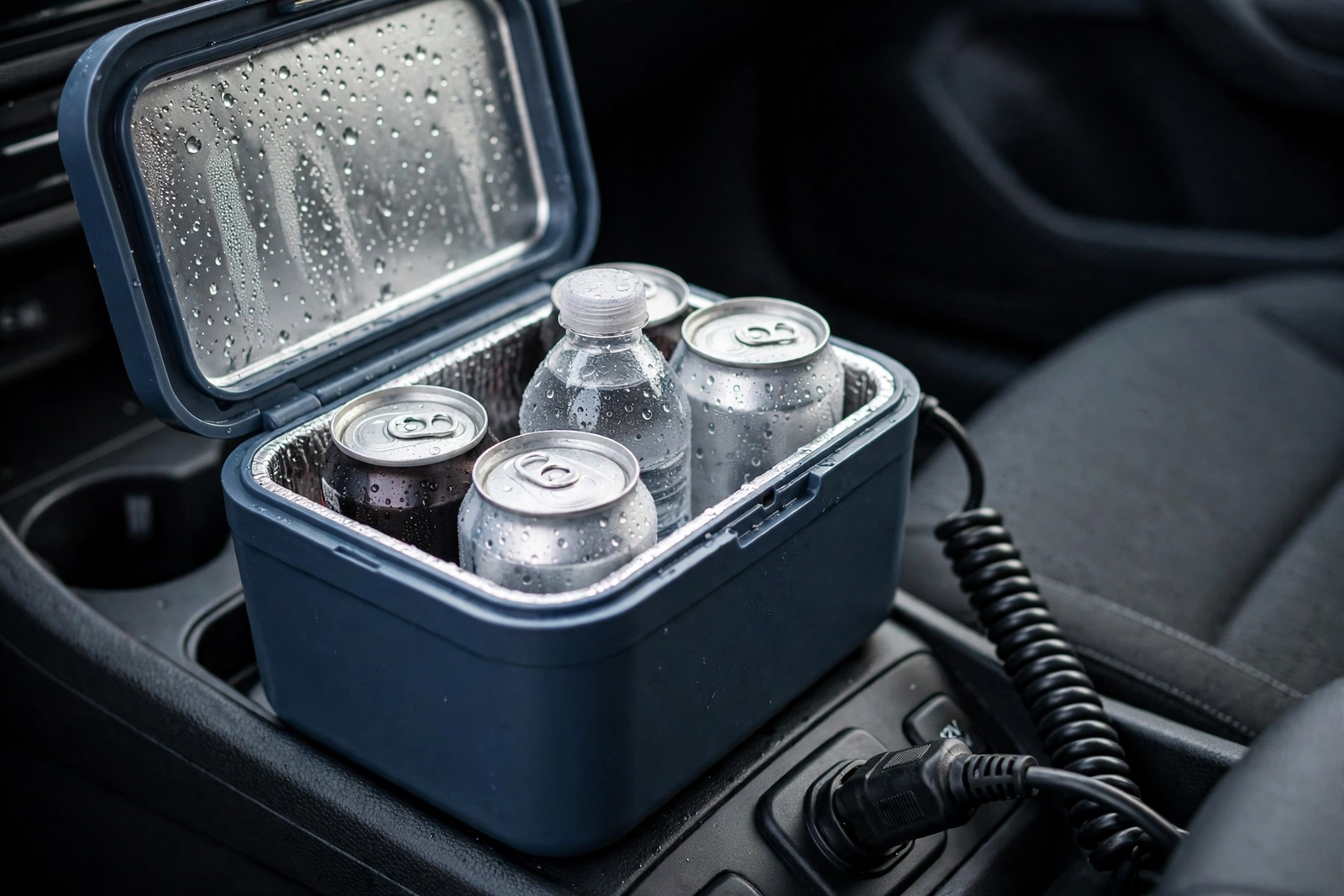
The P20 is the pick in this roundup for the driver who wants the simplest electric cooler there is: one plug, no settings, no ice, and a box that fits between the front seats of most minivans or in the footwell of a car. The 40-degree cooling gap and the warming function are the listing’s claims — no cooler was run or measured for this review — and the box has no thermostat, so it runs whenever it is plugged in. Unplug it when you park, or it keeps drawing power.
Koolatron Electric Portable Cooler Plug in 12V Car Cooler/Warmer, 18 qt (17 L), No Ice Thermo Electric Portable Fridge for Camping, Travel Road Trips Trucking with 12 Volt DC Power Cord, Gray/White on Amazon: thermoelectric cooler and warmer, model P20, 18-quart (17-liter) capacity, cools to 40 degrees Fahrenheit below the outside temperature, warms to 135 degrees Fahrenheit, holds up to 23 cans, 12V DC power cord. UPC 059586500206.
Buy the Koolatron P20 if: your trips are short, the weather is mild, and you want the simplest plug-in electric cooler with no settings to learn. Check that your car has a 12V socket within reach of where the box will sit.
BougeRV CRPRO 21: The Compressor Electric Cooler That Freezes
The BougeRV CRPRO 21 is the compressor electric cooler in this roundup, and it is the one that behaves like a real fridge. It is the BougeRV 12 Volt Refrigerator, model CRPRO 20, a 21-quart portable freezer with a compressor, sold by BougeRV under part number BJE0401-02001. The listing says it holds a temperature anywhere from minus 8 degrees Fahrenheit to 50 degrees Fahrenheit, so it can freeze food as well as chill it, and it runs on 12V or 24V DC power from the car or on 110 to 240V AC power from a household outlet.
The difference from the Koolatron is the thermostat. A compressor electric cooler holds the temperature you set, whatever the weather outside the car, and it keeps holding it on a hot day when a thermoelectric box would drift upward. That is why the CRPRO 21 suits multi-day trips and summer driving: frozen food stays frozen, and chilled food stays chilled, because the compressor cycles on and off to hold the set point. The trade-off is size and weight — a compressor, its motor and its insulation take up room — and that is why this is the most capable cooler of the three rather than the simplest.
The CRPRO 21 is the pick in this roundup for the driver who wants a fridge in the trunk rather than a cool box: set the temperature, load it, and forget about ice for the whole trip. If you want the bigger BougeRV instead, our BougeRV CR22 car fridge review covers the 23-quart model. The minus 8 to 50 degree range and the dual DC and AC power are the listing’s claims — no cooler was run or measured for this review. One honest flag belongs here: the listing crawl for this model is months old and no live offer was confirmed when it was read, so check that the listing shows a live offer before you order.
BougeRV 12 Volt Refrigerator, CRPRO 21 Quart 12V Car Fridge, Portable Freezer (-8℉~50℉), Compressor Electric Cooler with 12V/24 DC, 110-240 AC for Outdoor Camping Overlanding Truck RV SUV Van on Amazon: compressor fridge-freezer, model CRPRO 20, 21-quart capacity, minus 8 to 50 degrees Fahrenheit, 12V/24V DC and 110-240V AC power, sold by BougeRV. No live offer confirmed in the listing crawl — check the live offer before ordering.
Buy the BougeRV CRPRO 21 if: you want a compressor electric cooler that holds an exact temperature and can freeze, and you have trunk space for a 21-quart box. Confirm the listing shows a live offer first.
Alpicool C15: The Compact Compressor Electric Cooler
The Alpicool C15 is the compact compressor electric cooler in this roundup, and it answers the obvious question about the BougeRV: what if a 21-quart box is too big for your car. It is the Alpicool C15 Portable Car Freezer, a 16-quart (15-liter) fridge-freezer, model C15/C20, part number C15. The listing says it cools from minus 4 degrees Fahrenheit to 68 degrees Fahrenheit, runs on 12V or 24V DC power and on 100 to 240V AC power, and draws 45 watts. It is a compressor cooler, so it holds a set temperature like the BougeRV rather than cooling relative to the outside air like the Koolatron.
The C15’s extra features are the ones that matter in a small car. The listing says it has three battery-protection levels that cut the cooler off before it drains the car battery, plus an ECO mode that runs the compressor at lower power and a MAX mode that cools faster. Those are the listing’s claims — no cooler was run or measured for this review — but they address the two worries every small-car owner has: a dead battery in the morning and a cooler that is too big for the trunk. At 16 quarts it holds a day of food and drinks for one person or a couple, and it fits where a 21-quart or larger box cannot, on a back seat or in a small trunk.
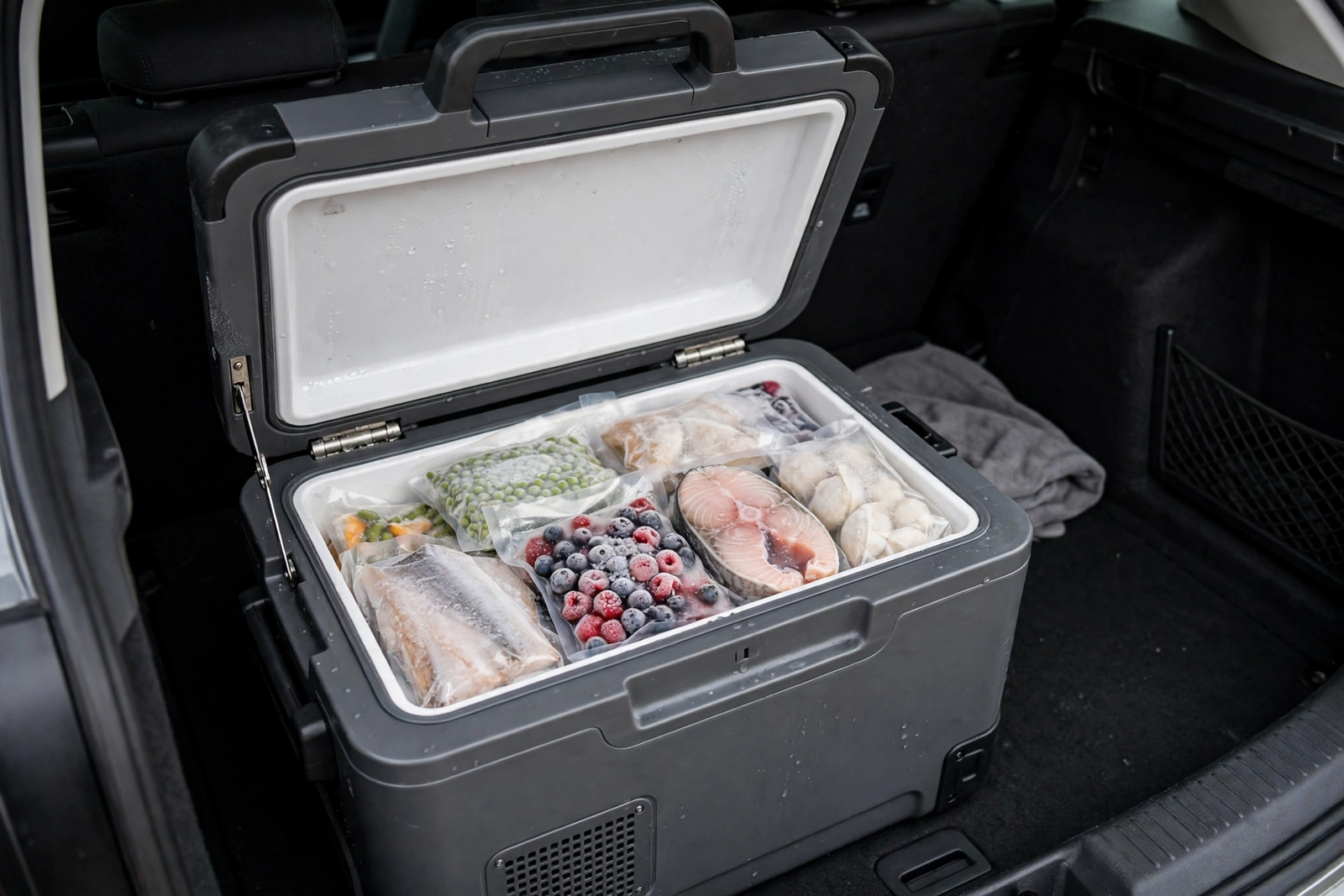
The C15 is the pick in this roundup for the driver with a small car and a short trip: compressor cooling, a set temperature, and battery protection, in the smallest box of the three. The minus 4 to 68 degree range, the 45-watt draw, the ECO and MAX modes and the battery protection are the listing’s claims. One honest flag belongs here too: the listing crawl for this model is months old and no live offer was confirmed when it was read, so check that the listing shows a live offer before you order.
Alpicool C15 Portable Car Freezer, 12 Volt Refrigerator, 16 Quart (15 Liter) Fast Cooling 12V Car Fridge -4℉~68℉, Car Cooler, 12/24V DC and 100-240V AC for Outdoor, Camping, RV, Truck, Boat on Amazon: compressor fridge-freezer, model C15/C20, 16-quart (15-liter) capacity, minus 4 to 68 degrees Fahrenheit, 45 watts, 12/24V DC and 100-240V AC power, ECO and MAX modes, 3-level battery protection. No live offer confirmed in the listing crawl — check the live offer before ordering.
Buy the Alpicool C15 if: you want compressor cooling in the smallest box of the three and you drive a car with limited trunk space. Confirm the listing shows a live offer first.
Thermoelectric vs Compressor: How the Cooling Differs
Thermoelectric and compressor are the two ways an electric cooler makes cold, and the choice decides what the cooler can actually do. A thermoelectric electric cooler, like the Koolatron P20, uses a Peltier module and a fan: it moves heat out of the box and cools to a fixed gap below the outside temperature, about 40 degrees Fahrenheit in the P20’s case, with no thermostat and no freezing. A compressor electric cooler, like the BougeRV CRPRO 21 and the Alpicool C15, uses a small compressor like a household fridge: it holds whatever temperature you set, down to freezing, whatever the weather outside.
The practical split follows from that. Thermoelectric suits short trips in mild weather, drinks and sandwiches, and drivers who want the lightest box and the lowest power draw. Compressor suits multi-day trips, hot weather, frozen food, and anyone who needs a set temperature they can trust. Our best car cooler for road trips article covers the holiday side of this category in more depth — four compressor fridges sized for family holiday driving — while this article covers the wider choice, including the thermoelectric option that the holiday roundup does not. The two articles share no cooler model: the holiday roundup’s picks are the BougeRV CR22, the EUHOMY 19-quart, the Alpicool CF45 and a SetPower 21-quart, and all four are compressor-only.
Power Draw and Your Car Battery: What an Electric Cooler Uses
Every electric cooler in this roundup runs on the car’s 12V supply, and that is the first thing to check before you order. The Koolatron P20 plugs into a 12V socket with an attached DC cord, the BougeRV CRPRO 21 runs on 12V or 24V DC, and the Alpicool C15 runs on 12V or 24V DC as well. The two compressor coolers also run on household AC power — the BougeRV on 110 to 240V AC and the Alpicool on 100 to 240V AC — so you can pre-cool those boxes at home before a trip, which saves the car battery on the first hour of driving. The Koolatron P20 runs on 12V DC only, and its household AC adapter is sold separately, per its manual.
Battery drain is the real worry, and the three coolers handle it differently. The Koolatron has no thermostat and no cut-off: it runs whenever it is plugged in, so unplug it when you park or it keeps drawing power from a socket that stays live. The Alpicool has three battery-protection levels that cut it off before the battery runs down, which is the listing’s claim, and the BougeRV’s compressor cycles on and off once the set temperature is reached, so it draws power in bursts rather than continuously. If your car has no 12V socket in the trunk, you will need a long cord or a power station, and our best car power inverters article covers the inverter side of running 12V gear from the car.
What Size Electric Cooler Fits Your Car
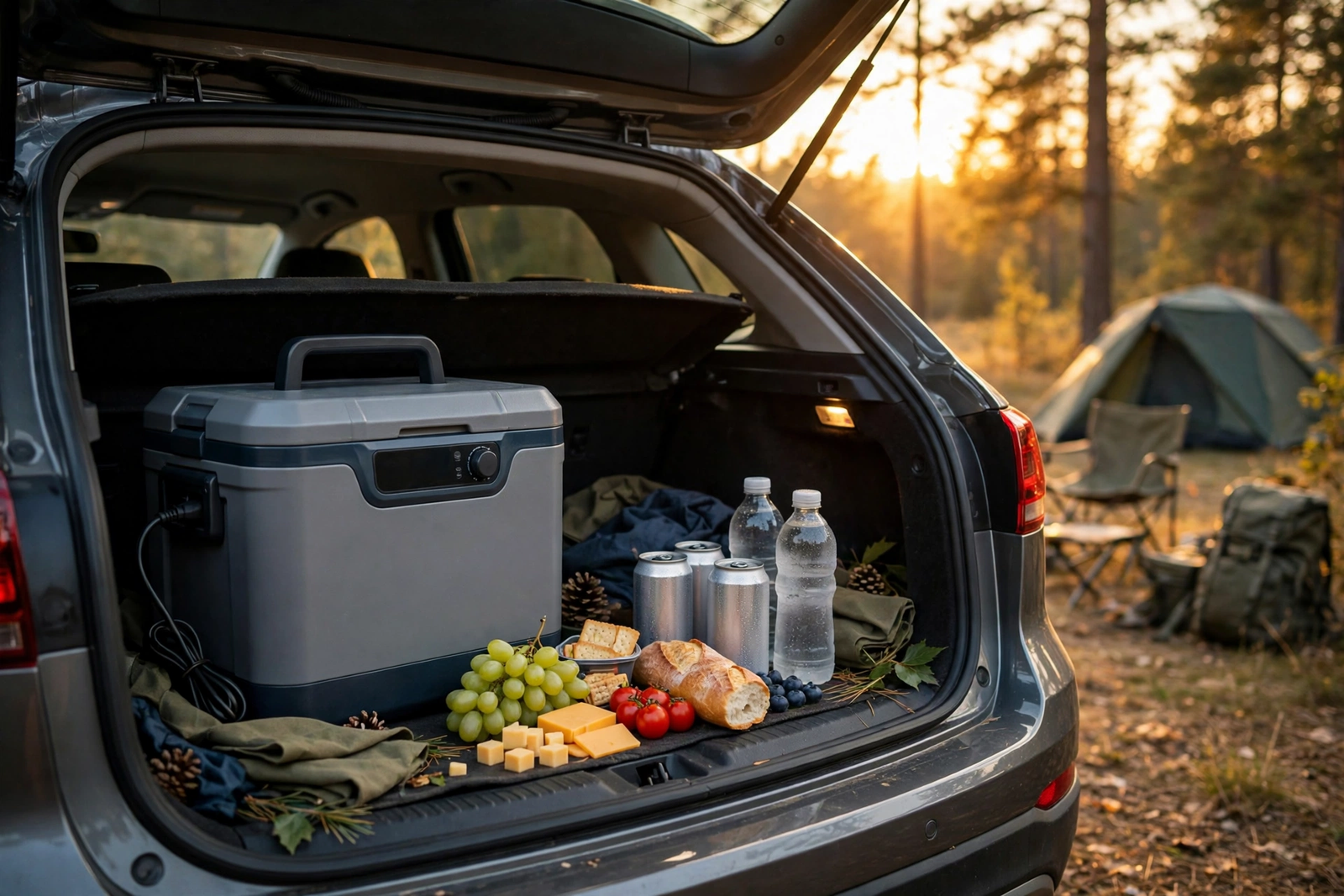
Size is the second thing to get right, because an electric cooler that does not fit the car is useless however well it cools. The three coolers here span the useful range for a car: the Alpicool C15 at 16 quarts is the smallest, for one person or a couple and a day of food and drinks; the Koolatron P20 at 18 quarts is the middle box, slim enough to fit between the front seats of most minivans; and the BougeRV CRPRO 21 at 21 quarts is the largest, for a family day out or a multi-day trip where frozen food has to stay frozen. Measure the space before you order — the trunk, the back seat, or the gap between the front seats — and compare it with the box dimensions on the listing.
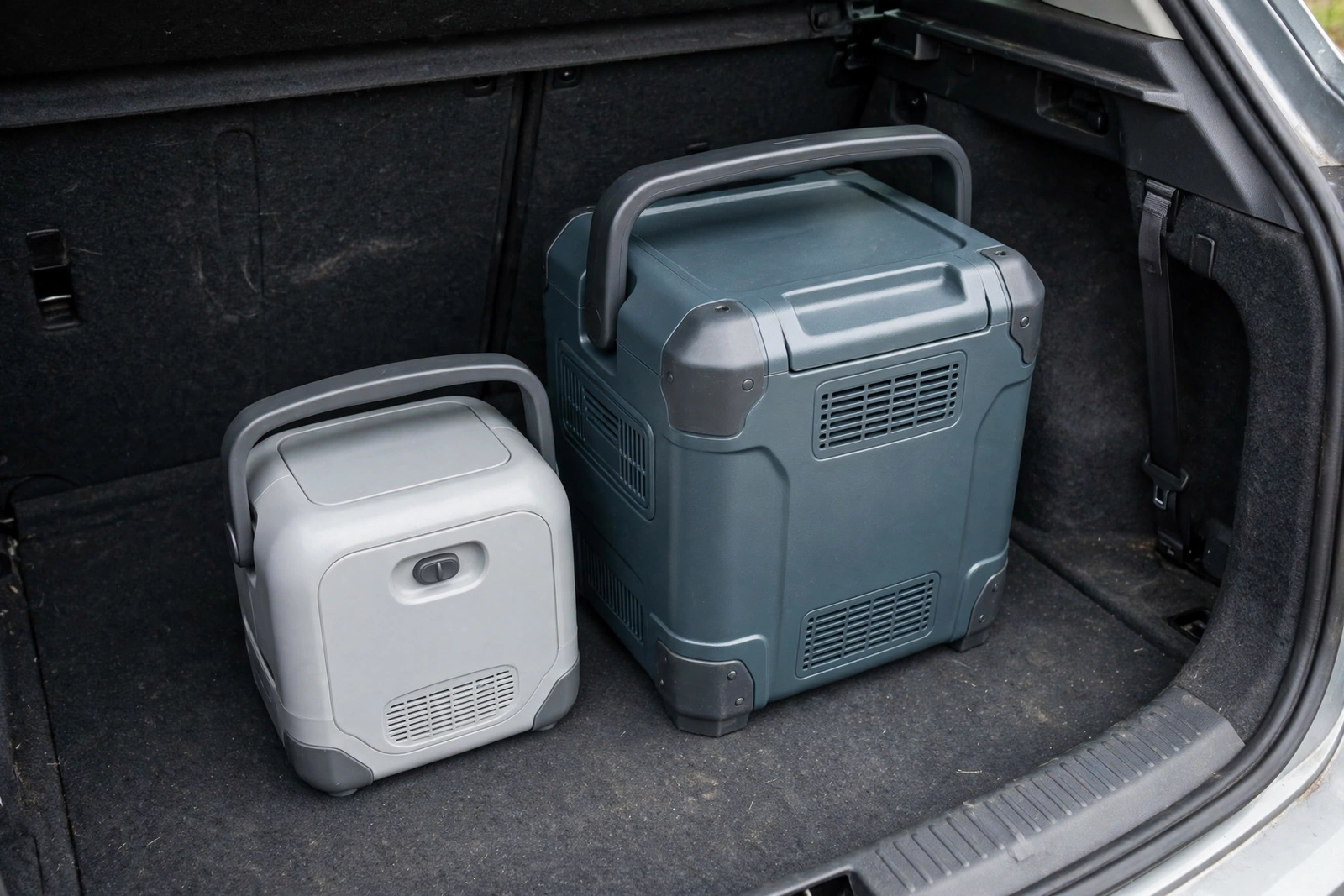
Think in cans and meals, not just quarts. The Koolatron listing says the P20 holds up to 23 standard cans, which is a useful yardstick: if your trip needs more than that, you need the larger box. A bigger electric cooler also needs more power and more trunk space, and it is heavier to carry, so do not buy the largest box by default. An RV fridge is a different job again — a built-in absorption fridge for a motorhome, not a portable box for a car — and our best RV refrigerators article covers those.
Packing an Electric Cooler So Food Stays Cold
An electric cooler works best when it is packed like a fridge, not like an ice chest. Pre-cool the box at home on household power before you load it — the two compressor coolers run on household AC, and the Koolatron needs its optional AC adapter, sold separately — and pre-chill the food and drinks in your kitchen fridge overnight: a compressor electric cooler holds a temperature far more easily than it creates one, and a thermoelectric electric cooler starts from the temperature of whatever you put in it. Load cold food into a cold box, and the cooler only has to hold the line.
Pack tight, with the things you need first on top. A full electric cooler holds its temperature better than a half-empty one, because cold food and drinks act as a cold store, and every time you open the lid warm air rushes in. Keep the lid closed between stops, keep the cooler out of direct sun — a box in a sun-baked trunk works harder than a box in the shade of the back seat — and leave a gap around the vents so the fan and the compressor can breathe. None of this needs extra gear; it is just the habit of treating the box as a fridge that travels with you.
Electric Cooler Mistakes to Avoid
The first electric cooler mistake is buying the wrong cooling type: a thermoelectric box for a multi-day summer trip, or a compressor freezer for a short commute. Match the technology to the trip — thermoelectric for short and mild, compressor for long and hot — and the rest of the decision gets easier. The second mistake is buying before checking the offer: all three listings in this roundup were read from months-old crawls with no live offer confirmed, so check that the listing shows a live offer before you order, and do not assume it is in stock.
The third mistake is leaving the cooler plugged in when you park on a socket that stays live: the Koolatron has no cut-off at all, and even a compressor cooler draws power in bursts. Unplug it, or use the battery protection if your cooler has it. The fourth is blocking the vents — a cooler pushed tight against the trunk wall cannot shed heat, and a thermoelectric box in particular needs airflow. And the fifth is expecting a thermoelectric electric cooler to freeze: it cools below the outside temperature, it does not freeze, and frozen food in a thermoelectric box will thaw by the end of a hot day.
Who Should Buy an Electric Cooler — and Who Should Not
Buy an electric cooler if: you drive long distances, camp, or carry food and drinks in the car often enough that the ice run has become a chore. A plug-in electric cooler ends the soggy sandwiches and the warm drinks, and saves the cost of the ice you would otherwise buy on every trip.
Buy with care if: your car has no 12V socket where the cooler will sit, or you only drive short distances. A cooler you cannot power is a heavy box, and a cooler for a ten-minute commute is overkill — a small insulated bag does that job. Measure the space, check the socket, and pick the cooling type for your longest trip, not your shortest.
Do not buy an electric cooler if: you want a fridge that lives in the car permanently, or you need to keep food frozen for days without power. A portable electric cooler is a travel appliance, not a built-in fridge, and it needs the car’s power while it runs. If the job is a motorhome fridge, the built-in absorption fridges in our RV refrigerator article are the right tool instead.
The Verdict
The best electric cooler for cars is the one whose cooling type matches your longest trip. The Koolatron P20 is the pick for short trips in mild weather — the simplest plug-in electric cooler of the three, with no settings and no ice. The BougeRV CRPRO 21 is the pick for real freezing and multi-day trips — a compressor electric cooler that holds an exact temperature whatever the weather. And the Alpicool C15 is the pick for small cars — compressor cooling and battery protection in the smallest box here.
Whichever cooler you choose, check three things before you order: whether the listing shows a live offer, whether your car has a 12V socket where the box will sit, and whether the box fits the space you measured. For the wider set of car-camping gear beyond cooling, our car camping guide covers the rest of the kit.
Frequently Asked Questions
What is the difference between a thermoelectric cooler and a compressor cooler?
A thermoelectric cooler uses a Peltier module and a fan to cool to a fixed gap below the outside temperature — about 40 degrees Fahrenheit for the Koolatron P20 — with no thermostat and no freezing. A compressor cooler uses a small compressor, like a household fridge, to hold whatever temperature you set, down to freezing, whatever the weather outside. Thermoelectric suits short trips in mild weather; compressor suits multi-day trips and hot weather.
Can an electric cooler freeze food?
A compressor electric cooler can: the BougeRV CRPRO 21 holds temperatures down to minus 8 degrees Fahrenheit and the Alpicool C15 down to minus 4 degrees Fahrenheit, per their listings, so both can freeze. A thermoelectric electric cooler cannot freeze — the Koolatron P20 cools to 40 degrees Fahrenheit below the outside temperature, which keeps drinks cold but never reaches freezing.
Will an electric cooler drain my car battery?
It can, if you leave it plugged into a 12V socket that stays live when the ignition is off. The Koolatron P20 has no cut-off, so unplug it when you park. The Alpicool C15 has three battery-protection levels that cut it off before the battery runs down, per its listing, and a compressor cooler draws power in bursts once it reaches its set temperature. If your car’s socket cuts power with the ignition off, the cooler only runs while the car is on, which is the safer setup.
Do electric coolers need ice?
No — none of the three coolers in this roundup needs ice. A thermoelectric cooler moves heat out of the box with a Peltier module and a fan, and a compressor cooler chills with a compressor, so both keep food cold without ice. That is the whole point of an electric cooler: no melting ice, no soggy food, and no ice run on the way home.
What size electric cooler do I need for a road trip?
For one person or a couple on a day trip, a 16-quart box like the Alpicool C15 is enough. For a family day out, an 18-quart box like the Koolatron P20 holds up to 23 standard cans, per its listing. For a multi-day trip, or frozen food that has to stay frozen, a 21-quart compressor box like the BougeRV CRPRO 21 is the safer pick. Measure the space in your car before you order, and think in cans and meals, not just quarts.
Can I plug an electric cooler into a household outlet?
Yes — the two compressor coolers here run on household AC power as well as car DC power: the BougeRV CRPRO 21 on 110 to 240V AC and the Alpicool C15 on 100 to 240V AC, per their listings. That lets you pre-cool the box at home before a trip. The Koolatron P20 runs on 12V DC from the car, and an AC adapter for household use is sold separately, per its manual.