Teslas are glasshouses. The Model Y and Model 3 wear some of the largest windshields on the road, and on a sunny day that glass turns the cabin into an oven — the dashboard, the steering wheel and the big touchscreen all soak up heat while the car sits parked. A universal shade leaves gaps at the corners, and gaps are where the heat gets in. The Spigen ZeroGap car sunshade is built on the opposite idea: a foldable, dual-layer shade cut to the exact shape of the Tesla Model Y and Model 3 windshields, with a cutout that wraps around the rearview mirror so the coverage runs edge to edge.
This review covers the fitment, the ZeroGap fit, the dual-layer material, the two-step install and storage, and the comparison with the KUST Tesla shade and the universal EcoNour. The Quick Pick table below has the short version.
As an Amazon Associate I earn from qualifying purchases.
| Pick | Product | Why it stands out | Check Price |
|---|---|---|---|
| Overall Winner | Spigen ZeroGap Windshield Sunshade for Tesla Model Y & Model 3 | ZeroGap edge-to-edge fit with mirror cutout, dual-layer nylon, fits Model Y and Model 3 including Highland and Juniper | |
| Best Budget | EcoNour Car Windshield Sun Shade | Universal foldable shade in 240T polyester, fits most cars, one-year warranty | |
| Premium Pick | KUST Windshield Sun Shade for Tesla Model Y and Model 3 | Custom fit for Tesla, four-layer construction, largest Tesla-shade review base |
Table of Contents
What the Spigen ZeroGap Car Sunshade Is — and What It Is Not
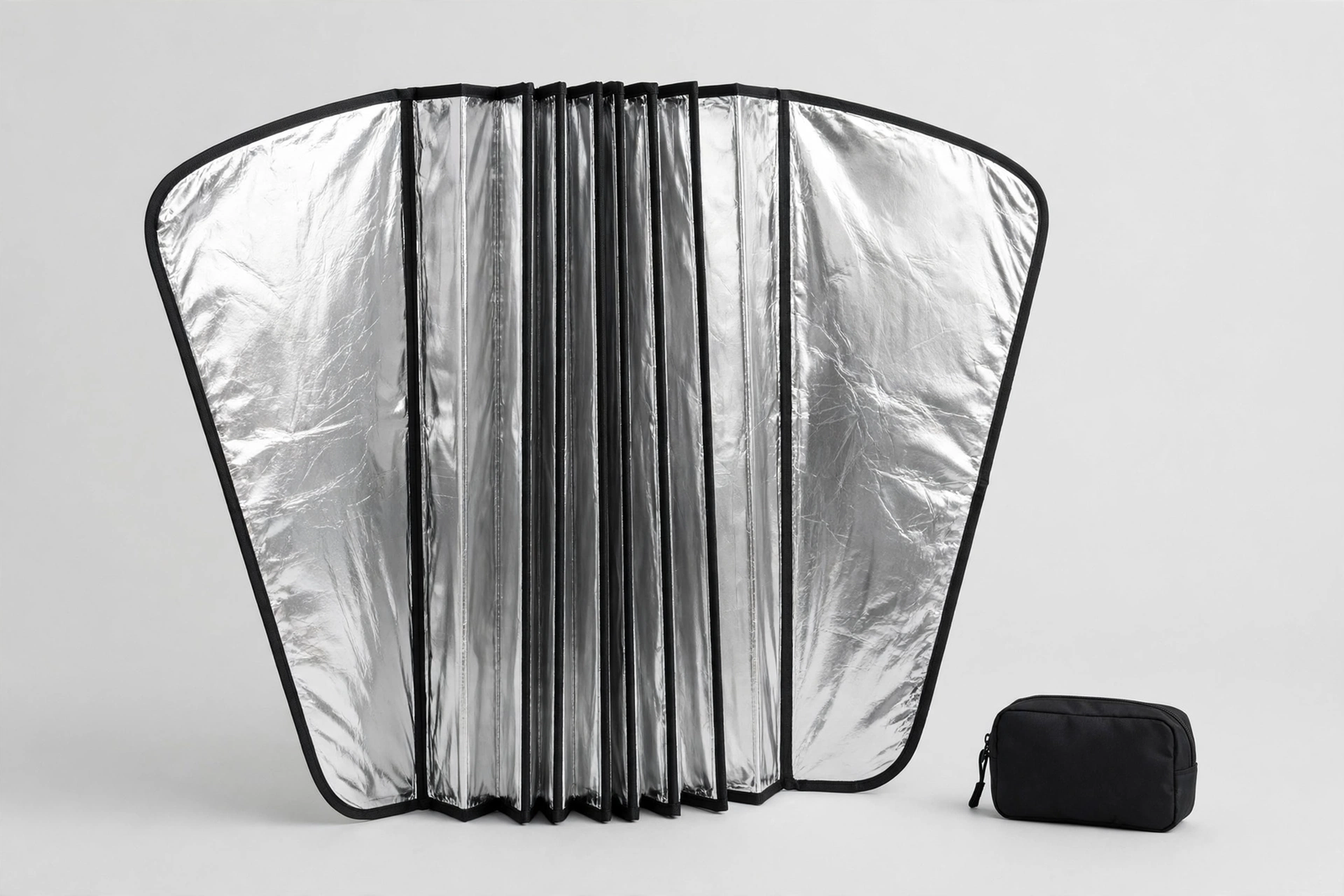
The Spigen ZeroGap is a foldable windshield shade made for exactly two cars: the Tesla Model Y and the Tesla Model 3. Its model number is ACP06160, and it is sold in black. The shade is a dual-layer design — a reflective outer surface with an insulating inner layer — made from thick nylon fabric that Spigen says holds its shape under intense sun. It folds down compactly and comes with its own storage pouch.
What makes it different from the generic foldable shades is the cut. Most car sun shades are universal rectangles sized to fit most windshields approximately, which means they fit no windshield exactly. The ZeroGap is precision-shaped to the Tesla windshield instead, including a close-fitting cutout for the rearview mirror. That is the whole idea behind the name: eliminate the exposed edges and light gaps, and more sunlight stays out.
It is not a roof shade — it covers the windshield only, and a Tesla’s glass roof is a second heat path this product does nothing about. It is not a driving aid: like every windshield shade, it is for parked cars only and must be folded away before you drive. And it is not universal — sell the Tesla and this shade does not follow you.
One more thing to know: the ZeroGap is not the only Spigen Tesla shade. Spigen also sells a separate triple-coated CryoShade, and a regional Amazon listing for this same ASIN describes a triple-coated CryoShade under the same model number, ACP06160 — while the ZeroGap listing itself says dual-layer. Check that the listing and box say ZeroGap and dual-layer before ordering.
Fitment: Which Model Y and Model 3 Years It Covers
Fitment comes first with any custom-cut shade: a shade cut for the wrong generation is just an expensive universal shade. The ZeroGap listing states compatibility with the Model 3 and Model Y for model years 2016 through 2026, explicitly including the Model 3 Highland refresh (2024–2026), the Model Y Juniper refresh (2025–2026), and the six-seat Model Y L Premium.
Read those years with care, because the listing’s start year does not line up with the cars’ history: the Model 3 was never a 2016 model year, and the Model Y did not exist before 2020 — so a “2016” start year cannot be literal. The sensible reading is that the listing uses 2016 as loose shorthand for “every Model 3 and Model Y ever made.” Our live KUST Tesla shade review uses the cleaner 2017–2026 span.
Verify your exact model year on the live listing before you order, and be extra careful if your car is a refresh — a Highland Model 3 and a pre-refresh Model 3 share a badge, not a windshield. If you own a Model S, a Model X, a Cybertruck, or any non-Tesla, this shade is not for you; our best windshield sun shade roundup covers universal and other custom-fit options for everything else.
The ZeroGap Fit: Edge-to-Edge Coverage and the Mirror Cutout
In a sunshade windshield pairing, fit is the performance. A shade that covers ninety percent of the glass still lets a shaft of sun through the uncovered ten percent, and on a Tesla that shaft lands on the dashboard — the hottest surface in the car. The ZeroGap’s answer is a precision-shaped cut running edge to edge, including the corners where universal shades gap first, with a close-fitting cutout around the rearview mirror.
The mirror cutout matters more than it sounds. On universal shades the mirror is the failure point: the shade bunches around the mount or leaves a wedge of uncovered glass beside it, and that wedge is where the afternoon sun comes through. By cutting the shade around the mirror, Spigen removes the wedge — and the shade looks factory-fitted once installed rather than draped.
One honest limit: a windshield shade only covers the windshield. Teslas have a huge glass roof, and on the worst days that roof is the other major heat source — many owners pair a windshield shade with a roof shade, as our KUST Tesla shade review notes. The ZeroGap does its one job well, but it does not make the car cool on its own; pre-cool through the app on extreme days.

Dual-Layer Material: What Spigen Says It Blocks
If you are shopping for a sunshade for car use, the first question is fit — the second is what the material does. Spigen describes the ZeroGap as a dual-layer design: a reflective outer surface that bounces sunlight back out, and an insulating inner layer that slows the heat that gets through. The fabric is thick nylon, which Spigen says holds its shape under intense sun rather than going limp after a summer.
Spigen’s stated purpose is protection, not just comfort: the listing says the shade helps block sunlight and reduce heat buildup before it reaches the cabin, protecting the dashboard, steering wheel, touchscreen and belongings from the fading, cracking and warping that prolonged sun exposure causes. That is the maker’s claim — we have not measured cabin temperatures ourselves, and this review claims no test results.
The National Weather Service reports a parked car’s interior can rise 20 degrees Fahrenheit in 10 minutes, and 50 degrees within an hour. A reflective shade does not refrigerate the car — it intercepts the direct sunlight that drives the fastest heat gain. Two layers beat one only if both do their part, which is why the nylon’s thickness and the coating’s quality matter more than the layer count on the box.
Installation, Folding, and Storage
Installation is the ZeroGap’s most user-friendly feature: a fast two-step process, per Spigen — secure the centre strap around the rearview mirror, then lower the sun visors. That is the whole job — no suction cups, no clips, no tools. The strap holds the top edge, the visors pin the shade, and removal reverses it — seconds, once you have done it twice.
That strap is also the difference between this shade and the KUST, which installs by unfolding and seating the top edge under the headliner with the visors holding it. Both take about thirty seconds, but the ZeroGap’s mirror strap gives a positive anchor rather than relying on friction and fit alone — useful on a steeply raked Tesla windshield where gravity is always trying to slide the shade down.
Storage is handled by an included pouch. The shade folds compactly into the pouch, and the pouch has an exterior Velcro panel that attaches to carpeted surfaces, so it stays put instead of rolling around — a small detail that solves a real annoyance.

Spigen ZeroGap vs the Alternatives (KUST, EcoNour)
The honest rival is the KUST Tesla shade — the other custom-fit shade for these exact two cars, and the one our KUST Tesla shade review calls the best-selling Tesla-specific shade. The KUST is cut for 2017–2026 Model Y and Model 3 windshields, including the Juniper and Highland refreshes, with four layers: 250T reflective polyester, double reflective plus double thermal. Its review base is the largest of any Tesla-specific shade we cover — 4.5 stars across more than 31,000 reviews in our research snapshot. Against that, the ZeroGap offers dual-layer nylon, the mirror cutout, and the mirror-strap anchor. The KUST wins on layer count and buyer validation; the ZeroGap wins on the mirror cutout and strap fixing.
The EcoNour is the other direction: a universal foldable shade in 240T polyester with a silver reflective coating, sized 64 by 32 inches in the Medium variant, backed by a one-year warranty and carrying the largest review base in our best windshield sun shade roundup — 4.3 stars across more than 127,000 reviews. Its listing claims 99 percent heat blockage. The EcoNour fits almost any car and follows you to your next car — but on a Tesla it gaps at the corners.
A price-tracking site reports an 8.8 out of 10 score for the ZeroGap based on 1,182 reviews — a tracker snapshot, not a live Amazon rating, and a smaller buyer base than the KUST’s.
Who Should Buy It — and Who Should Skip It
Buy the ZeroGap if you own a Model Y or a Model 3, park in the sun most days, and want a shade that looks factory-fitted rather than draped. The mirror cutout, the strap anchor and the edge-to-edge cut are genuinely useful on a Tesla’s steep windshield, and the pouch with its Velcro panel gives the shade a home between uses instead of letting it slide around the trunk. It also suits buyers who trust the Spigen name and want a two-step install with no suction cups to fail in summer heat. For the rest of the heat system, our windshield cover roundup covers tint, film and side-window shades.
Skip it if you drive anything other than a Model Y or a Model 3 — the custom cut is the product, and on any other car it is the wrong shape. Skip it too if you want the deepest buyer validation: the KUST has more than 31,000 reviews behind its fit, and the ZeroGap’s buyer base is far smaller. And skip it if you need full-cabin heat control from one purchase — a car window sun shade for the side glass and a roof shade are separate buys.

Verdict
The Spigen ZeroGap car sunshade does one idea properly: a shade cut for exactly two windshields, with a mirror cutout, a mirror-strap anchor and a storage pouch that stays put. Its dual-layer nylon build and two-step install are honest, practical features, and its fitment covers Model Y and Model 3, including Highland, Juniper and the six-seat Model Y L Premium. Its limits are equally clear: it fits nothing else, it covers the windshield only, and its buyer base is far smaller than the KUST’s. Verify the listing says ZeroGap and dual-layer before you order, given the model-number conflict with the triple-coated CryoShade. Accept those facts and this is a strong buy for a Tesla owner who parks in the sun; if any of them is a deal-breaker, the KUST and EcoNour above are the honest next steps.
Frequently Asked Questions
Does the Spigen ZeroGap fit the Model Y and Model 3?
Yes. The ZeroGap is precision-shaped for the Tesla Model Y and Model 3 windshields, including the Model 3 Highland refresh for 2024, 2025 and 2026, the Model Y Juniper refresh for 2025 and 2026, and the six-seat Model Y L Premium. Verify your exact model year against the fitment years on the live listing before ordering, because refresh generations can have different glass.
Will the ZeroGap fit other Teslas or cars?
No. The custom cut is Model Y and Model 3 specific — not the Model S, Model X, or Cybertruck, and not non-Tesla vehicles. The shade is shaped for those two windshields only, so on any other car it is the wrong shape. Universal shades cover everything else.
How do you install the Spigen ZeroGap?
Installation takes two steps and no tools: secure the centre strap around the rearview mirror, then lower the sun visors to hold the shade against the glass. Removal reverses it. The whole routine takes seconds once you have done it twice.
What is the ZeroGap made of?
The ZeroGap listing describes a dual-layer design made from thick nylon fabric: a reflective outer surface that bounces sunlight back out, and an insulating inner layer that slows the heat that gets through. Spigen says the fabric is made to maintain its shape and performance under intense sun exposure. Note that a regional listing ties this model number to a triple-coated CryoShade — the ZeroGap listing itself says dual-layer, so confirm the listing says ZeroGap and dual-layer before ordering.
Where do you store the ZeroGap between uses?
The shade folds compactly into an included storage pouch, and the pouch has an exterior Velcro panel that attaches to carpeted surfaces, so it stays put in the trunk or cabin instead of rolling around. Keep the pouch somewhere you can reach it easily, and the shade will get used every day instead of twice a summer.
Should I buy the Spigen ZeroGap or the KUST Tesla shade?
Both are custom-fit shades for the Model Y and Model 3, so the choice is about details. The KUST has a four-layer construction and a far larger review base at 4.5 stars across more than 31,000 reviews in our research snapshot. The ZeroGap counters with a mirror cutout, a mirror-strap anchor, and a storage pouch with a Velcro panel. If the largest buyer validation matters most, choose the KUST; if the mirror cutout and strap fixing matter most, choose the ZeroGap.