Best Electric Car Charger for Home: 4 Level 2 Picks That Actually Fit Your Garage
An electric car charger for home turns overnight parking into a full battery every morning — but only if it matches your house, your car, and your patience. A Level 2 charger on a 240-volt circuit fills a typical EV in 4 to 8 hours, against the 30-plus hours a standard wall outlet needs, and the right unit is the one your panel can support, your car can accept, and your garage can reach. This roundup covers four verified Level 2 chargers: the simple rugged one, the smart one, the WiFi one, and the compact one.
The short answer: for most garages, the Grizzl-E Classic is the overall pick — a simple 40-amp plug-in charger in a metal case with no app to babysit. The ChargePoint Home Flex is the smart pick if you want app control and scheduling; the Emporia is the WiFi pick if you want to watch your energy use; the Wallbox Pulsar Plus is the compact pick if space is tight. All four use the J1772 connector, and all four need a licensed electrician for the 240-volt circuit.
As an Amazon Associate I earn from qualifying purchases.
Quick Pick: Best Electric Car Charger for Home
| Pick | Product | Best For | Check Price |
|---|---|---|---|
| Overall Winner | Grizzl-E Classic Level 2 EV Charger, 40 Amp, NEMA 14-50 Plug, J1772 | Simple and rugged: metal case, no app, plug-in install | Check Price on Amazon |
| Best Smart Charger | ChargePoint Home Flex Level 2 EV Charger, J1772, NEMA 14-50 Plug | App control, scheduling, and adjustable amperage from 16 to 50 amps | Check Price on Amazon |
| Best WiFi Pick | Emporia Level 2 EV Charger, NEMA 14-50, J1772, 25-Foot Cable | WiFi energy monitoring and 48 amps when hardwired | Check Price on Amazon |
| Best Compact Pick | Wallbox Pulsar Plus Level 2 EV Charger, 40 Amp, J1772, 25-Foot Cable | The smallest smart charger here, for tight garage walls | Check Price on Amazon |
Table of Contents
How to Choose an Electric Car Charger for Home
Start with the circuit, not the charger. Every electric car charger for home here is a Level 2 unit on 240 volts, needing a dedicated circuit with spare capacity: 40 amps needs a 50-amp circuit, 48 amps a hardwired 60-amp circuit. If your panel is full, have a licensed electrician check it before you order anything.
Next, check the connector on your electric car charger for home: all four picks here use the J1772 connector, which fits most non-Tesla EVs. Tesla drivers use the supplied J1772 adapter. NACS versions exist, but the listings linked here are J1772 — confirm the connector before you order.
Then decide how smart your electric car charger for home needs to be. A dumb charger like the Grizzl-E Classic just charges. A smart electric car charger for home adds app control, scheduling, and energy tracking — worth it if your electricity is cheaper overnight. Finally, measure the cable run: it must reach the car’s charge port without stretching across the floor. Three ship with a 24- or 25-foot cable and the ChargePoint with a 23-foot cable (per the datasheet and manual), which covers most garages, but a charge port on the far side of a wide car still deserves a tape measure before you buy.
Grizzl-E Classic: Best Electric Car Charger for Home Overall
The Grizzl-E Classic is the overall winner because it does the fewest things wrong: a 40-amp Level 2 charger in a heavy-duty metal case, NEMA 14-50 plug, 24-foot cable, J1772 connector. It is UL certified, its enclosure rated NEMA-4 against water and dust, and built in Canada for cold weather. No app, no WiFi, no screen: plug the car in and it charges.
The Classic’s amperage is adjustable in steps — 16, 24, 32 or 40 amps — so your electrician can set it to match your circuit. It is also the most portable: unplug it and it travels with you if you move. The honest limit is its simplicity: no scheduling, no energy tracking, no remote control. If your electricity is cheaper overnight, schedule the charge in the car instead. The Grizzl-E Classic is the pick for the buyer who wants an electric car charger for home, not a gadget.
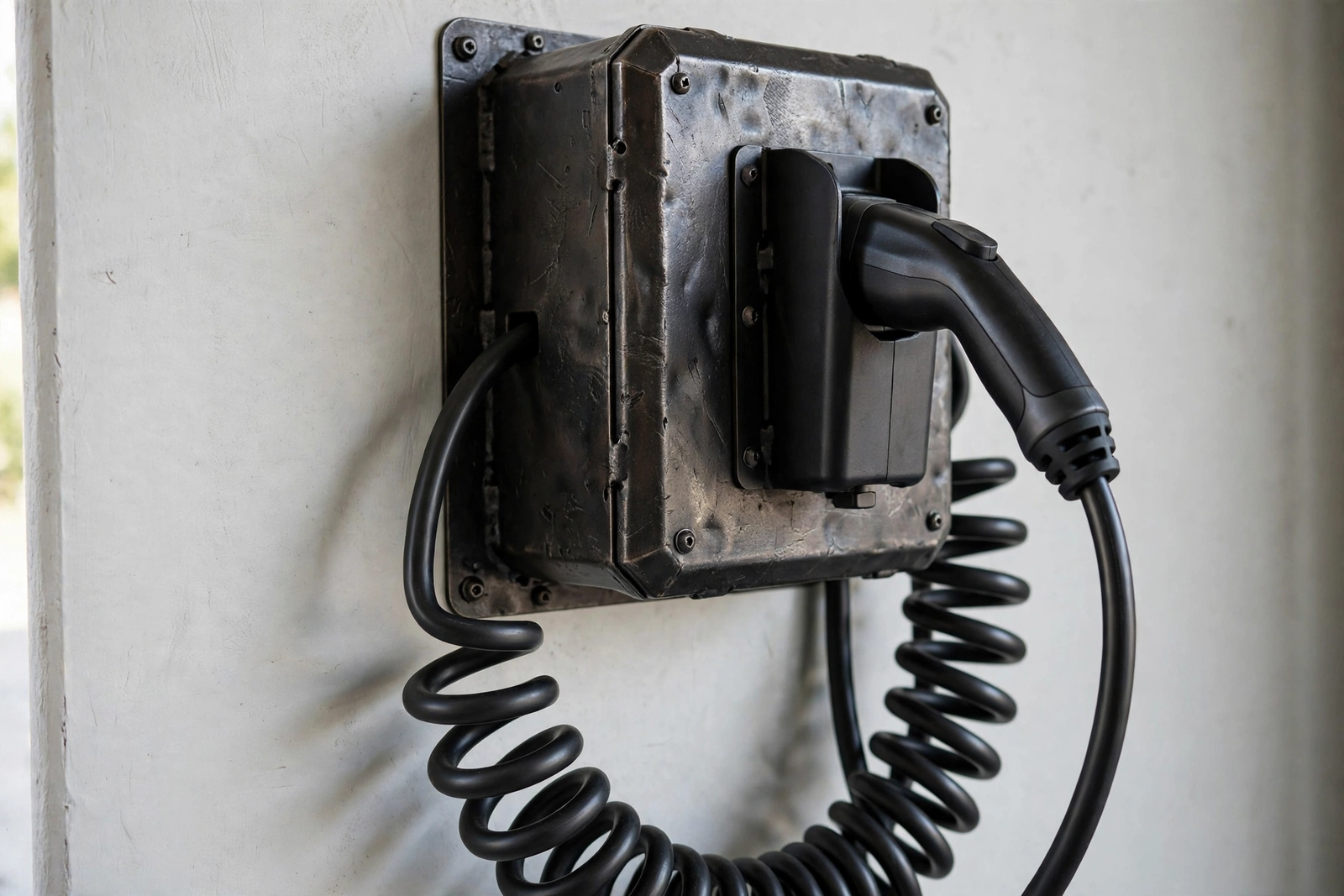
Grizzl-E Classic Level 2 EV Charger on Amazon: 40 amp, NEMA 14-50 plug, 24-foot cable, J1772 connector, UL certified, metal case.
ChargePoint Home Flex: Best Smart Electric Car Charger for Home
The ChargePoint Home Flex is the smart pick. This is the J1772 plug-in version, model CPH50-NEMA14-50-L23, on a NEMA 14-50 plug, with app control, scheduling, and amperage adjustable from 16 to 50 amps. On the plug it charges at up to 40 amps; hardwired, the same family reaches 50 amps — the fastest charge in this roundup. It is UL certified, with the most polished app of the four.
What you pay for over the Grizzl-E is control: set the charge window once and the car fills on cheap overnight power, and the app shows charging history and lets you adjust the amperage without opening the unit. The trade is that the Home Flex is a connected product: it wants WiFi and an account. If you will not use the smart features, the Grizzl-E gives you the same electrons for less fuss. Buy the Home Flex if you want an electric car charger for home you will actually schedule and track; otherwise the Classic’s simplicity is worth more.
ChargePoint Home Flex Level 2 EV Charger on Amazon: J1772, NEMA 14-50 plug, model CPH50-NEMA14-50-L23, app control with amperage adjustable from 16 to 50 amps.
Emporia Level 2: Best WiFi Electric Car Charger for Home
The Emporia Level 2 is the WiFi pick, and the fastest plug-in charger in this roundup when hardwired — the ChargePoint hardwired at 50A is faster overall. This is the NEMA 14-50 version, model EMEVSE1: a J1772 charger, 25-foot cable, WiFi, and the Emporia app, which tracks how much energy each charge uses and what it costs. On the plug it charges at up to 40 amps (up to 38 miles of range per hour per the listing); hardwired it reaches 48 amps (up to 46 miles per hour). UL certified, sold by Emporia Corp. with Amazon fulfilment.
For an electric car charger for home, Emporia’s edge is energy visibility: the app shows the cost of every session — the question every new EV owner asks. It also pairs with Emporia’s home energy monitors. The trade is the same as the ChargePoint’s, one step further: a connected product whose best features assume WiFi and an account. The honest note is the variant trap: the same charger in white and black, plug and hardwired, plus a newer Pro line. The ASIN here, B09ZNN3JB7, is the white NEMA 14-50 plug version — check the colour and plug type before you order.
Emporia Level 2 EV Charger on Amazon: NEMA 14-50 plug, J1772, 25-foot cable, WiFi, 40 amps on the plug and 48 amps hardwired.
Wallbox Pulsar Plus: Best Compact Electric Car Charger for Home
The Wallbox Pulsar Plus is the compact pick — the smallest smart charger in this roundup, in a housing smaller than a lunchbox. This is the 40-amp J1772 version, model PUP1-U-1-5-N-002-A: a 240-volt Level 2 charger delivering up to 9.6 kW, with a 25-foot cable, WiFi and Bluetooth, and the myWallbox app. It is UL and Energy Star certified, and assembled in the USA. A 48-amp hardwired version exists; the linked listing is the 40-amp J1772 version.
Compact does not mean basic: this electric car charger for home has the ChargePoint’s smart features — scheduling, app control, and power-sharing if you install two units — in far less wall. The trade is less room for cable storage, so plan a hook or holster for the 25-foot cable. A cable organizer keeps the charging cable off the floor. It is also the charger most likely to be bought in the wrong variant: 40- and 48-amp, J1772 and NACS, plug-in and hardwired. The ASIN here, B08H2LYFHX, is the 40-amp J1772 version — confirm both before you order.
Wallbox Pulsar Plus Level 2 EV Charger on Amazon: 40 amp, J1772, 25-foot cable, WiFi and Bluetooth, UL and Energy Star certified.
Side-by-Side: The Four Chargers Compared
Three differences: amps, connection, and smarts. The table is the whole comparison on one screen — amperage and plug type per the linked listing for each ASIN, J1772 on all four.
| Spec | Grizzl-E Classic (B082LMVSLY) | ChargePoint Home Flex (B07WXZDHGV) | Emporia Level 2 (B09ZNN3JB7) | Wallbox Pulsar Plus (B08H2LYFHX) |
|---|---|---|---|---|
| Max amperage | 40 amps, adjustable 16/24/32/40 | Up to 50 amps hardwired; 40 amps on the NEMA 14-50 plug | 40 amps on the plug; 48 amps hardwired | 40 amps (9.6 kW); a 48-amp hardwired version exists |
| Plug type | NEMA 14-50 plug | NEMA 14-50 plug | NEMA 14-50 plug | NEMA 14-50 plug |
| Connector | J1772 | J1772 | J1772 | J1772 |
| Cable length | 24 feet | 23 feet (datasheet + manual) | 25 feet | 25 feet |
| Smart features | None — no app, no WiFi | App control, scheduling, adjustable amperage | WiFi, app energy monitoring and cost tracking | WiFi, Bluetooth, app scheduling, power-sharing |
| Enclosure | Metal case, NEMA-4 rated | Not stated in the sources consulted | Not stated in the sources consulted | Compact housing, NEMA Type 4 rated (48-amp version) |
| Certification | UL certified | UL certified | UL certified | UL and Energy Star certified |
| Best for | Simple, rugged home charging | Smart scheduling and control | Energy monitoring and fastest plug-in charging | Tight garage walls |
Plug-In vs Hardwired: Which Install Fits Your Home
All four chargers here are linked as plug-in NEMA 14-50 versions, and for most homes that is the right call. A plug-in electric car charger for home needs one thing: a NEMA 14-50 outlet on a dedicated 240-volt circuit, installed by a licensed electrician. Once the outlet is in, the charger mounts on the wall, plugs in, and charges at up to 40 amps. If you move, you unplug it and take it with you; if it fails, you unplug it and swap it.
Hardwired is the pick for maximum speed and permanence: it connects directly to the panel, removing the plug as a failure point and unlocking the higher amperages — 48 amps on the Emporia and the Wallbox 48-amp version, 50 amps on the ChargePoint Home Flex. The cost is permanence — the charger stays with the house — and a bigger install. Rule of thumb: plug-in if you rent or might move; hardwired if you own the home and want the fastest charge. Our best home EV charger for garage guide covers the install steps for both methods.
Installation: What to Ask Your Electrician
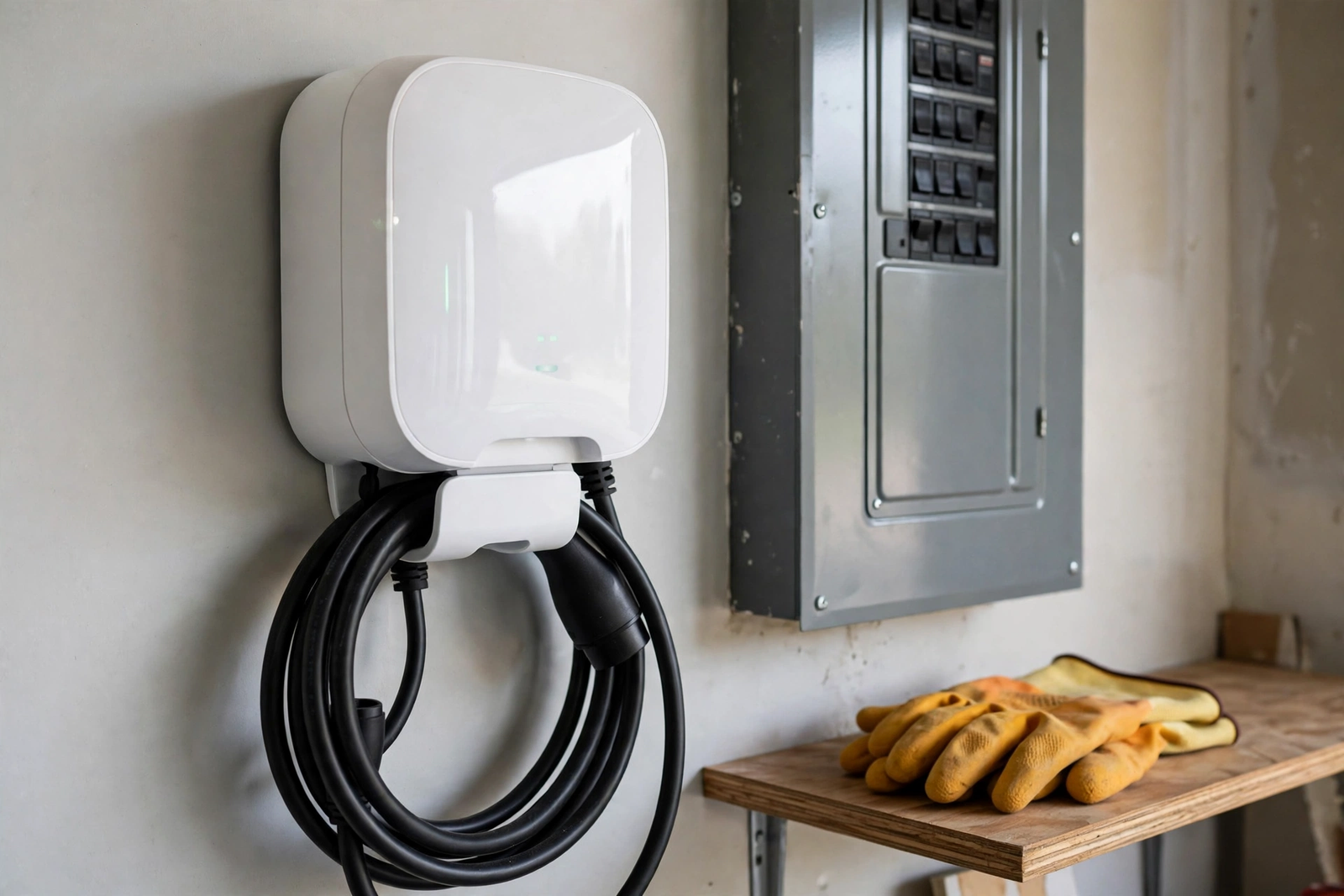
Mounting an electric car charger for home on the wall is a DIY job. The 240-volt circuit is not — this section gives you the questions, not the wiring instructions. First, ask whether your panel has spare capacity: a charger is a continuous load, so the circuit must be sized above the draw — a 50-amp circuit supports 40 amps of charging, a 60-amp circuit 48. Second, ask about the wire run: the shorter it is, the cheaper the install — mount it on the wall nearest the panel and the car’s charge port. Third, ask whether your area needs a permit — most codes require one, and your electrician usually handles it.
Fourth, have the electrician set the amperage on your electric car charger for home to match the circuit, not the charger’s maximum — a 40-amp charger on a 40-amp circuit is a fire risk. Fifth, check the ground-fault protection: most modern chargers have it built in. And the rule that never changes: never use a standard extension cord with an EV charger — they cannot handle the sustained current and can melt or catch fire. If the cable does not reach, move the charger. Hire a licensed electrician for the panel work; the rest of installing an electric car charger for home is a wall mount and a plug.
Who Should Buy Which Home EV Charger
Buy the Grizzl-E Classic if: you want a charger that behaves like an appliance — mount it, plug it in, forget the app exists. It is also the pick for cold climates and outdoor installs.
Buy the ChargePoint Home Flex if: you want the most polished smart charger, with scheduling that saves money on overnight rates.
Buy the Emporia Level 2 if: you want to see what charging costs, session by session, and 48 amps when hardwired here.
Buy the Wallbox Pulsar Plus if: your garage wall is crowded and you want the smallest smart charger here.
Buy no electric car charger for home at all if: you drive under 30 miles a day and your car came with a portable Level 1 cord — a standard outlet adds 3 to 5 miles of range per hour. Step up to Level 2 when the overnight math stops working.
The Verdict
The best electric car charger for home is the one your house can support and your car can use — for most homes, the Grizzl-E Classic: a simple 40-amp plug-in charger in a metal case, with no app to maintain. It charges a typical EV overnight, unplugs if you move, and has the fewest parts to go wrong.
But the right electric car charger for home depends on what you value. If your electricity is cheaper overnight, the ChargePoint Home Flex pays for its smarts. If you want to know what every charge costs, the Emporia’s energy monitoring is the reason to buy it. If your garage wall is tight, the Wallbox Pulsar Plus fits where the others will not. Whichever electric car charger for home you buy, get the panel checked first, hire a licensed electrician for the 240-volt circuit, and confirm the J1772 connector on the listing — the charger is the easy part; the circuit is the job.
Grizzl-E Classic Level 2 EV Charger on Amazon: 40 amp, NEMA 14-50 plug, 24-foot cable, J1772 connector.
Frequently Asked Questions
What is the best electric car charger for home?
The best electric car charger for home for most drivers is a Level 2 unit on a 240-volt circuit. In this roundup the Grizzl-E Classic is the overall pick: a simple 40-amp plug-in charger in a metal case with no app to babysit. If you want app control and scheduling, the ChargePoint Home Flex is the smart pick. If you want energy monitoring, the Emporia is the WiFi pick. If space is tight, the Wallbox Pulsar Plus is the compact pick.
Do I need a hardwired charger or a plug-in one?
Most homes are best served by a plug-in Level 2 charger on a NEMA 14-50 outlet: it charges at up to 40 amps, installs with one outlet, and unplugs if you move. A hardwired charger is the pick if you want the maximum speed — up to 48 or 50 amps — or a permanent, neater install with no plug to loosen. Either way, hire a licensed electrician for the 240-volt circuit and check whether your area needs a permit.
Will a J1772 charger fit my Tesla?
Yes, with the adapter. All four chargers in this roundup use the J1772 connector, which fits most non-Tesla EVs directly. Tesla vehicles use the NACS connector, so Tesla drivers charge with the J1772 adapter supplied with the car. NACS versions of some of these chargers exist — the linked listings here are the J1772 versions, so confirm the connector on the listing before you order.
How long does it take to charge an EV at home?
A Level 2 electric car charger for home takes 4 to 8 hours for a full charge on a typical 60 kWh battery with a 40-amp charger. Larger batteries or lower amperage settings take longer. A standard wall outlet adds only 3 to 5 miles of range per hour, so it suits low-mileage drivers only. Check your vehicle’s manual for its specific acceptance rate — the car, not the charger, sets the ceiling.
How many amps do I need for a home EV charger?
A 40-amp charger covers most homes and most EVs: it fills a typical battery overnight. A 48-amp charger is faster but needs a hardwired 60-amp circuit and a vehicle that accepts 48 amps. Before you buy, have a licensed electrician confirm your panel has the spare capacity — a charger is a continuous load, so a 50-amp circuit supports 40 amps of charging, and a 60-amp circuit supports 48.
Can I install a home EV charger myself?
Mounting the unit on the wall is a DIY job; the 240-volt circuit is not. A new 240-volt circuit needs a dedicated breaker, correctly sized wire, and usually a permit, and mistakes at this voltage are a fire risk. Hire a licensed electrician for the panel work, and have them confirm the amperage setting on the charger matches your circuit. Never use a standard extension cord with an EV charger.