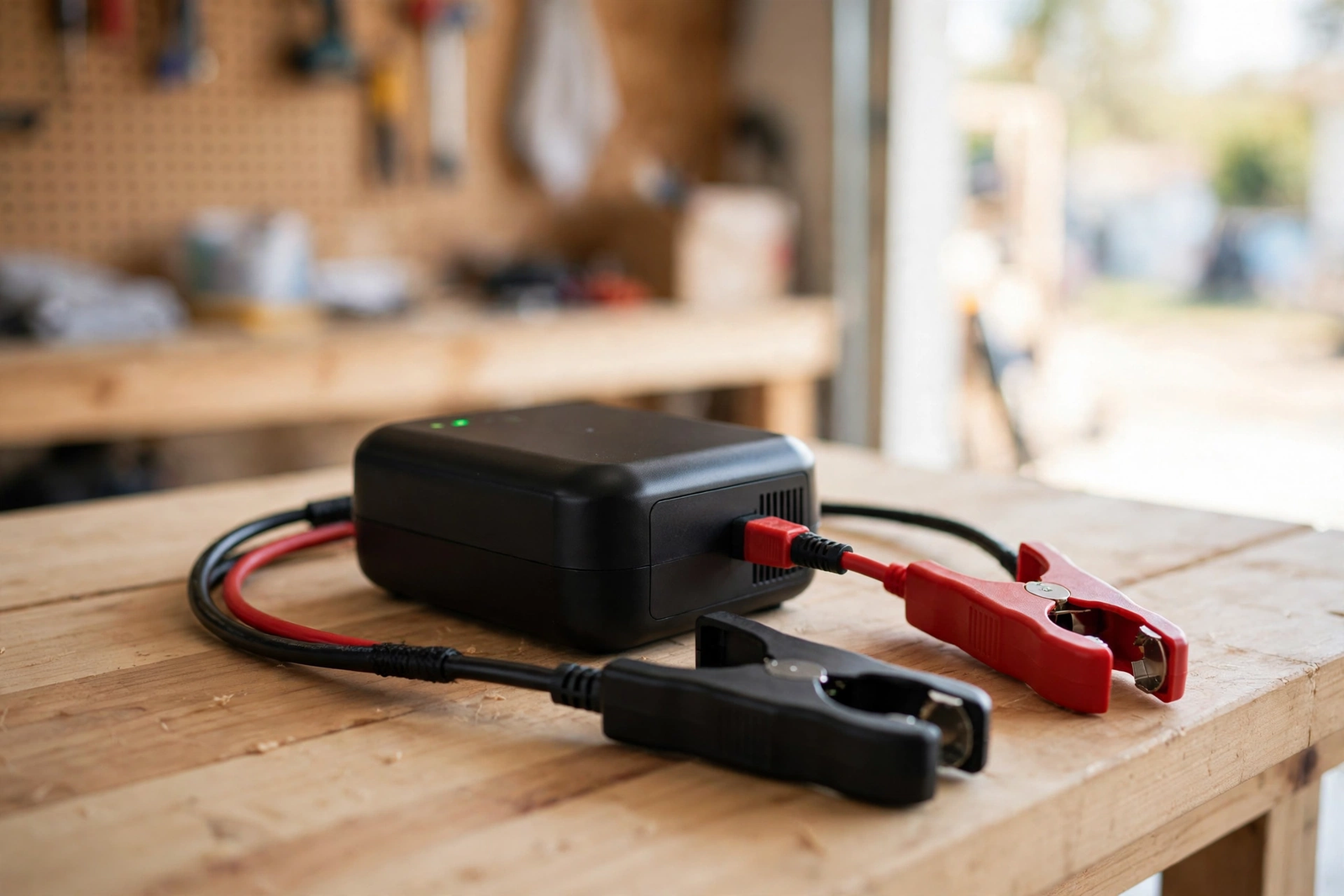
A dead battery is a slow problem with a slow fix. The NOCO GENIUS2 is a 2-amp 6V/12V smart battery charger, maintainer, and desulfator built for the small batteries most households own: motorcycles, ATVs, lawn tractors, classic cars, and boats in winter storage. It charges lead-acid batteries up to 40 amp-hours and lithium batteries too, maintains batteries of any size, and can revive a dead battery from zero volts with Force Mode. The honest limit is in the headline number: 2 amps is slow, and a flat full-size car battery is outside what this smart battery charger is rated to recharge.
In this review of the NOCO GENIUS2 smart battery charger, we cover what 2 amps means in charging times, how the six charging modes work, what Force Mode and the desulfator can and cannot do, and how it compares with the NOCO GENIUS5 and the Battery Tender Junior. If you want the short version, the Quick Pick table below has it.
As an Amazon Associate I earn from qualifying purchases.
| Pick | Product | Why it stands out | Check Price |
|---|---|---|---|
| Overall Winner | NOCO GENIUS2 | 2A 6V/12V smart charger, charges up to 40Ah, lithium and AGM modes, Force Mode from 0V | |
| Best Budget | Battery Tender Junior | 750mA 12V maintainer with a 4-step charge and a 5-year warranty — lead-acid only, no lithium or 6V | |
| Premium Pick | NOCO GENIUS5 | 5A 6V/12V smart charger, charges up to 120Ah — the right NOCO for full-size car and truck batteries |
Table of Contents
What the NOCO GENIUS2 Smart Battery Charger Is — and What It Is Not
The GENIUS2 is three tools in one small box: a battery charger, a battery maintainer, and a battery desulfator. As a charger it delivers 2 amps to 6-volt and 12-volt batteries. As a maintainer it holds a full battery at full charge indefinitely, switching to float mode so it never overcharges. As a desulfator it runs a repair stage inside its 9-step charging algorithm that targets the sulfate buildup that robs old lead-acid batteries of capacity. It covers lead-acid types — wet, gel, maintenance-free, calcium, enhanced flooded, and AGM — plus 12-volt lithium-ion including LiFePO4.
It is built for small batteries. NOCO rates it for charging batteries up to 40 amp-hours, which covers motorcycle, ATV, scooter, lawn tractor, snowmobile, jet ski, and golf cart batteries, plus classic cars. It maintains batteries of all sizes, so a bigger battery can stay on it all winter — but recharging a flat one is a different job, and the 40Ah ceiling is the line. It is also a 6-volt charger: owners of vintage cars and older motorcycles with 6-volt electrics have very few modern smart chargers to choose from.
It is not a jump starter: it cannot start a dead car on the spot — if that is the job, see our NOCO Boost GB70 jump starter review. It is not a fast charger for full-size car batteries: a 60Ah sedan battery from flat is outside its rated range, and the bigger GENIUS5 exists for exactly that job. And it does not detect your battery type — NOCO chargers do not automatically detect battery type, so you select the mode yourself before charging begins. Pick the wrong mode and the battery gets the wrong voltage profile.
2 Amps in Practice: Charging Times and the 40Ah Ceiling
Charging time is roughly amp-hours divided by amps, per NOCO’s table: an 8Ah battery takes about 3 hours, a 12Ah battery about 4.5 hours, an 18Ah battery about 6.75 hours, a 24Ah battery about 9 hours, and a 40Ah battery about 15 hours. Those are full-charge times from flat; a battery at half charge takes half the time. This smart charger works on an overnight timescale, not a lunch-break one: connect it in the evening, collect a full battery in the morning.
The 40Ah ceiling deserves a straight reading, because most buyers get it wrong. A typical sedan battery is around 60Ah, and a truck battery is 80Ah or more. The GENIUS2 can maintain a battery that size — once it is full, the maintainer holds it there — but NOCO rates charging only up to 40Ah. If you need a battery charger for car batteries over 40Ah that have gone flat, the GENIUS2 is the wrong charger for that job, and the GENIUS5, rated to 120Ah at 5 amps, is the step up.
Charging Modes: 12V, AGM, Lithium, and 6V
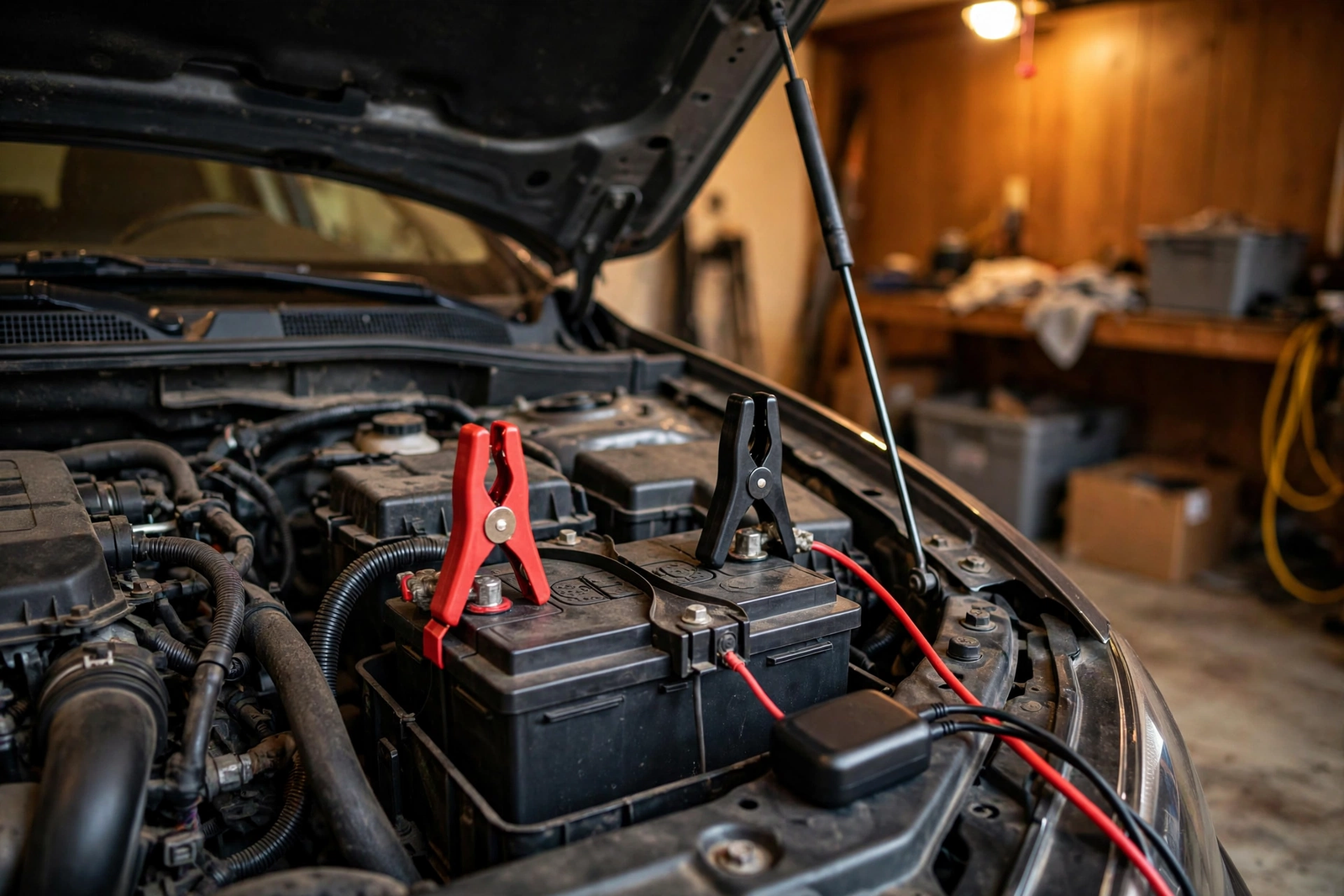
The GENIUS2 has six modes: Standby, 12V, 12V AGM, 12V Lithium, 6V, and Force. Each mode is a different voltage profile at 2 amps: standard 12V batteries charge at 14.5V, AGM at 14.8V, 12V lithium at 14.6V, and 6V batteries at 7.25V. The differences look small and matter: AGM batteries need the higher voltage to charge fully, and lithium batteries need their own profile to charge safely. The 12V Lithium mode is for lithium-ion batteries with a battery management system only, including LiFePO4 — a lithium battery without a BMS does not belong on this charger.
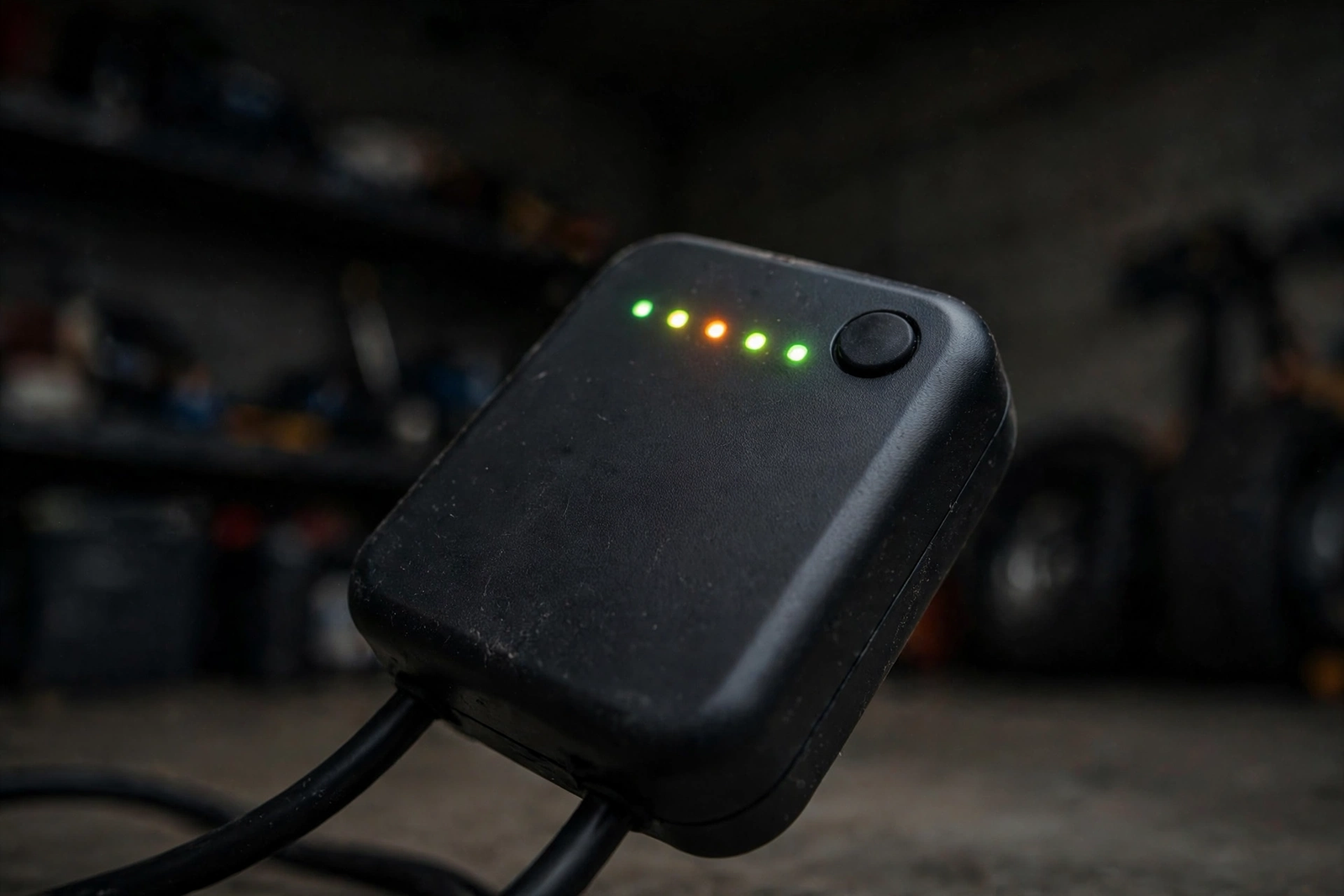
Selecting a mode is a press of the mode button, with two exceptions: 6V mode needs a press and hold of about three seconds, and Force Mode about five seconds. Once you pick the mode, the GENIUS2 is a fully automatic battery charger: it runs the 9-step charging algorithm on its own — diagnosis, bulk charging, absorption, and maintenance — and it remembers the last selected mode when it is plugged in again. The manual step is the mode choice; everything after that is automatic.
Force Mode, Dead Batteries, and the Desulfator
A battery that has sat flat for months reads so low that a normal charger will not even recognise it is connected. The GENIUS2 has a start-voltage sensor that detects and charges dead batteries as low as 1 volt. For a battery reading below 1 volt — effectively zero — Force Mode takes over: press and hold the mode button for five seconds and the charger begins charging, running in Force Mode for five minutes before returning to standard charging. It is the feature that separates a smart charger from a basic trickle charger.
The desulfator works more quietly. Lead sulfate crystals build up on battery plates during discharge, and they harden into the main cause of capacity loss in aging lead-acid batteries. NOCO’s 9-step algorithm includes a repair stage that targets that buildup, starting automatically when it detects a sulfated battery. As a maintainer it can then stay connected 24/7 without overcharging, holding a stored battery at full charge through winter. Caveat: desulfation helps tired batteries recover capacity; it cannot fix a shorted cell or a physically damaged battery. A battery that will not hold charge after a full cycle needs replacing.
GENIUS2 vs GENIUS5 vs Battery Tender Junior
The GENIUS5 is the same idea with more current: 5 amps instead of 2, charging batteries up to 120Ah instead of 40Ah, in a larger unit at 1.5 lbs against the GENIUS2’s 1.1 lbs. Both are 6V/12V chargers for lead-acid and lithium batteries, both have Force Mode from zero volts, both run the 9-step algorithm with thermal compensation, both are IP65, and both carry a 3-year limited warranty. The GENIUS5 also has a separate Repair mode, where the GENIUS2’s desulfation runs automatically inside the algorithm. Our NOCO GENIUS5 review covers it in full: charging car or truck batteries from flat means GENIUS5, small batteries or maintenance duty means GENIUS2.
The Battery Tender Junior is the budget alternative. It is a 750mA 12-volt maintainer — less than half the GENIUS2’s current — with a 4-step charging program for lead-acid batteries from 3Ah to 30Ah. It is 12-volt only, so no 6-volt classic cars, and lead-acid only, so no lithium batteries. It also needs at least 3 volts from the battery before it will start charging, where the GENIUS2 detects down to 1 volt and Force Mode covers zero. In return the Junior offers a 5-year warranty against NOCO’s 3 years and a lower price. For a motorcycle battery in winter storage it is the cheaper answer; for a lithium battery, a 6-volt system, or a deeply discharged battery, it is the wrong one.
| GENIUS2 | GENIUS5 | Battery Tender Junior | |
|---|---|---|---|
| Charge current | 2A | 5A | 0.75A |
| Voltages | 6V / 12V | 6V / 12V | 12V only |
| Charging capacity | Up to 40Ah | Up to 120Ah | 3–30Ah |
| Maintenance capacity | All battery sizes | All battery sizes | Up to 30Ah |
| Chemistries | Lead-acid + lithium | Lead-acid + lithium | Lead-acid only |
| Dead-battery detection | 1V, Force Mode from 0V | 1V, Force Mode from 0V | Needs 3V minimum |
| Protection rating | IP65 | IP65 | Not rated |
| Warranty | 3-year limited | 3-year limited | 5-year |
The choice comes down to battery size and chemistry. Small batteries and 6-volt systems point at the GENIUS2; full-size car and truck batteries point at the GENIUS5; a single 12-volt lead-acid motorcycle battery in winter storage points at the Battery Tender Junior. None of the three is a jump starter — none of them will start a dead car.
Size, Build, and What Is in the Box
The GENIUS2 is a small unit: 3.7 by 2.4 by 1.7 inches and 1.1 lbs, small enough to sit on a battery or hang on a wall. The housing is rated IP65, dust-tight and resistant to water jets, so a damp garage or light splashes are fine — it is not submersible, and the AC plug should stay dry. It draws at most 30 watts, works from 120 to 240 volts AC, and its thermal compensation adjusts the charge to the ambient temperature, so a cold garage gets a different charge than a hot one.
In the box are the charger, an AC cable, a DC cable with battery clamps, integrated eyelet terminals for hard-to-reach batteries, and a mounting bracket with screws. The eyelets are the detail worth using: bolt them to the terminals once, and the charger connects with a quick plug instead of clamps. The charger draws less than 0.5mA back from the battery when unplugged from the wall, so leaving it connected while unplugged will not drain the battery. NOCO backs the GENIUS2 with a 3-year limited warranty, and the clamps are spark-proof with reverse-polarity protection, so connecting them the wrong way round will not spark or damage anything.
Who Should Buy It — and Who Should Skip It
Buy the GENIUS2 if your batteries are small: motorcycles, ATVs, scooters, lawn tractors, snowmobiles, jet skis, and golf carts are its home ground. Buy it if you store a vehicle for winter — as a battery maintainer for car owners who park a vehicle for months, it holds any size battery at full charge. Buy it if you have a 6-volt classic car or a lithium powersport battery, because few chargers at this size cover both. And buy it if you have ever found a battery reading near zero and wanted a charger that would at least try.
Skip it if your main job is recharging a flat full-size car or truck battery — the GENIUS5 charges up to 120Ah at 5 amps and does what the GENIUS2 is not rated to do. Skip it if you only have 12-volt lead-acid motorcycle batteries and want the cheapest maintainer: the Battery Tender Junior costs less and its 5-year warranty is longer, unless you need lithium, 6 volts, or a sub-3-volt recovery. And skip it if you need roadside help: a charger cannot jump-start a dead car, and a jump starter with a built-in compressor such as the WOLFBOX MV24A is the tool for the roadside.
Verdict
The NOCO GENIUS2 smart battery charger is the right-sized charger for small batteries: 2 amps is slow, but slow on purpose — a gentle charge that suits motorcycle, ATV, and lawn tractor batteries, with 6-volt and lithium modes most chargers this size lack, Force Mode for batteries other chargers would refuse, and a maintainer that can sit connected all winter. Its limits are equally clear: the 40Ah charging ceiling rules out flat full-size car batteries, and it will not jump-start anything. Accept those two facts and this is a strong buy; if either is a deal-breaker, the GENIUS5 or the Battery Tender Junior above is the honest next step.
Frequently Asked Questions
How long does the GENIUS2 take to charge a car battery?
It depends on the battery’s size: at 2 amps, an 8Ah battery takes about 3 hours, a 12Ah battery about 4.5 hours, an 18Ah battery about 6.75 hours, a 24Ah battery about 9 hours, and a 40Ah battery about 15 hours, per NOCO’s own charging-time table. A typical 60Ah sedan battery is above the GENIUS2’s 40Ah charging ceiling, so this charger is not the right tool to bring a flat full-size car battery back — the GENIUS5, rated to 120Ah at 5 amps, is the step up for that job.
Can the GENIUS2 charge lithium batteries?
Yes. Select the 12V Lithium mode, which charges at 14.6V and 2A, and use it only for 12-volt lithium-ion batteries with a battery management system, including LiFePO4. AGM batteries have their own mode at 14.8V, and standard flooded batteries use the 12V mode at 14.5V — pick the mode that matches your battery, since each chemistry needs a different voltage profile.
What is Force Mode on the GENIUS2?
Force Mode is a manual override for batteries too dead for the charger to detect. The GENIUS2’s start-voltage sensor automatically detects and charges batteries down to 1 volt; for a battery reading below 1 volt, press and hold the mode button for five seconds to enter Force Mode, which begins charging from zero volts and runs for five minutes before returning to standard charging in the selected mode.
Can I leave the GENIUS2 connected all winter?
Yes. As a maintainer it can stay connected 24/7 without overcharging: once the battery is full it switches to a float maintenance mode, and thermal compensation adjusts the charge to the ambient temperature. It maintains batteries of all sizes, so a stored car, boat, or motorcycle battery stays at full charge through winter, and the desulfation stage in the 9-step algorithm helps tired lead-acid batteries recover capacity while it is connected.
Should I buy the GENIUS2 or the GENIUS5?
It comes down to battery size. The GENIUS2 charges at 2 amps for batteries up to 40Ah — motorcycles, ATVs, lawn tractors, and small batteries — while the GENIUS5 charges at 5 amps for batteries up to 120Ah, which covers full-size car and truck batteries. Both are 6V/12V chargers for lead-acid and lithium batteries, both have Force Mode from zero volts, both are rated IP65, and both carry a 3-year limited warranty. If your batteries are all small, the GENIUS2 costs less and does the job; if you charge car batteries from flat, buy the GENIUS5.
Does the GENIUS2 work on 6V batteries?
Yes. The GENIUS2 is a 6-volt and 12-volt charger: press and hold the mode button for about three seconds to select 6V mode, which charges at 7.25V and 2A for batteries up to 40Ah. That covers vintage cars and older motorcycles with 6-volt electrics, as well as 6-volt lead-acid types including wet, gel, maintenance-free, calcium, enhanced flooded, and AGM batteries.