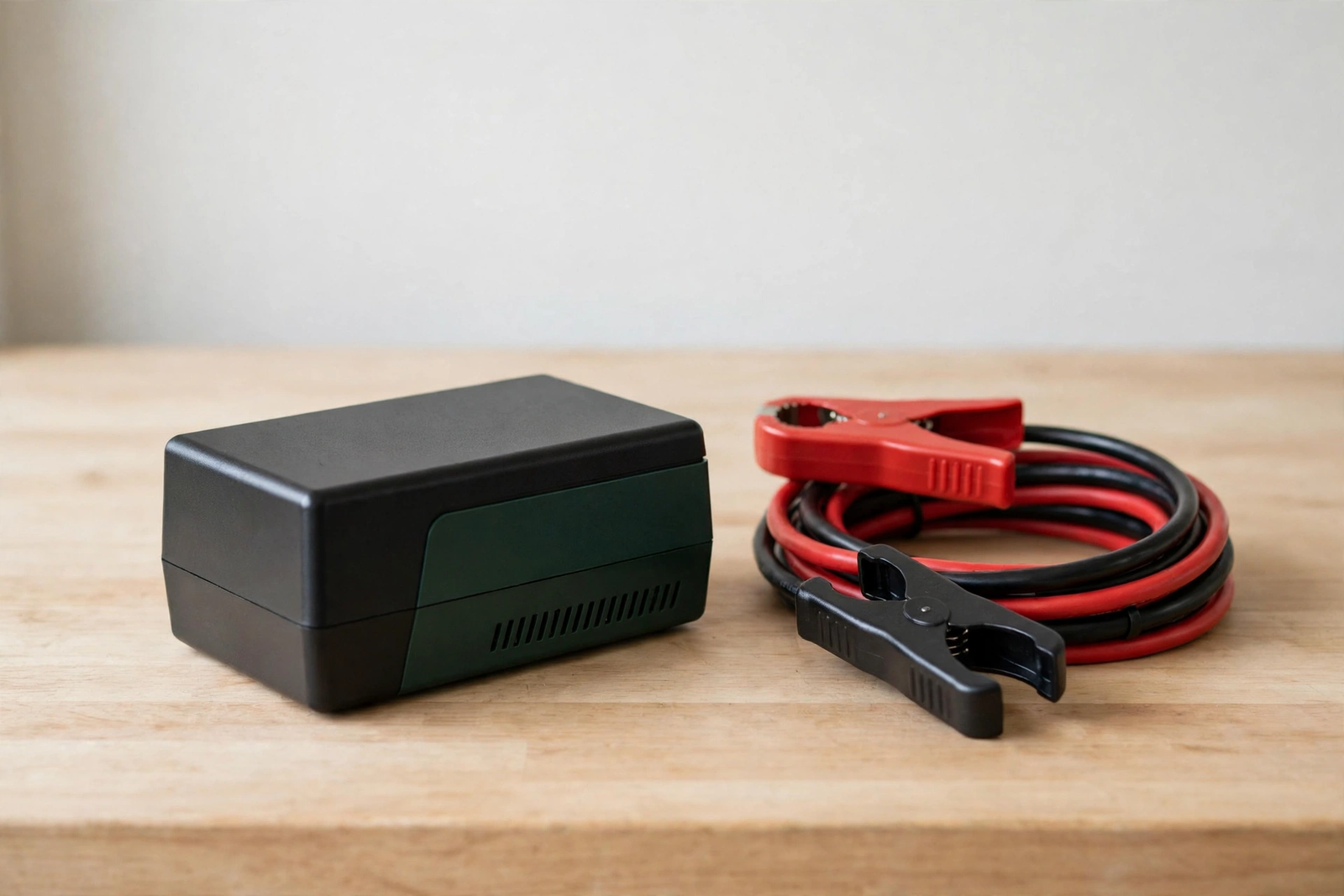
A motorcycle that sits all winter, a classic car that only comes out on dry weekends, a lawn tractor parked from October to April — they all share the same ending. The battery that was fine in autumn is flat by spring, and a flat lead-acid battery left that way loses capacity for good. The Battery Tender Junior 12V, 750mA Battery Charger and Maintainer, model 021-0123, is the classic answer: a trickle charger with a microprocessor inside, built to charge a small 12-volt lead-acid battery slowly and hold it at full charge for as long as it stays connected.
In this review of the Battery Tender Junior trickle charger, we cover what 750 milliamps means in real charging times, how the 4-step charge works, what the red and green lights are telling you, and how it compares with the NOCO GENIUS2 and the NOCO GENIUS5, the two smart chargers most buyers shortlist. If you want the short version first, the Quick Pick table below has it.
As an Amazon Associate I earn from qualifying purchases.
| Pick | Product | Why it stands out | Check Price |
|---|---|---|---|
| Overall Winner | Battery Tender Junior | 750mA 12V maintainer with a 4-step charge and a 5-year warranty — the simple answer for stored 12V lead-acid batteries from 3–30Ah | |
| Best Budget | NOCO GENIUS2 | Best-value smart charger: 2A, 6V/12V, lithium and AGM modes, Force Mode from 0V, 3-year limited warranty | |
| Premium Pick | NOCO GENIUS5 | 5A 6V/12V smart charger, charges up to 120Ah — the right NOCO for full-size car and truck batteries |
Table of Contents
What the Battery Tender Junior Trickle Charger Is — and What It Is Not
The Junior is a 12-volt, 750-milliamp charger and maintainer for lead-acid batteries — flooded, AGM, and gel — from 3Ah to 30Ah. That covers motorcycle, ATV, scooter, snowmobile, lawn tractor, and golf cart batteries, Deltran calls it much more than a trickle charger because a microprocessor runs the charge in four steps. In plain terms, it is a trickle charge battery charger with a brain: it charges slowly, then holds the battery at float voltage without overcharging it.
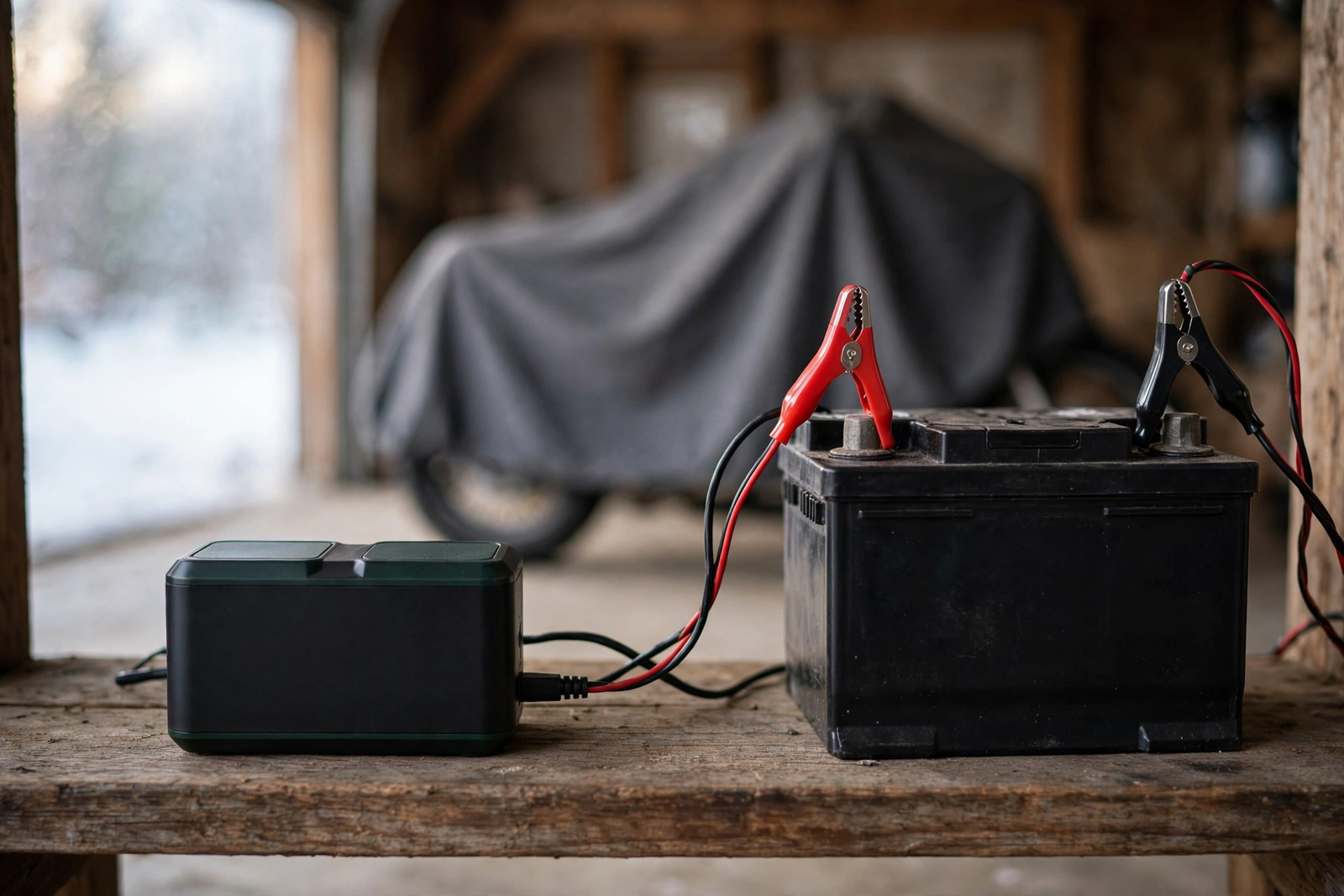
As a battery maintainer, the Junior can stay connected indefinitely once the battery is full. Float mode offsets self-discharge, so a bike that sits from November to March starts in spring instead of greeting you with a dead battery. The unit weighs 0.65 lbs, has a 12-foot output cord, and plugs into a standard 120-volt outlet. There are no modes to select and no buttons to press.
What the Junior is not matters just as much. It is not a jump starter: it cannot start a dead vehicle, and at 750 milliamps it is not even a fast charger. It is not a lithium charger — lead-acid only — and it is not a 6-volt charger: model 021-0123 is 12-volt only. It has no desulfator and no repair mode, and it will not start charging a battery below 3 volts. This review is about the 750mA Junior, model 021-0123, only. A newer 800mA Junior exists under a different model number — check the model number before ordering.
750mA in Practice: Charging Times and the 30Ah Ceiling
Charging time is roughly amp-hours divided by amps, and at 0.75 amps the Junior works in days, not hours. An 8Ah battery takes about 11 hours from flat, a 12Ah battery about 16 hours, an 18Ah battery about 24 hours, and a 30Ah battery about 40 hours — bulk-charge figures before the absorption stage finishes the job, so real times run longer. Connect it on Friday evening and the battery is ready for the weekend, but it will not rescue a dead battery before a morning ride.
The 30Ah ceiling deserves a straight reading. A typical sedan battery is around 60Ah, and a truck battery is 80Ah or more. The Junior is rated for batteries from 3Ah to 30Ah, for charging and maintenance alike — a bigger battery is outside what it is built to look after. If you need a battery charger for car batteries over 30Ah that have gone flat, the Junior is the wrong tool, and the GENIUS5, rated to 120Ah at 5 amps, is the step up.
That slowness is also the point. A gentle 0.75-amp charge suits small batteries a big charger would cook, and float mode means the battery can sit on it all winter without overcharging. If your battery goes flat often and you need it back the same day, 750 milliamps will frustrate you. If it goes flat because the vehicle sits, slow and steady is the right medicine.
The 4-Step Charge: Initialization, Bulk, Absorption, Float
The Junior’s microprocessor runs a four-step program, and each step has a job. Initialization checks the battery first: the monitor circuit verifies the voltage is high enough and the connections are good before serious current flows. This is the step that refuses a battery below 3 volts — a safety feature, not a fault.
Bulk charge is the main event: a constant 0.75 amps until the battery is roughly 75 to 80 percent recharged. Absorption follows, holding a constant voltage while the current tapers off. It ends when the current drops below a threshold or its timer expires. Float is the final step and the one that makes the Junior a maintainer: it holds a constant float voltage, keeping the battery fully charged indefinitely, with a reset monitor that guards against current draw from the vehicle.
Compare that with the NOCO chargers and the Junior’s simplicity shows both ways. The GENIUS2 runs a 9-step algorithm with a desulfation stage and six selectable modes; the Junior runs four steps and asks you nothing. Nothing to set wrong suits a charger used twice a year — but there is no desulfation stage to help a tired battery recover. Four steps, fully automatic, is the whole offer.
Reading the LED: What Red, Green, and Flashing Mean
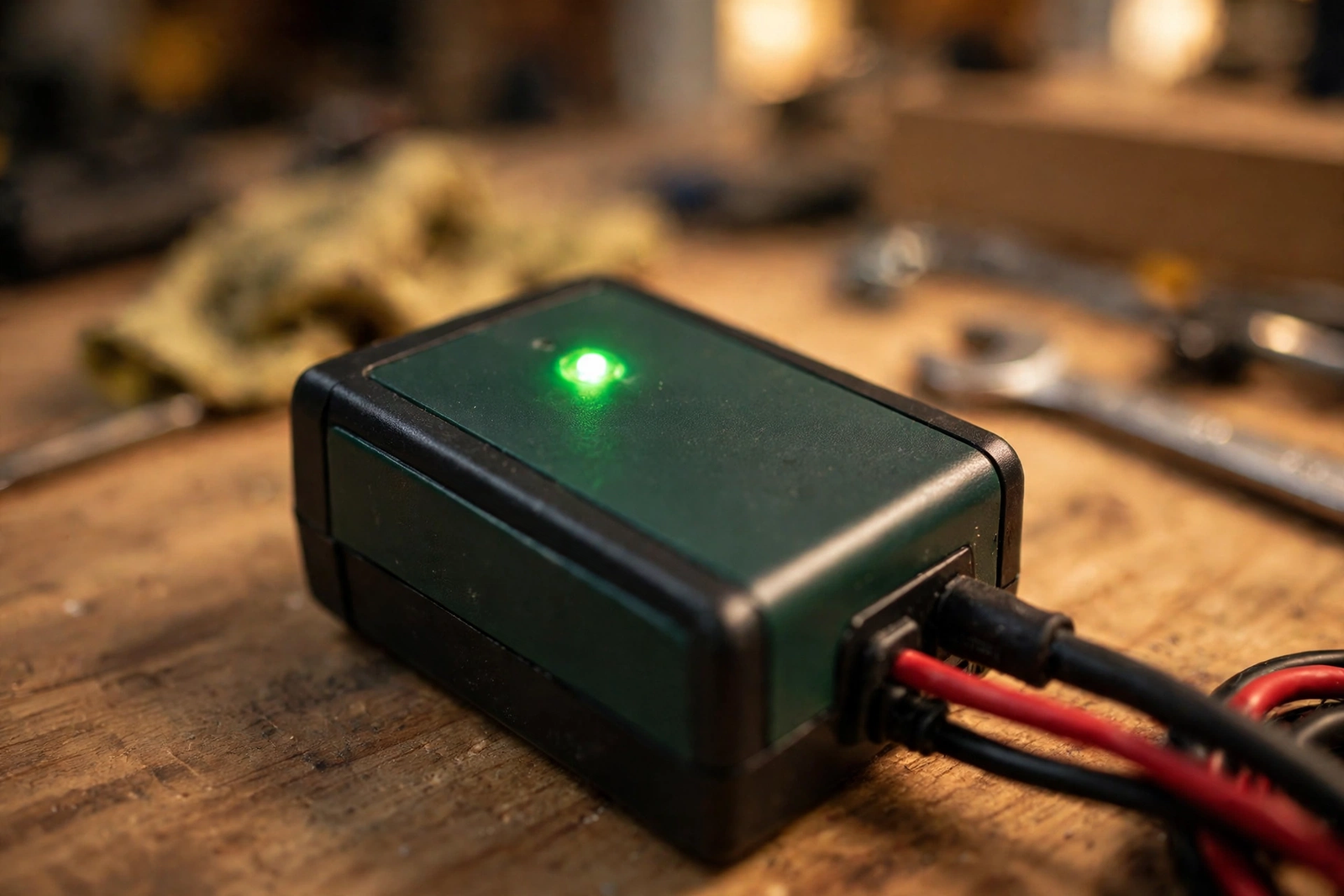
The Junior has no display and no buttons — one two-colour LED is the entire interface. Flashing red means the charger has AC power and its microprocessor is working, but no battery is connected or there is a connection problem. Steady red means the battery is connected and charging. Past 80 percent, green flashes while red stays on. Steady green means the charge is complete and the charger is in float mode.
One more signal matters: an orange light means something is wrong — usually a sulfated battery, a poor or corroded connection, or a reverse-polarity hook-up. Check the connections first: clean the terminals, confirm red goes to positive and black to negative, and try again. If the orange light stays on with clean, correct connections, the battery itself is the likely problem, and no charger here will fix a shorted cell or a damaged case.
The LED is simple, but it is also the Junior’s only diagnostic tool. It will not tell you the battery’s voltage, its remaining capacity, or the hours left — for that you need a multimeter or a charger with a display. What it does tell you, at a glance from across the garage, is whether the charger is working, whether the battery is nearly done, and whether something needs attention.
Setup: Clips, Ring Terminals, and the 12-Foot Cord
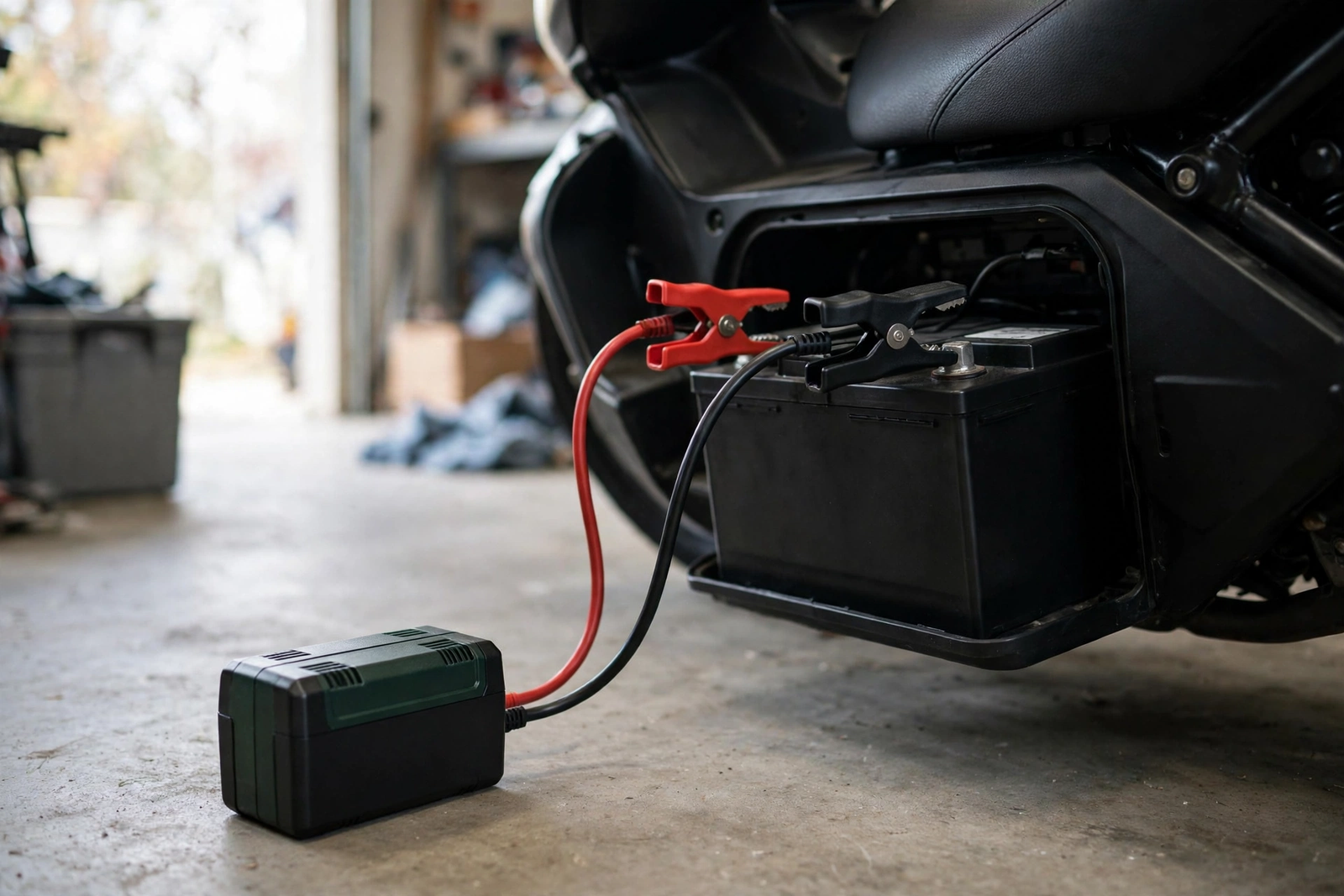
Connect the red clamp to the positive terminal and the black clamp to the negative, then plug the charger into a standard 120-volt outlet. The charger produces no output voltage until its leads are connected to a battery, which is what makes the clamps spark-proof. It is also protected against reverse polarity and short circuits.
The box includes two ways to connect, and the second is worth using. Alongside the alligator clips comes a fused ring terminal harness: bolt the rings to the terminals once, and the charger connects with a quick plug instead of clamps. That matters on motorcycles and ATVs, where the battery often hides under a seat or panel — with the harness fitted, winter hook-up means plugging in one connector, not removing bodywork.
One practical note: the Junior is a mains-powered indoor device, and no weatherproof rating is stated for it. It belongs in a garage or shed with the vehicle, not out in the rain, and the wall plug should stay dry like any mains device. That is a real difference from the NOCO chargers here, which are both rated IP65.
Junior vs GENIUS2 vs GENIUS5
The NOCO GENIUS2 is the closest rival and the clearest step up. It charges at 2 amps instead of 0.75, covers 6-volt as well as 12-volt batteries, handles lithium including LiFePO4, and detects batteries down to 1 volt, with Force Mode from zero. Our NOCO GENIUS2 review covers it in full: for a motorcycle battery in winter storage the Junior is the cheaper answer, but for a lithium battery, a 6-volt system, or a battery below 3 volts, the GENIUS2 is the right charger.
The NOCO GENIUS5 is the bigger step: 5 amps, charging batteries up to 120Ah, which covers full-size car and truck batteries the Junior cannot look after. Our NOCO GENIUS5 review covers it in full: like the GENIUS2 it is a 6V/12V charger for lead-acid and lithium batteries, with Force Mode from zero volts, a 9-step algorithm, thermal compensation, and an IP65 rating, backed by a 3-year limited warranty.
| Battery Tender Junior | GENIUS2 | GENIUS5 | |
|---|---|---|---|
| Charge current | 0.75A | 2A | 5A |
| Voltages | 12V only | 6V / 12V | 6V / 12V |
| Charging capacity | 3–30Ah | Up to 40Ah | Up to 120Ah |
| Maintenance capacity | Up to 30Ah | All battery sizes | All battery sizes |
| Chemistries | Lead-acid only | Lead-acid + lithium | Lead-acid + lithium |
| Dead-battery start | Needs 3V minimum | 1V, Force Mode from 0V | 1V, Force Mode from 0V |
| Desulfator | No | Yes, repair stage | Yes, Repair mode |
| Protection rating | Not rated | IP65 | IP65 |
| Weight | 0.65 lbs | 1.1 lbs | 1.5 lbs |
| Warranty | 5-year | 3-year limited | 3-year limited |
The choice comes down to battery size and chemistry. A single 12-volt lead-acid motorcycle, ATV, or lawn tractor battery in winter storage points at the Junior. Small batteries, 6-volt systems, lithium batteries, or a battery that has gone below 3 volts point at the GENIUS2. Full-size car and truck batteries point at the GENIUS5. None of the three is a jump starter — none of them will start a dead vehicle.
Who Should Buy It — and Who Should Skip It
Buy the Junior if you store a vehicle for months: a motorcycle, ATV, scooter, snowmobile, boat, or classic car with a 12-volt lead-acid battery between 3Ah and 30Ah is exactly what it was built for. Buy it if you want the simplest possible charger — no modes, no buttons, no settings to get wrong — and if a 5-year warranty matters, because it is the longest of the three chargers here.
Skip it if your battery is lithium: the Junior is lead-acid only, and a lithium battery needs a charger with a lithium mode. Skip it if your battery is 6-volt, or if it has gone below 3 volts — the Junior will refuse it, and the GENIUS2 with Force Mode is the charger that will at least try. Skip it if your main job is a flat full-size car battery, where the GENIUS5 is the right tool.
Verdict
The Battery Tender Junior trickle charger is the right-sized charger for small stored batteries: 750 milliamps is slow, but slow on purpose — a gentle charge that suits motorcycle, ATV, and lawn tractor batteries, with a 4-step program that asks nothing of you, a float mode that can sit connected all winter, and a 5-year warranty that outlasts both NOCO rivals. As a battery trickle charger, the Junior does exactly one job, and it does it well. Its limits are equally clear: the 30Ah ceiling rules out flat full-size car batteries, it will not touch lithium or 6-volt batteries, and it refuses any battery below 3 volts. Accept those facts and this is a strong buy; if any is a deal-breaker, the GENIUS2 or GENIUS5 above is the honest next step.
Frequently Asked Questions
How long does the Battery Tender Junior take to charge a motorcycle battery?
It depends on the battery’s size: at 0.75 amps, an 8Ah battery takes about 11 hours, a 12Ah battery about 16 hours, an 18Ah battery about 24 hours, and a 30Ah battery about 40 hours, before the absorption stage finishes topping it off — so real times run longer. Those are full-charge times from flat, worked out from the 0.75-amp rate; a battery at half charge takes roughly half the time. This is a connect-and-walk-away charger, not a same-day rescue tool.
Can I leave the Battery Tender Junior connected all winter?
Yes. Once the battery is full, the Junior switches to float mode and holds it at full charge without overcharging, and float charging continues indefinitely. That is the point of the charger: a motorcycle, ATV, or classic car that sits from autumn to spring starts when you need it instead of greeting you with a dead battery. Keep the charger and its wall plug dry and indoors, as no weatherproof rating is stated for it.
Can the Battery Tender Junior charge a lithium battery?
No. The Junior is for 12-volt lead-acid batteries only — flooded, AGM, and gel types. It has no lithium mode, so a lithium powersport battery needs a charger with a lithium mode, such as the NOCO GENIUS2, which covers 12-volt lithium-ion batteries including LiFePO4. Do not connect a lithium battery to the Junior.
What if my battery reads below 3 volts?
The Junior will not start charging a battery that reads below 3 volts: its initialization step verifies the battery voltage first and refuses a battery it cannot verify. If your battery is that deeply discharged, the NOCO GENIUS2 is the charger that will at least try — it detects batteries down to 1 volt and its Force Mode starts charging from zero volts. A battery that will not hold charge after a full cycle on a charger that accepts it needs replacing.
Should I buy the Battery Tender Junior or the NOCO GENIUS2?
It comes down to battery size and chemistry. The Junior charges at 0.75 amps for 12-volt lead-acid batteries from 3Ah to 30Ah, with no modes to select and a 5-year warranty. The GENIUS2 charges at 2 amps for batteries up to 40Ah, covers 6-volt and 12-volt systems and lithium batteries, detects down to 1 volt, and has Force Mode from zero volts, with a 3-year limited warranty. If your batteries are all small 12-volt lead-acid, the Junior does the job; if you have lithium, 6-volt, or deeply discharged batteries, buy the GENIUS2.
Does the Battery Tender Junior work on a car battery?
Only on a small one. The Junior is rated for 12-volt lead-acid batteries from 3Ah to 30Ah, for charging and for maintenance alike, so a typical 60Ah sedan battery is outside its range, and a truck battery even more so. A small car battery inside 30Ah can sit on the Junior all winter, but bringing a flat full-size car battery back needs a bigger charger — the NOCO GENIUS5, rated to 120Ah at 5 amps, is the step up for that job.