Engine Air Filter Review: The Mazda Kit, a Washable K&N, and a Budget Panel
An engine air filter is the cheapest part standing between your engine and the dirt on the road. It sits in a black plastic box under the hood, and every breath your engine takes passes through it: dust, grit, pollen, and road debris get caught in the pleated paper while clean air goes on to the cylinders. When the filter clogs, the engine has to work harder to breathe — throttle response goes dull and peak power drops, and in the worst case dirt gets past a damaged filter and into the engine itself. On a modern fuel-injected engine a clogged filter costs power, not measurable fuel economy, unless it is severely restricted.
The short answer: if you drive a Mazda 3, Mazda 6 or CX-5 and both filters are due, buy the Mazda kit — engine and cabin filters matched to the car in one box. If you drive a Subaru and plan to keep it for years, buy the washable K&N and clean it instead of replacing it. If you drive a Toyota or Lexus and want the cheapest correct panel, buy the EPAuto. Whatever you buy, check the fitment chart for your exact model and year first: an engine air filter that does not seal is worse than an old one.
As an Amazon Associate I earn from qualifying purchases.
Quick Pick: Engine Air Filter
| Pick | Product | Best For | Check Price |
|---|---|---|---|
| Overall Winner | BESTWELL4U Engine and Cabin Air Filter for Mazda 3, Mazda 6 and CX-5 | Mazda 3, Mazda 6 and CX-5 owners: engine + cabin kit, one-box service | Check Price on Amazon |
| Washable Pick | K&N 33-2304 High-Flow Engine Air Filter | Washable oiled cotton gauze for 2003–2021 Subaru models | Check Price on Amazon |
| Disposable Panel Pick | EPAuto GP586 (XA10586) Engine Air Filter | Rigid panel for Toyota, Lexus and Subaru models, 2017–2025 | Check Price on Amazon |
Table of Contents
What an Engine Air Filter Does
An engine air filter is a pleated panel — usually paper, sometimes oiled cotton gauze — sealed into a plastic air box under the hood, with an intake tube running from the front of the car. An air filter’s job is simple: catch everything in the incoming air that is not air. Dust, sand, pollen, leaves, and insects get trapped in the pleats while clean air passes through to the throttle body and the cylinders, where it mixes with fuel and burns.
The filter works by restriction, which is also how it fails. As the pleats load up with dirt, less air gets through, and the engine has to pull harder for the same breath. That is why a clogged engine air filter shows up as sluggish throttle response and weaker peak power rather than a warning light: nothing breaks, the engine just breathes through a straw. Fuel economy barely moves on a modern fuel-injected engine unless the filter is severely restricted.
BESTWELL4U Engine and Cabin Air Filter for Mazda 3, Mazda 6 and CX-5 on Amazon: engine + cabin kit, matched to Mazda 3, Mazda 6 and CX-5 — verify your exact model and year against the listing’s fitment chart before ordering.
The Mazda Kit: Engine and Cabin Filters for Mazda 3 and CX Models
The hero product in this engine air filter review is not a single filter at all: it is a maintenance bundle. The BESTWELL4U kit (part number BWBU811-259CX5-16) pairs an engine air filter with a cabin air filter, both sized for Mazda 3 (2014–2018), Mazda 6 (2014–2021) and CX-5 (2013–2023, except Turbo), so a Mazda owner doing a scheduled service gets both filters in one box instead of two separate orders.
The kit fits Mazda 3 (2014–2018), Mazda 6 (2014–2021) and CX-5 (2013–2023, except Turbo) only, and that “only” carries the whole buying rule. Filter dimensions changed across Mazda generations, so a kit that fits one Mazda 3 may not fit another — verify your exact model and year against the listing’s fitment chart before ordering, and use the listing’s vehicle selector rather than the title alone. Our Spearhead vs Mazda cabin filter comparison covers the same kit from the cabin-air side, where the Mazda kit won for owners doing a full service and the Spearhead won for drivers chasing cleaner cabin air.
Engine Air Filter Replacement: When to Change It
Engine air filter replacement follows a simple schedule: every 15,000 to 30,000 miles under normal driving, or once a year, whichever comes first — that is the range most manufacturers publish. Dusty roads, city traffic, construction zones, and dry summers shorten it to 12,000 to 15,000 miles — if you drive on dirt roads, check the filter twice as often.
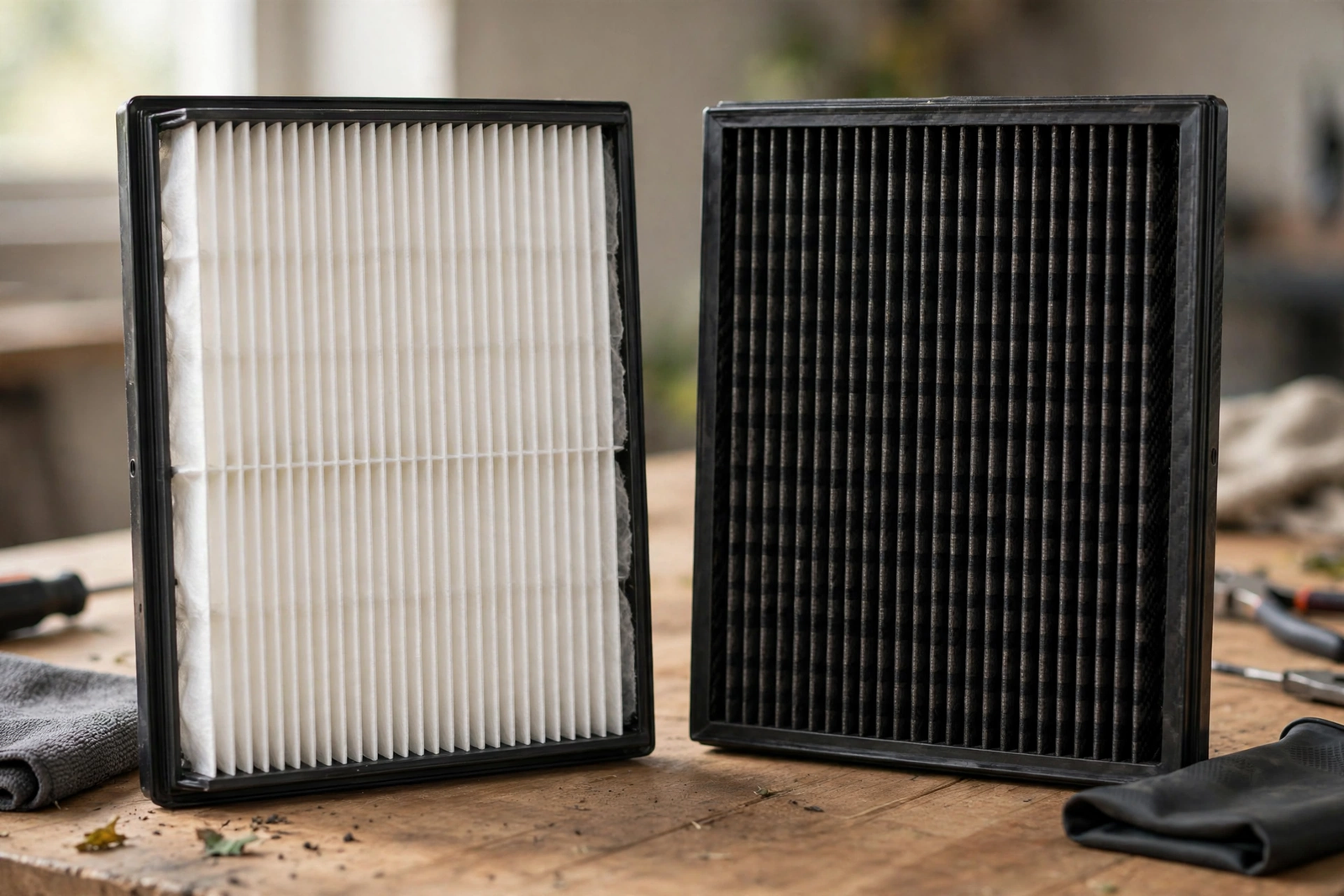
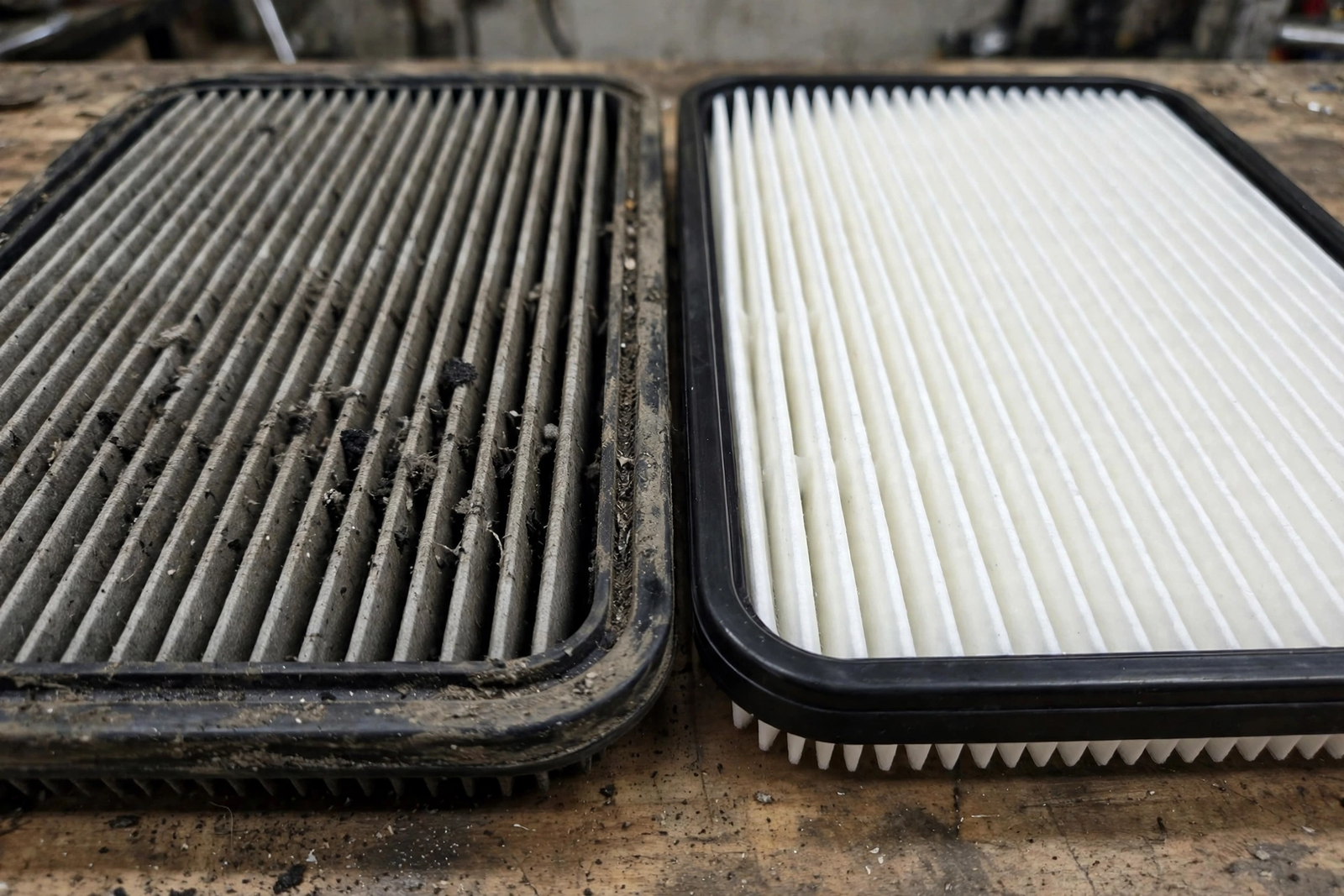
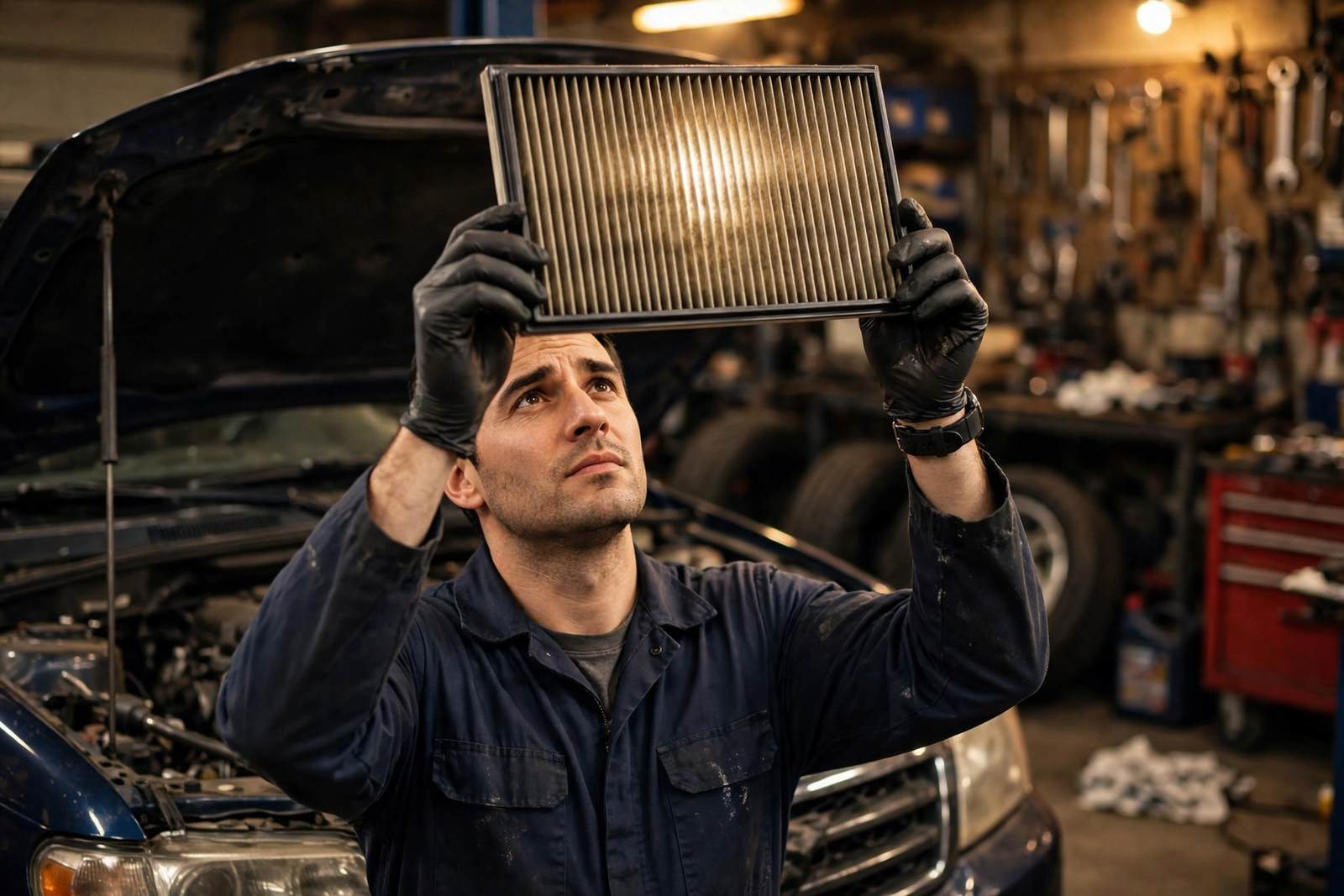
The mileage number is a guide, not a law. The honest way to decide is to look at the filter. Pull it out of the air box, hold it up to the light, and check whether light passes through the pleats. A clean filter glows; a clogged one is dark grey or black with embedded grit. If you cannot see light through it, replace it regardless of mileage.
How to Replace an Engine Air Filter
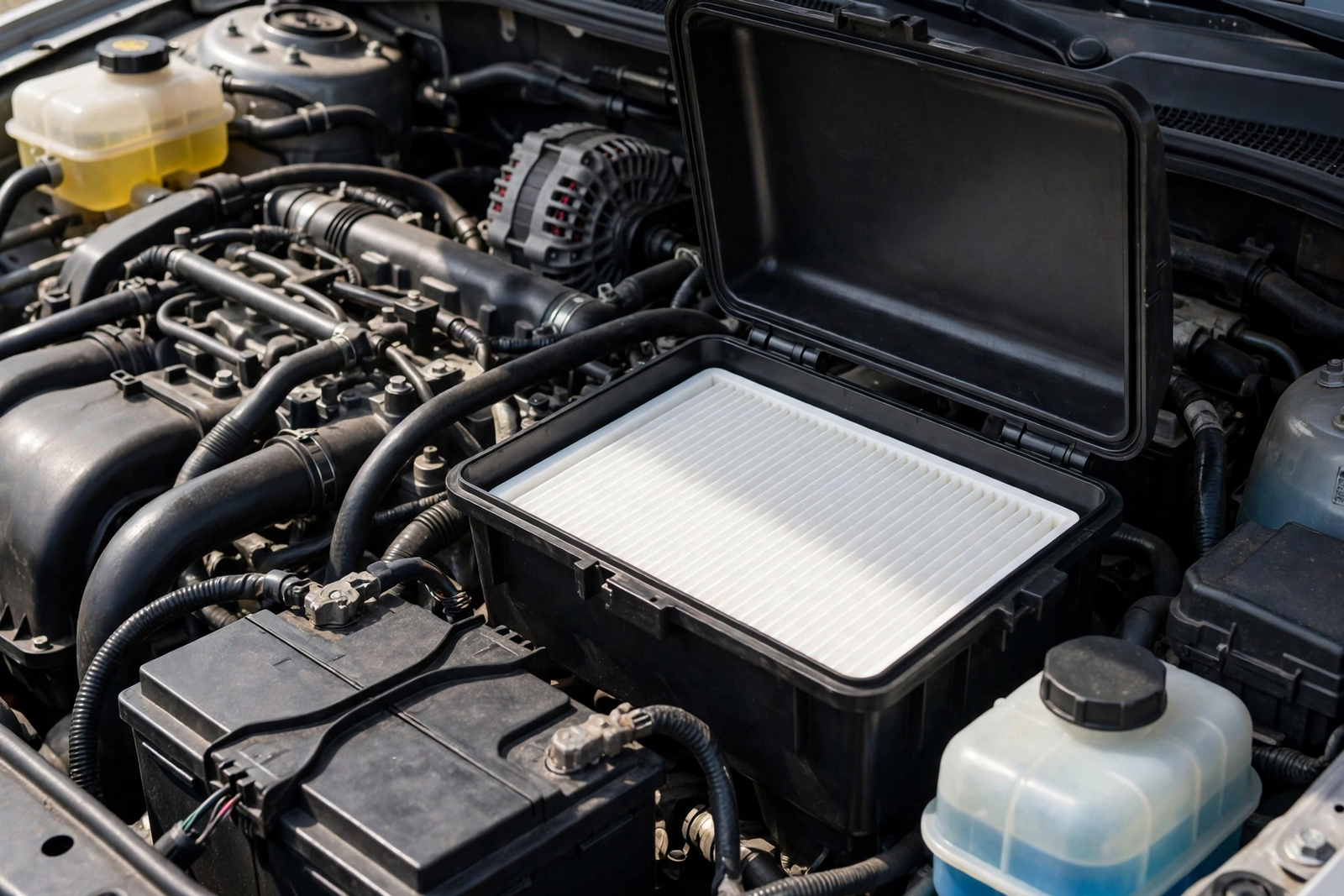
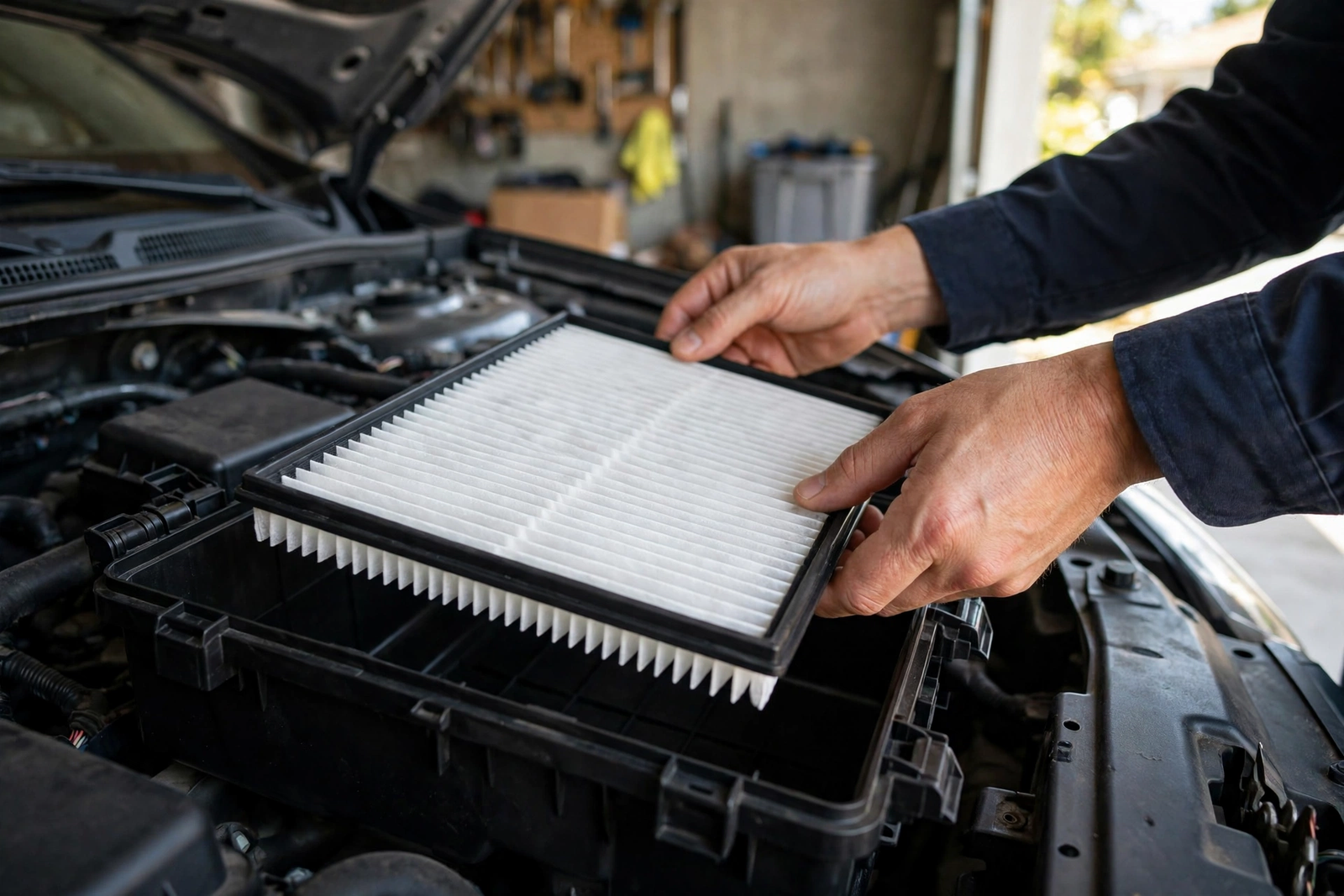
Replacing an engine air filter is a beginner job, and on most cars it takes under ten minutes with no tools. Open the hood and find the air filter box: a large black plastic box, usually on one side of the engine bay, with a thick intake tube running from the front of the car. Unclip the lid — most boxes use metal spring clips, some use a few screws — and lift it off.
Before the new filter goes in, check the box itself. Wipe out any leaves, grit, or debris sitting in the bottom of the housing, and check the rubber seal around the rim: a cracked or flattened seal lets unfiltered air bypass the filter. Seat the new air filter the same way the old one sat, with the rubber gasket flat against the housing and no gaps at the edges.
Disposable Paper vs Washable Cotton: K&N 33-2304
The K&N 33-2304 is the other way to buy an air filter: instead of a disposable paper panel you throw away, it is a washable, reusable panel of layered oiled cotton gauze, made to fit 2003–2021 Subaru models — Forester, Legacy, Outback, Impreza, WRX, Levorg, Crosstrek, and Tribeca, for select models within those years. It drops into the factory air box the same way a paper filter does, and K&N claims it increases airflow by up to 50% over a disposable paper filter.
One washable filter can replace years of paper filters, if you keep the car that long. K&N says the filter only needs cleaning every 75,000 miles under normal highway driving conditions, and backs it with a 10-Year/Million Mile Limited Warranty. The washable route only makes sense if the filter fits your car and you keep the car long enough to clean it more than once
K&N 33-2304 High-Flow Engine Air Filter on Amazon: washable oiled cotton gauze panel for 2003–2021 Subaru models, select models — check fitment for your exact model and year.
The Budget Panel: EPAuto GP586 for Toyota and Lexus
The EPAuto GP586 (XA10586) is the budget way to buy an air filter: a rigid paper panel, sold by EPFamily Direct and shipped from Amazon, that replaces the factory filter on a long list of Toyota, Lexus, and Subaru models from 2017 to 2025 — Camry, Corolla, RAV4, Avalon, Highlander, Sienna, Venza, and C-HR on the Toyota side; ES300h, UX200, NX350h, NX450h+, and RX350h on the Lexus side; and the Subaru BRZ.
The GP586 is a rigid panel with a rubber gasket, built to the factory dimensions for the models listed, and it installs the same way as the factory part — unclip the air box, swap the panel, refasten the clips. The GP586 covers a wide range of models, but “wide range” is not “your car” — a RAV4 and a Highlander take different panels in some years, and the listing’s vehicle selector is the check that catches it.
Signs Your Engine Air Filter Is Clogged
A clogged air filter rarely announces itself with a warning light. The symptoms are gradual, which is why they get blamed on everything else. The first is sluggish throttle response: the car feels lazier pulling away from a stop, because the engine is not getting the air it asks for. The second is weaker peak power under hard acceleration: a restricted filter limits the air the engine can pull at wide-open throttle. Fuel economy barely changes on a modern fuel-injected engine, which meters fuel to the air it actually measures — a fuel-economy loss from a clogged filter is a sign the restriction is severe.
Pull it out and look at it: a healthy filter is off-white or pale grey with visible pleats; a clogged one is dark grey or black, with grit embedded in the pleats and debris sitting in the air box. Hold it up to the light — if light does not pass through the media, the air filter is done, whatever the mileage says.
Engine Air Filter vs Cabin Air Filter: Different Parts
These two filters share a name and a shape, and that is where the similarity ends. The air filter lives under the hood in the air box, cleans the air the engine breathes, and protects the engine from grit. The cabin air filter lives behind the glove box, cleans the air you breathe, and protects the cabin from dust, pollen, and exhaust fumes.
They also fail differently. A clogged engine filter hurts performance; a clogged cabin filter weakens the airflow from the vents and makes the cabin smell stale. The Mazda kit in this review bundles both, which is convenient and confusing in equal measure: convenient because one order services the whole car, confusing because the two filters look alike out of the box. For the cabin half on its own, our CARORY cabin air filter review covers an activated-carbon cabin filter with odor control, and our Spearhead vs Mazda cabin filter comparison puts the Mazda kit’s cabin half against an odor-defense upgrade.
Who Should Buy Which Filter
Buy the Mazda kit if: you drive a Mazda 3 (2014–2018), Mazda 6 (2014–2021) or CX-5 (2013–2023, except Turbo) and both filters are due. Two filters, one box, matched to the car — it is the efficient maintenance buy. Buy the K&N 33-2304 if: you drive a 2003–2021 Subaru on the fitment list and plan to keep it for years. One washable filter can replace years of paper panels, as long as you follow K&N’s cleaning and re-oiling routine and do not over-oil.
Buy the EPAuto GP586 if: you drive a 2017–2025 Toyota, Lexus, or Subaru BRZ on the fitment list and want a straightforward replacement panel. It is a disposable paper filter at a disposable-filter job — no washable routine, no airflow claim, just the right size and a clean seal. Buy none of these if: your car is not on any of their fitment lists. Air filters are sized to the millimeter, and the wrong panel either does not seal or does not fit at all.
The Verdict
An air filter is the highest-value maintenance job on most cars: a cheap part, a ten-minute swap, and an engine that breathes properly again. The Mazda kit is the buy for Mazda 3, Mazda 6 and CX-5 owners doing a full service — engine and cabin in one box, matched to the car. The K&N is the buy for long-term Subaru owners who would rather clean a filter than keep buying them. The EPAuto is the buy for Toyota and Lexus owners who want the right panel at a budget price.
A clean air filter is invisible when it works — the car just drives the way it should — and that is exactly the point.
BESTWELL4U Engine and Cabin Air Filter for Mazda 3, Mazda 6 and CX-5 on Amazon: engine + cabin kit for Mazda 3, Mazda 6 and CX-5 — verify your exact model and year against the listing’s fitment chart before ordering.
Frequently Asked Questions
How often should I replace my engine air filter?
Every 15,000 to 30,000 miles under normal driving, or once a year, whichever comes first — that is the range most manufacturers publish. Dusty or severe conditions shorten it to 12,000 to 15,000 miles. Dusty roads, city traffic, and dry summers shorten the interval, so check the filter twice as often if you drive on dirt roads. Your owner’s manual is the authority for your car, and a visual check beats the mileage number: if light does not pass through the pleats, replace the filter regardless of mileage.
What happens if I never replace my engine air filter?
A clogged engine air filter restricts airflow, so the engine has to work harder to breathe. Throttle response goes dull and peak power drops, gradually enough that the change gets blamed on everything else. Fuel economy barely moves on a modern fuel-injected engine unless the filter is severely restricted. In the worst case a damaged or torn filter lets dirt past the media and into the engine, where grit wears internal parts. Replace the filter on schedule — it is one of the cheapest parts on the car.
Can I clean and reuse a paper engine air filter?
No. Paper engine air filters are disposable by design: replace them, do not clean them. Blowing a paper filter out with compressed air can tear the media or open holes you cannot see, and a torn filter passes dirt straight into the engine. If you want a reusable filter, buy a washable cotton panel like the K&N 33-2304 and follow the manufacturer’s cleaning and re-oiling routine — do not rinse a paper filter and put it back.
Will the Mazda kit fit my Mazda?
Only if your exact model and year are on the listing’s fitment chart. The kit is made for Mazda 3 (2014–2018), Mazda 6 (2014–2021) and CX-5 (2013–2023, except Turbo), but filter dimensions changed across Mazda generations, so a kit that fits one Mazda 3 may not fit another. Verify your exact model and year against the listing’s fitment chart and use the listing’s vehicle selector before ordering — a filter that does not seal lets unfiltered air bypass it.
Is a washable K&N engine air filter worth it?
It is worth it if your Subaru is on the fitment list and you plan to keep the car for years. One washable filter can replace years of paper panels, and K&N says it only needs cleaning every 75,000 miles under normal highway driving conditions. It is not worth it if you sell the car soon, or if your model is not covered. Follow K&N’s cleaning and re-oiling instructions and do not over-oil, because excess oil can foul the mass airflow sensor.
Engine air filter vs cabin air filter — what is the difference?
The engine air filter cleans the air the engine breathes and sits under the hood in the air box; the cabin air filter cleans the air you breathe and sits behind the glove box. They are different parts with different jobs, different sizes, and different replacement intervals, and they are not interchangeable. The Mazda kit in this review includes both; the K&N and the EPAuto are engine filters only.