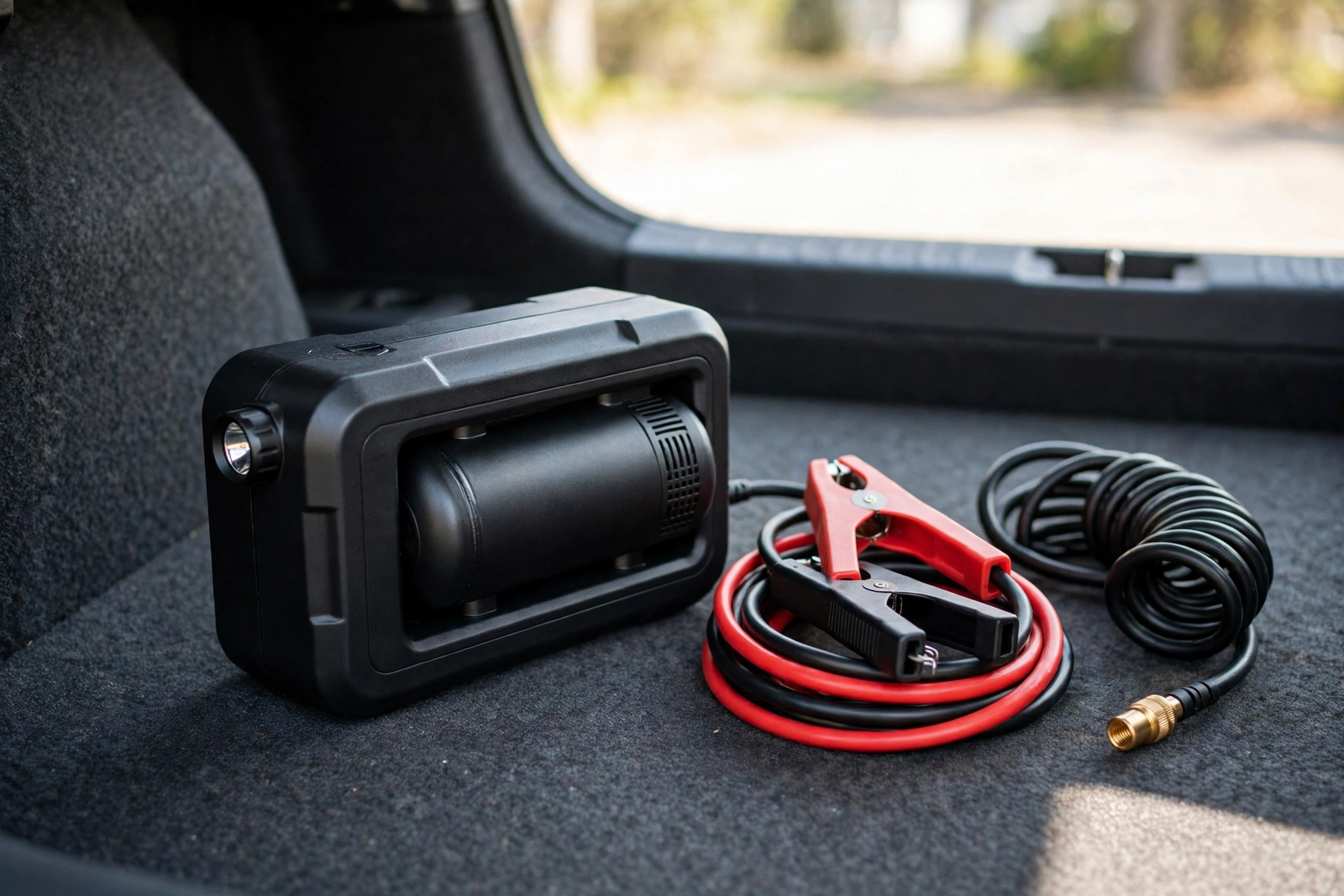
A dead battery has a way of picking the worst morning: cold, dark, and ten minutes before you need to leave. Jump starting a car is the skill that gets you moving again, and it is worth learning before you need it. The TREKURE 8-in-1, model Beta06, is built for exactly that morning: a 6000A jump starter and a 150 PSI air compressor in one box, with a 23,800mAh battery, a power bank, and an LED light for working in the dark.
In this review, we teach the steps first and review the tool second: jump starting a car with the TREKURE, the same job with jumper cables from another car, what the 6000A and 10L diesel ratings cover, how the 150 PSI compressor behaves, and how it compares with the WOLFBOX MV24A and VTOMAN X7. The Quick Pick table below has the short version.
As an Amazon Associate I earn from qualifying purchases.
| Pick | Product | Why it stands out | Check Price |
|---|---|---|---|
| Overall Winner | TREKURE 8-in-1 Jump Starter + Air Compressor | 6000A peak, 150 PSI compressor, 23,800mAh battery, 2-year warranty | |
| Best Budget | WOLFBOX MV24A Jump Starter + Air Compressor | 4000A peak and a 160 PSI compressor — the proven combo unit | |
| Premium Pick | VTOMAN X7 Jump Starter + Air Compressor | 4250A peak, 160 PSI, 5.1-inch screen, up to 70 starts per charge |
Table of Contents
What the TREKURE 8-in-1 Is — and What It Is Not
The TREKURE 6000A 8-in-1, model Beta06, is a portable jump starter and air compressor sharing one battery and housing. On the jump-start side it is a 6000A peak-current lithium polymer pack with heavy-duty clamps, rated for all gas and up to 10L diesel engines in 12V vehicles. The built-in pump reaches 150 PSI, with an LCD display, preset pressure and auto shut-off. The 23,800mAh battery also powers a power bank and an LED light. In the box: the unit, jumper cable with forced-start button, detachable hose, three nozzles, USB-C cable, adaptor and rugged case.
A dead battery and a soft tire are the two most common roadside problems, and they arrive together on the same cold morning. The TREKURE puts both fixes in the trunk as one item at 1.96 lbs, far lighter than the big combo units — the WOLFBOX MV24A, covered in our WOLFBOX MV24A review, weighs about 5.3 lbs. TREKURE backs it with a 2-year warranty and lifetime support, and ten safety protections cover short circuits, overheating, overvoltage, overcharging and reverse connection.
What it is not matters just as much. It is not a battery charger: it gives a dead-but-healthy battery the surge it needs to start, but it will not recharge a flat battery or fix a worn-out one. For charging, the NOCO GENIUS2, covered in our NOCO GENIUS2 review, is the right tool. It is not a workshop compressor either: it tops up tires, balls and small inflatables, nothing more. And it is not a different TREKURE: the 10-in-1 Beta07 is a separate unit, so none of its figures belong here.
Jump Starting a Car with the TREKURE: Step by Step
Jump starting a car is a short procedure, but the order of the steps is the safety system. A portable battery jump starter replaces the donor car with a box in your hand: a jump start from battery power alone needs no second vehicle. Here is how to jump start a car with a portable unit.
Method 1 — with the TREKURE. Check the unit is charged, and switch the ignition and accessories off. Connect the red clamp to the dead battery’s positive (+) terminal, then the black clamp to unpainted metal on the engine block or chassis, away from the battery. Plug the cable into the EC port and check the indicator: green means start the engine; red or flashing means check the connections, or press the forced-start button if the battery is completely dead. Once it is running, unplug the cable from the unit first, then remove the black clamp, then the red clamp.
One honest note: TREKURE’s own manual connects the black clamp to the negative terminal. This review teaches the standard practice instead — black to unpainted metal away from the battery — because the final connection can spark.
Method 2 — with jumper cables from another car. Park the donor car close by, with both ignitions off, and do not let the cars touch. Connect red to the dead battery’s positive (+) terminal, then the other red clamp to the donor battery’s positive (+) terminal. Connect black to the donor battery’s negative (-) terminal, then the last black clamp to unpainted metal on the dead car, away from its battery. Start the donor car, let it run for a minute or two, then start the dead car. Remove the clamps in reverse order: black from the dead car’s ground, black from the donor negative, red from the donor positive, red from the dead positive. Drive the revived car for a good run afterwards.
Never jump a battery that is cracked, leaking, swollen or frozen — a damaged battery can be dangerous, and no jump starter makes it safe. If it looks damaged, stop and get professional help. This unit is rated for 12V vehicles only: do not use it on 24V systems.

Power and Engine Fit: 6000A, All Gas and 10L Diesel
Peak current decides whether a jump starter can crank your engine, and the TREKURE’s figure is 6000A — the highest in this series, above the MV24A’s 4000A, the X7’s 4250A, and the GB70’s 2000A, covered in our NOCO Boost GB70 review. TREKURE rates it for all gas and diesels up to 10L, covering most cars, SUVs, pickups and light-duty diesels. The forced-start button is for a completely dead battery: where a normal jump starter may refuse a battery reading near zero volts, forced start pushes current through.
One conflict needs a straight word: the manual’s specification table and the listing’s technical table both say 6000 Amps, and the listing title says 6000A and 150 PSI — but a crawl of the same listing showed “5500A” in the title, and a retailer mirror repeated it. This review uses 6000A, because that is what the manual and the technical table state, but check the figure on the listing you buy from. A diesel near the 10L limit deserves that check.
Two figures we do not state, because no TREKURE source gives them: jump starts per charge and a cold-temperature rating. Treat the pack as generous, not a counted promise, and do not borrow figures from the Beta07 — they describe a different product.
The Air Compressor: 150 PSI in Practice
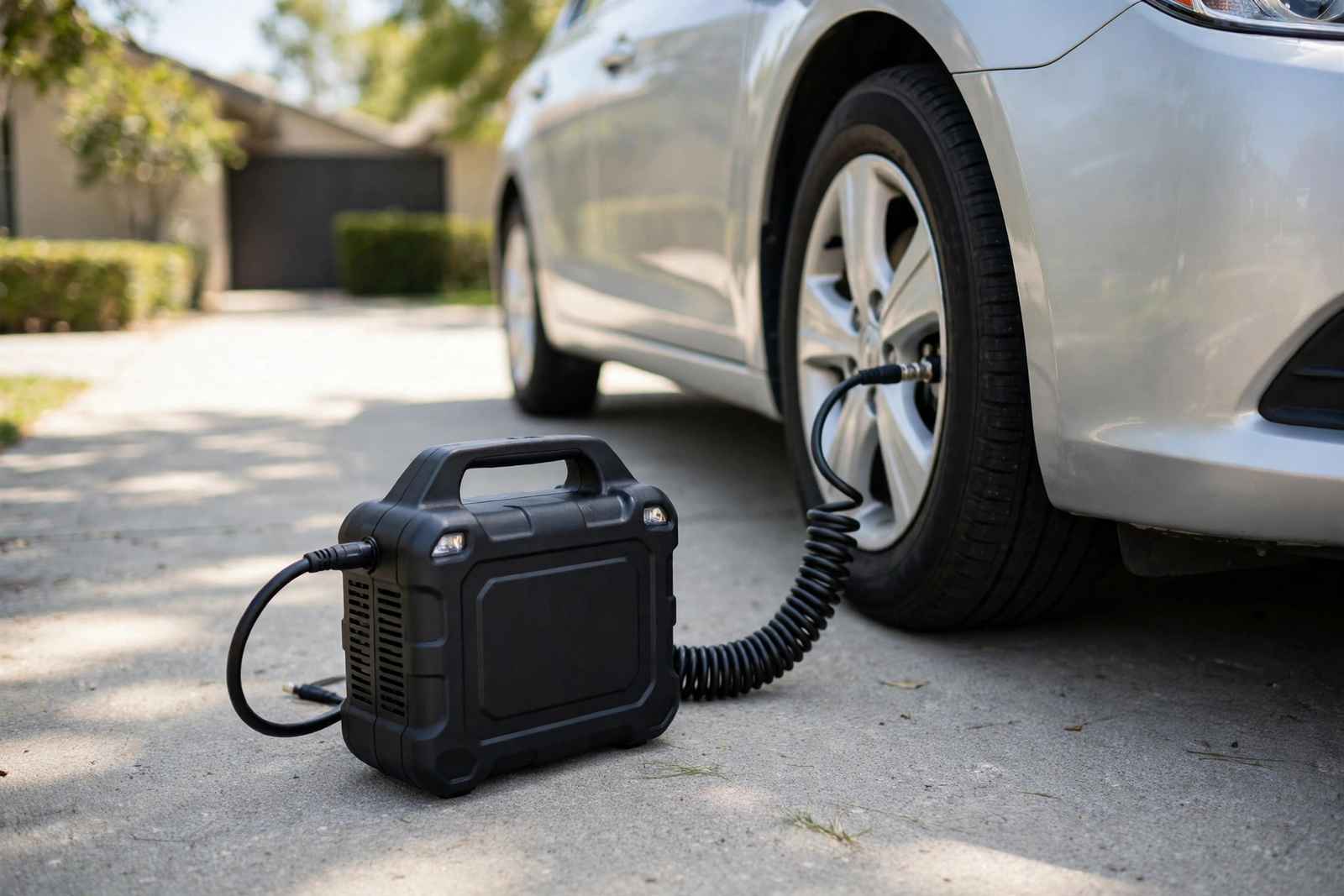
The compressor is what separates the TREKURE from a plain jump starter. It reaches 150 PSI, well above the 30 to 35 PSI a normal car tire needs: the LCD shows the current pressure, you set the target in PSI, KPA or BAR, and it stops itself at the preset pressure. The detachable hose screws onto the unit, the nozzle clamps onto the valve stem, and three gas nozzles cover balls and small inflatables as well as tires.
That 150 PSI ceiling sits just below the 160 PSI of both rivals, but the difference is academic: a tire needing 32 PSI does not care whether the pump could reach 150 or 160. The preset and auto shut-off matter more, stopping you over-inflating a tire in the dark. One honest limit: it is a portable pump, not a workshop compressor — it inflates tires and small inflatables, not air tools. No inflation time or airflow figure is published for the Beta06; the 45 litres per minute figure online belongs to the Beta07.
Battery, Charging, and Power-Bank Use
The battery is a 23,800mAh lithium polymer pack — close to the 24,000mAh in the MV24A and the X7, and large enough that the compressor and power-bank functions do not leave the jump-start side short. Charging runs over USB-C with the cable included; the wall adapter is not, so you use your own. The LCD shows the charge percentage, and the manual says to recharge every 3 to 6 months even when unused.
As a power bank it offers dual USB outputs for phones and tablets, plus a 160W EC output: plug the included cigarette-lighter adaptor into the EC port and it powers 12V DC devices. No USB-C charging wattage is published for the Beta06 — the 45W figure belongs to the Beta07, and the MV24A’s 65W is a different product’s number.
TREKURE vs the Alternatives (WOLFBOX MV24A, VTOMAN X7)
The honest comparison is against the other combo units, and the MV24A is the closest. Covered in our WOLFBOX MV24A review, it offers 4000A against the TREKURE’s 6000A, a 160 PSI compressor against 150 PSI, 65W USB-C, a 400-lumen LED, IP64 protection and a rating down to -4°F. It is the more proven unit, though its diesel rating conflicts too: Amazon says 10L, Best Buy says 6L. What it costs you is weight — about 5.3 lbs against 1.96 lbs — and 2000A of peak current.
The VTOMAN X7 is the premium-flavoured rival: 4250A for 12V vehicles up to 10L gas and 10L diesel, a 160 PSI compressor, and the biggest screen here — a 5.1-inch display showing battery level, inflation mode and real-time pressure. VTOMAN rates it for up to 70 jump starts per charge from an 88.8Wh battery, with a 400-lumen LED, 10-layer protection, -4°F to 140°F operation, and an 18-month warranty with lifetime support. It wins on the screen, the counted starts and an undisputed diesel rating, but gives up 1750A and the 2-year warranty.
The third name is for buyers who do not need a compressor: the NOCO Boost GB70, covered in our NOCO Boost GB70 review. It is a focused 2000A jump starter for gas to 8.0L and diesel to 6.0L, with up to 40 starts per charge from a 56Wh battery, a 400-lumen LED, IP65 protection and a 1-year warranty. It cannot inflate a tire. So the TREKURE 6000A is the strongest pick on paper; the MV24A is the most proven combo; the GB70 is the simpler buy if you only need to jump.
Who Should Buy It — and Who Should Skip It
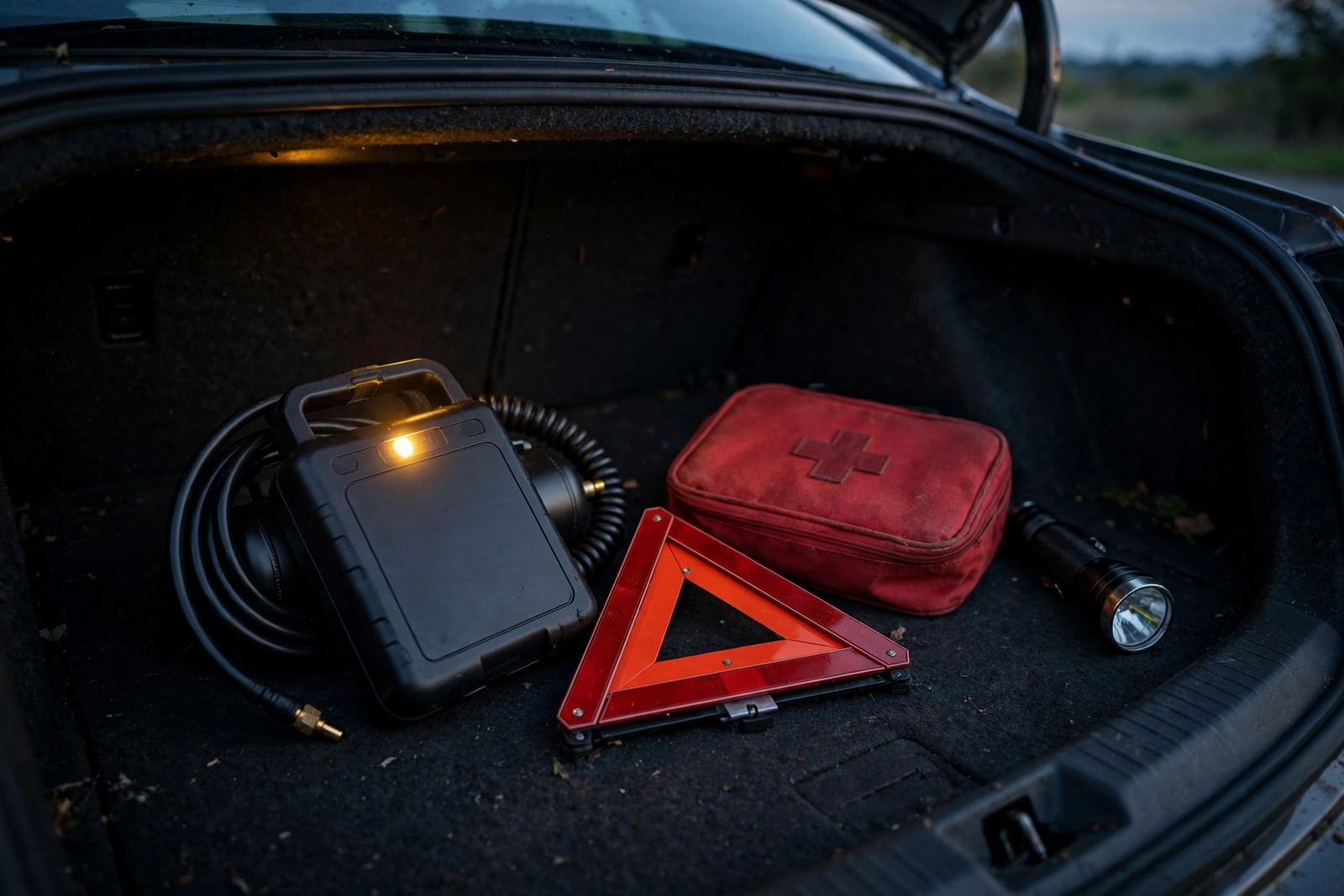
Buy the TREKURE if you want one roadside box that both jumps and inflates, with the strongest peak current here and the lightest unit — 6000A at 1.96 lbs is a combination neither rival matches. It suits big gas engines or diesels up to 10L, commuters who park outside, road-trippers, and anyone whose trunk holds a warning triangle and a first-aid kit.
Skip it if your biggest engine is a small four-cylinder with standard tires — a smaller jump starter and a pocket inflator cover both jobs. Skip it too if your diesel is above 10L, or if you need a workshop compressor. And skip it if a long, proven track record matters more than headline numbers: TREKURE is less established than NOCO or WOLFBOX, and the 5500A versus 6000A conflict means checking the listing first.
Verdict
Jump starting a car is a simple skill, and the TREKURE 6000A is a simple answer to it: 6000A for all gas and 10L diesel engines, a 150 PSI compressor with preset pressure and auto shut-off, a 23,800mAh battery that doubles as a power bank, and a 2-year warranty, in a 1.96 lb unit. Its limits are clear: the 5500A conflict needs a check before you order, no starts-per-charge or cold-temperature figure is published, and it is not a battery charger or a workshop compressor. Accept those facts: this is the strongest combo on paper here.
Frequently Asked Questions
Can the TREKURE jump start a diesel engine?
Yes, if the diesel engine is 10L or smaller. TREKURE rates the Beta06 for all gas engines and diesel engines up to 10L in 12V vehicles, with 6000A of peak current. The forced-start button on the jumper cable helps with a battery that is completely dead. If your diesel is larger than 10L, the TREKURE is not rated for it and you need a bigger unit.
How do I jump start a car with the TREKURE?
Check the unit is charged and switch off the ignition and accessories. Connect the red clamp to the positive terminal of the dead battery and the black clamp to a solid, unpainted metal ground on the engine block or chassis, away from the battery. Plug the cable into the TREKURE’s EC port, check the indicator is green — press the forced-start button if it is red or flashing and the battery is completely dead — then start the engine. Once it is running, unplug the cable from the unit, then remove the black clamp, then the red clamp.
Can I use the TREKURE as a battery charger?
No. Shoppers looking for a battery charger jump starter should know the TREKURE is a jump starter, not a charger: it gives a dead-but-healthy battery the surge it needs to start, but it will not recharge a flat battery or fix a worn-out one. If the job is charging, a real charger such as the NOCO GENIUS2 is the right tool — it charges and maintains batteries rather than starting cars.
How much pressure can the TREKURE compressor reach?
Up to 150 PSI. The LCD display shows the current tire pressure, you set the target in PSI, KPA or BAR, and the compressor stops itself once the preset pressure is reached. That ceiling is well above the 30 to 35 PSI a normal car tire needs, and the three gas nozzles in the box cover balls and small inflatables as well as tires.
How long does the TREKURE battery last between charges?
TREKURE’s manual says to recharge the unit every 3 to 6 months even when it has not been used, to keep the battery healthy. The battery is 23,800mAh, but TREKURE publishes no number of jump starts per charge for the Beta06, so this review states none. Top the unit up after you use it, and check the charge before a long trip or before winter.
Should I buy the TREKURE or the WOLFBOX MV24A?
On paper, the TREKURE wins: 6000A against 4000A, 1.96 lbs against about 5.3 lbs, and a 2-year warranty. The MV24A answers with a 160 PSI compressor against 150 PSI, 65W USB-C charging, IP64 protection, a rating down to -4°F, and the longer, more proven track record. If the strongest peak current and the lightest box matter most, choose the TREKURE; if the proven combo and faster USB-C charging matter more, choose the MV24A.