A cabin air filter replacement cost is one of the smallest numbers in car maintenance — and one of the most misunderstood. The Spearhead Odor Defense Breathe Easy Cabin Filter BE-285 is built for drivers who want that number to stay small: a single activated-carbon filter with electrostatic media, cut for Toyota, Lexus, Jaguar, Land Rover, Pontiac, Scion and Subaru models from 2005 to 2025, that swaps in behind the glove box in minutes. The filter is the cheap half of the job; the expensive half is paying a shop to fit it. Note the model number: the BE-285 is a different model from the Spearhead BE-157 in our roundup — same line, different size and fitment.
In this review of the Spearhead BE-285, we break down what a cabin filter change actually costs — doing it yourself against having a shop do it — and cover what the filter is and which cars it fits, what the media does, how the install works, when to change it, and how it compares with the EPAuto CP134 and the CARORY carbon filter. The Quick Pick table below has the short version first.
As an Amazon Associate I earn from qualifying purchases.
| Pick | Product | Why it stands out | Check Price |
|---|---|---|---|
| Overall Winner | Spearhead Odor Defense Breathe Easy Cabin Filter BE-285 | Electrostatic media plus activated carbon, up to 25% longer lasting, for Toyota and Lexus models | |
| Best Budget | CARORY Activated Carbon Cabin Air Filter | Carbon odor control at a lower price point, per our cabin air filter roundup | |
| Premium Pick | EPAuto CP134 (CF10134) Premium Cabin Air Filter | Activated-carbon media, single-pack, fits a wide range of Honda and Acura models |
Table of Contents
Cabin Air Filter Replacement Cost: What the Spearhead BE-285 Is — and Which Cars It Fits
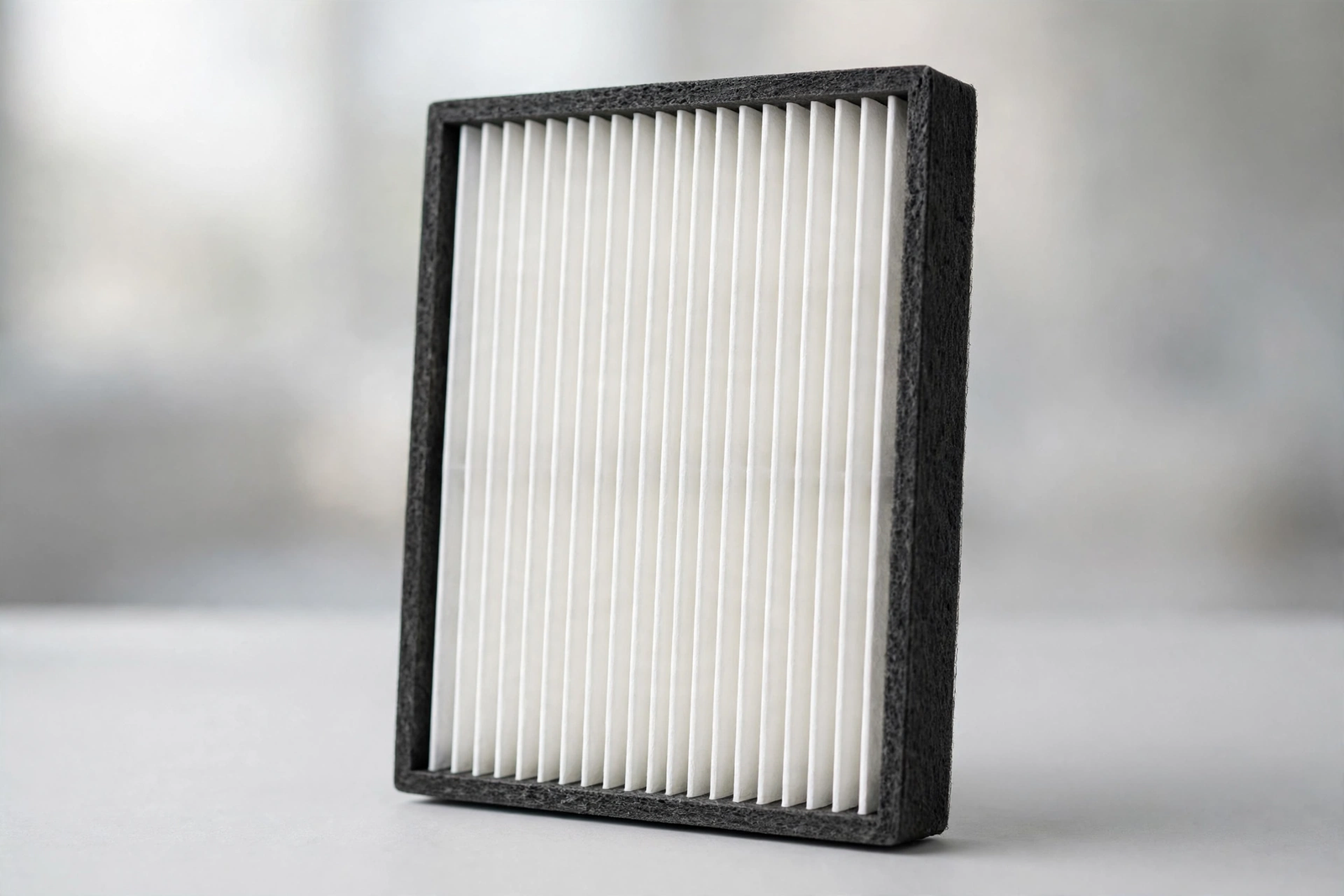
The BE-285 is the activated-carbon variant of Spearhead’s Breathe Easy line. The line comes in three versions for the same housing: the BE-285P particulate filter for dust, the BE-285 carbon filter for odour and fumes, and the BE-285H HEPA filter for air-quality-sensitive drivers. This review covers the middle one, the version most buyers need — one disposable filter in the box.
The listing covers select Toyota, Lexus, Jaguar, Land Rover, Pontiac, Scion and Subaru models from 2005 to 2025. The word “select” matters — the fitment chart is the authority. The BE-285 cross-references the FRAM CF10285, the size used across a long list of Toyotas including the Camry, Corolla, RAV4 and Highlander. It measures 8.46 by 7.64 by 1.14 inches.
Do not confuse the BE-285 with the BE-157. The BE-157 is the Spearhead filter in our cabin air filter roundup — a different part number, a different size, and a different set of cars. The two share the Odor Defense name, but they do not fit the same housings — ordering the wrong one wastes the purchase.
What a Cabin Filter Change Actually Costs: DIY vs the Shop
A cabin filter change has two parts: the filter and the fitting. Do it yourself and the filter is the whole job. Have a shop do it and you pay for the same filter plus labour. That labour fee is where the money goes. Our CARORY cabin air filter review notes a dealer labour fee for this exact job often exceeds the filter’s price threefold — one of the highest-value DIY jobs on any car. The saving is not in buying the cheapest filter — it is in skipping the labour fee entirely.
The second half of the cost picture is how often you pay it. Spearhead claims the BE-285 lasts up to 25 percent longer than standard filters; our roundup cites up to 15,000 miles for the Odor Defense line against the usual 12,000-mile interval. A longer interval means fewer changes over the years you own the car. That is a real saving if the claim holds for your driving — dusty roads, heavy traffic and allergy season shorten any filter’s life.
Choosing the right variant is the third cost decision. If your only complaint is dust, the particulate BE-285P does the job for less. If the complaint is smell — exhaust fumes, a musty vent, smoke residue — the carbon BE-285 is the rational buy, because a particle-only filter does nothing for odours. This review states no prices — check the live listing. The comparison that matters is the filter alone against the filter plus a labour fee.
Electrostatic Media and Activated Carbon: What the Filter Actually Does
A basic cabin filter is a particle screen: pleated media that catches dust and pollen as air passes through. The BE-285 adds a second job. Its media is electrostatic, described as twice as heavy as standard filter media, so it holds a stronger charge and traps fine particles — dust, pollen and allergens — that plain paper lets through. That two-layer idea is now standard across most carbon cabin air filters.
The carbon layer is coconut-shell activated carbon, per our roundup. Activated carbon adsorbs gases and odour molecules — exhaust fumes, road smells, musty air — that pass straight through a plain particle filter. Third-party roundups describe the Breathe Easy build as multi-stage: an electrostatic layer for dust, an antimicrobial layer, and the carbon layer for fumes.
Carbon helps with odours, not with everything. It will not fix a mouldy evaporator core, which needs a proper HVAC cleaning, and it does not last forever — the carbon saturates over time, which is why yearly replacement matters more with carbon filters than with basic ones. A saturated filter still catches dust, but its odour-fighting benefit is gone.

Fitment: The One Thing to Get Right
Cabin filters are sized to the millimetre for each vehicle, and the BE-285 is no exception. A filter slightly too small leaves gaps where unfiltered air bypasses it; one too big will not seat and can whistle or rattle. Use the listing’s vehicle selector and confirm the BE-285 is listed for your exact year, make, model and trim before ordering. The cross-reference list — FRAM CF10285 and Toyota OEM part numbers — is a second check, but the vehicle selector decides.
There are two fitment traps specific to this filter. The first is the BE-157 confusion above: the two Spearhead models look alike in a search result, and the wrong one will not fit your housing. The second is the year edge: a model year near the edge of that range deserves a second look at the compatibility chart.
One more check before you buy: make sure your car takes a cabin filter in this size — a model year just outside the listed range may not. Your owner’s manual confirms the filter location and part number. Our cabin air filter roundup compares the three.
How to Replace It: A Ten-Minute Glove-Box Job
On most cars the cabin filter lives behind the glove box, and the BE-285 is a drop-in replacement for that slot. Open the glove box, release the damper arm or side stops, and drop it down — the filter door is right there. Slide the old filter out, noting the airflow arrow, then slide the BE-285 in the same way and reassemble the glove box. No tools on most models, under ten minutes for a first-timer — the whole cabin filter replacement takes less time than the drive to the shop.
The airflow arrow is the one step people get wrong. The arrow points in the direction of airflow, which is almost always downward or toward the cabin. If you did not note the old filter’s direction, the housing usually has one moulded into it. A filter installed backwards still filters, but it filters worse.
The other mistake is skipping the side-by-side comparison. Hold the new BE-285 next to the old filter first: same length, same width, same thickness. If anything looks off, stop and check the part number rather than forcing the filter into the housing. A forced filter can bow and let unfiltered air bypass it.

When to Replace It: Signs Your Filter Is Spent
Most manufacturers recommend every 12,000 to 15,000 miles or once a year — the standard guidance our roundup follows. Spearhead’s longer-life claim sits at the top of that range: up to 25 percent longer than standard filters, described as up to 15,000 miles for the Odor Defense line. The interval is a guide, not a deadline. Dusty roads, city traffic and allergy season all shorten it.
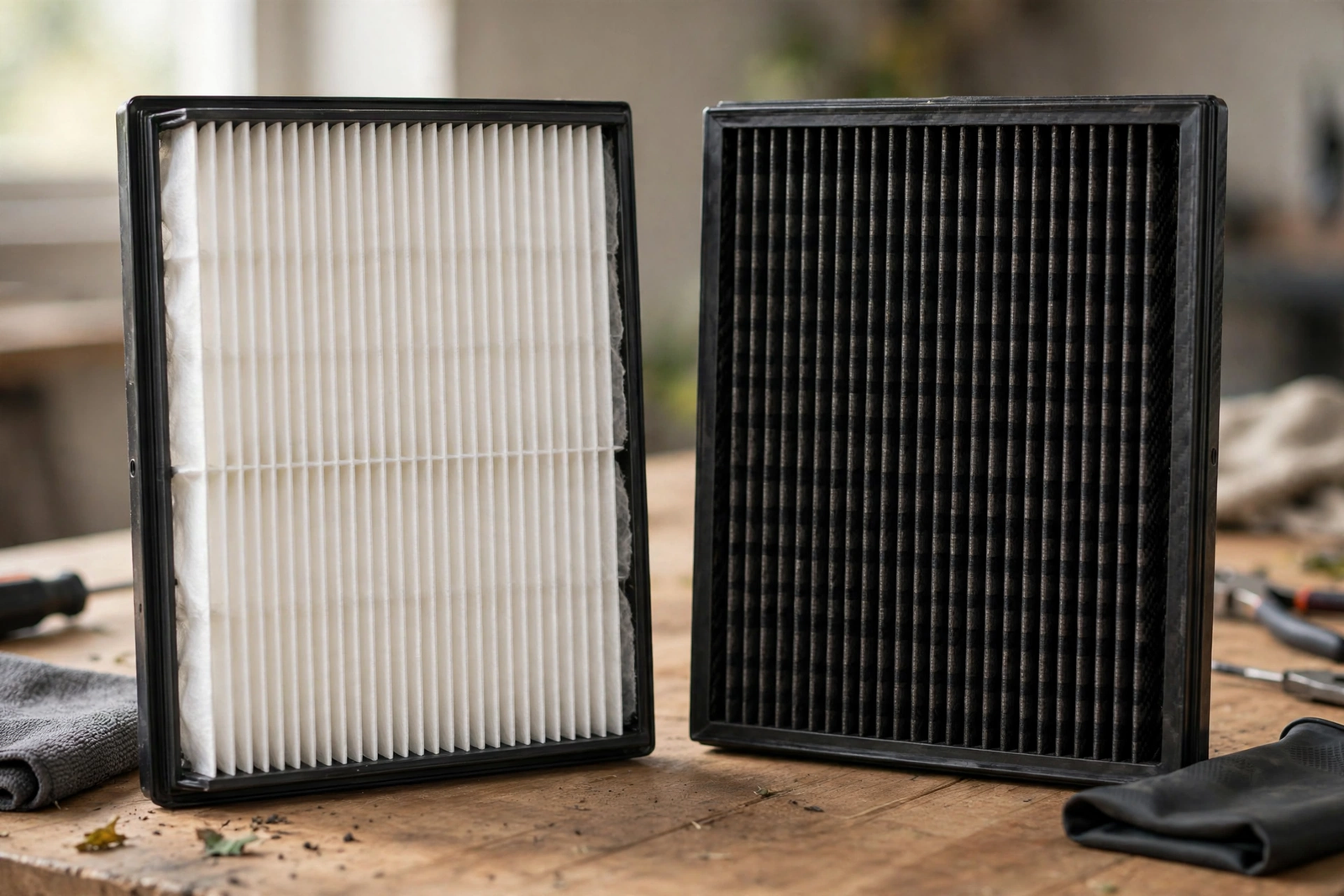
Replace sooner if you notice the symptoms of a spent filter. Weak airflow from the vents is the first sign: a clogged filter restricts airflow, which makes the air conditioning feel weak and forces the blower motor to work harder. A persistent musty smell when the air first kicks on is the second. Visible dirt when you pull the filter out is the third — grey or black pleats, or leaves and debris in the media, mean the filter is overdue.
One symptom deserves a different fix. If a new filter does not clear a musty smell, the problem is probably not the filter: a mouldy evaporator core, a clogged drain, or odour-soaked upholstery will keep smelling no matter how fresh the filter is. Those need cleaning, not another filter — the filter cleans incoming air only.

Spearhead BE-285 vs the Alternatives (EPAuto CP134, CARORY)
The CARORY activated carbon cabin filter is the direct rival, and the one most BE-285 buyers will actually cross-shop — because it fits the same cars. The CARORY CF285 covers the same Toyota, Lexus, Subaru, Jaguar and Land Rover models in the same CF10285 size. Our CARORY cabin air filter review reports a 4.7-star average across 10,300 reviews, and our roundup gave it the Best Budget slot. The BE-285 counters with denser electrostatic media and a longer-life claim.
The EPAuto CP134 is the premium rival on paper and a non-rival in practice, because it fits different cars. The CP134 is cut for Honda and Acura models only, and it will not fit a Toyota or a Lexus. So the two filters are not competing for the same car: if you drive a Toyota or Lexus, the BE-285 is the fit; if you drive a Honda or Acura, the CP134 is.
The Mazda set belongs in a different comparison altogether. Our Spearhead vs Mazda cabin filter comparison covers it: an engine plus cabin filter bundle for Mazda 3 and CX models. It is a maintenance bundle, not a cabin-air upgrade, and it only makes sense if you drive a compatible Mazda.
The three filters cover three different buying decisions, and as with any car air filter, the right size for your car matters more than the brand on the box. Buy the BE-285 if you drive a listed Toyota, Lexus, Subaru, Jaguar or Land Rover and your complaint is smell or stale cabin air. Buy the CARORY if the same cars are yours and the budget matters more than the media density. Buy the CP134 only if you drive a Honda or Acura. Skip the carbon versions if your only complaint is dust — the particulate BE-285P exists for that buyer.
Verdict
For the drivers it fits, the Spearhead BE-285 keeps cabin air filter replacement cost down to the filter itself: a ten-minute DIY job, electrostatic media plus activated carbon, and a longer-life claim that stretches the interval. Its limits are equally clear: it fits select Toyota, Lexus, Jaguar, Land Rover, Pontiac, Scion and Subaru models only, it is a different model from the BE-157, and the carbon layer saturates — so follow the yearly interval. If you drive a covered Toyota or Lexus and your filter is due, this is a strong buy — and doing it yourself is where the saving lives.
Frequently Asked Questions
How much does a cabin filter change cost if I do it myself?
The filter itself is the whole job when you do it yourself — no tools on most cars and under ten minutes. A shop adds a labour fee on top of the filter, and our CARORY review notes a dealer labour fee for this exact job often exceeds the filter’s price threefold. This review states no prices because listing prices move with sales and stock; check the live listing before you buy, and compare it against what your dealer or shop would charge for the same job including labour.
Which cars does the BE-285 fit?
Select Toyota, Lexus, Jaguar, Land Rover, Pontiac, Scion and Subaru models from 2005 to 2025. The BE-285 cross-references the FRAM CF10285, the size used across a long list of Toyotas including the Camry, Corolla, RAV4 and Highlander. Always confirm your exact year, make, model and trim against the listing’s fitment chart before ordering, because “select” means not every model from those years is covered.
Is the BE-285 the same as the BE-157?
No. The BE-285 and the BE-157 are different models in the same Spearhead Odor Defense line, with different sizes and different fitments. The BE-157 is the filter in our cabin air filter roundup, sized for mostly newer models; the BE-285 is the CF10285-size filter covered in this review. They do not fit the same housings, so check the part number on the listing before you order.
What is the difference between the BE-285, BE-285P and BE-285H?
They are three variants for the same housing size. The BE-285P is the particulate filter for everyday dust defence. The BE-285 is the activated-carbon filter for odour and fume control — the version reviewed here. The BE-285H is the HEPA filter for drivers sensitive to air quality. Match the variant to your complaint: dust alone takes the particulate version, smell takes the carbon version, and air-quality sensitivity takes the HEPA version.
How often should I replace the BE-285?
Every 12,000 to 15,000 miles or once a year, whichever comes first — the standard guidance our roundup follows. Spearhead claims up to 25 percent longer service life than standard filters, described as up to 15,000 miles for the Odor Defense line, which sits at the top of that range. Replace sooner if vent airflow weakens, a musty smell persists, or the filter looks visibly dirty when you pull it out, and sooner still if you drive on dusty roads or in heavy traffic.
Spearhead BE-285 or CARORY — which should I buy?
Both fit the same cars in the same CF10285 size, so the choice is about media and budget. The CARORY is the budget carbon filter — activated-carbon odour control at a lower price point, with a 4.7-star average across 10,300 reviews per our CARORY review. The BE-285 counters with denser electrostatic media and a longer-life claim of up to 25 percent. If the budget matters most, buy the CARORY; if the heavier media and the longer interval matter most, buy the BE-285.