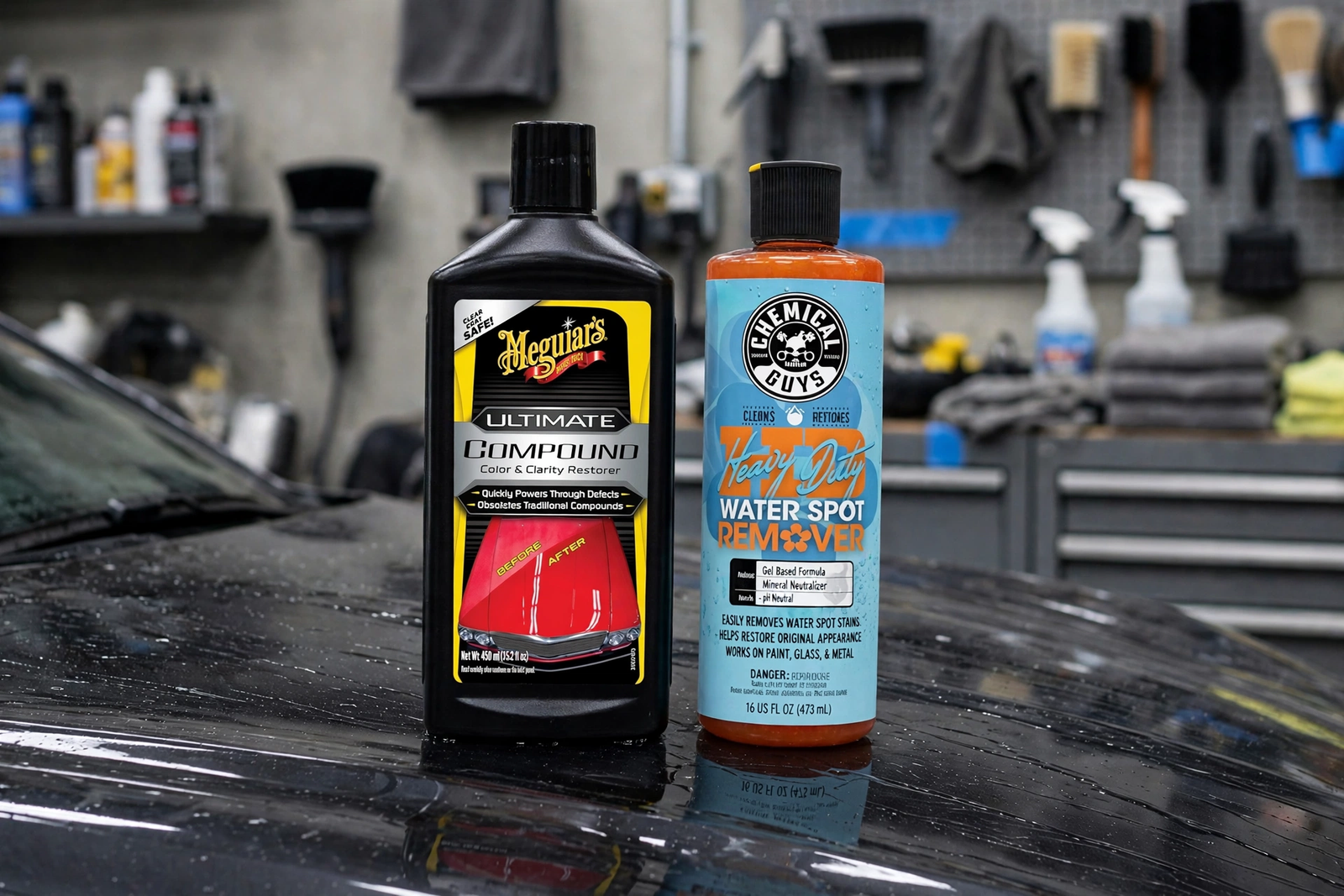
This is not a like-for-like comparison, and honesty requires saying so up front. Meguiars Ultimate Compound is a scratch and swirl remover: a diminishing-abrasive compound that levels clear coat. Chemical Guys Heavy Duty Water Spot Remover is a gel that dissolves mineral deposits left by hard water. They fix different problems, which is exactly why buyers compare them: the question is not which is better, it is which problem your paint actually has.
The one-line version: swirls, light scratches, and oxidation call for the Meguiars compound; crusty white water-spot etchings call for the Chemical Guys gel. Using the wrong one wastes an afternoon.
The short answer: for swirls, light scratches, and dull oxidized paint, Meguiars Ultimate Compound is the pick: a clear-coat-safe compound at 4.4 stars across 11,000-plus reviews. For hard-water spots and mineral etchings, Chemical Guys Heavy Duty Water Spot Remover gel is the pick: it dissolves deposits the compound cannot. Diagnose first, buy second.
As an Amazon Associate I earn from qualifying purchases.
Table of Contents
Table of Contents
Quick Pick: Meguiars vs Chemical Guys
| Pick | Product | Best For | Check Price |
|---|---|---|---|
| For Scratches & Swirls | Meguiars Ultimate Compound Scratch Remover | 4.4 stars across 11,000+ reviews; clear-coat-safe correction | |
| For Water Spots | Chemical Guys Heavy Duty Water Spot Remover Gel | Gel formula dissolves mineral deposits on paint and glass | |
| Best Value Fix | Meguiars Ultimate Compound Scratch Remover | A little compound corrects a lot of paint |
Meguiars Ultimate Compound: For Scratches, Swirls, and Oxidation
Ultimate Compound uses diminishing abrasives: the particles break down as you work, starting with cut and finishing toward polish. That makes it forgiving by hand, which is why it is the default recommendation for first-time paint correction. It is safe on clear coats when used as directed, and the 4.4-star rating across 11,000-plus reviews reflects a huge base of successful DIY jobs.
What stands out: accessibility. You can correct swirls by hand with a foam applicator, no machine required, though a dual-action polisher is faster on large panels. It removes light scratches, swirls, water-spot haze that has not etched, and oxidation.
Worth knowing: it cannot fix what it cannot reach. Deep scratches through the clear coat, etched water spots, and rock chips need other remedies. And compounding removes a thin layer of clear coat, so go easy; this is not a product to use aggressively every wash.
Chemical Guys Heavy Duty Water Spot Remover: For Mineral Deposits
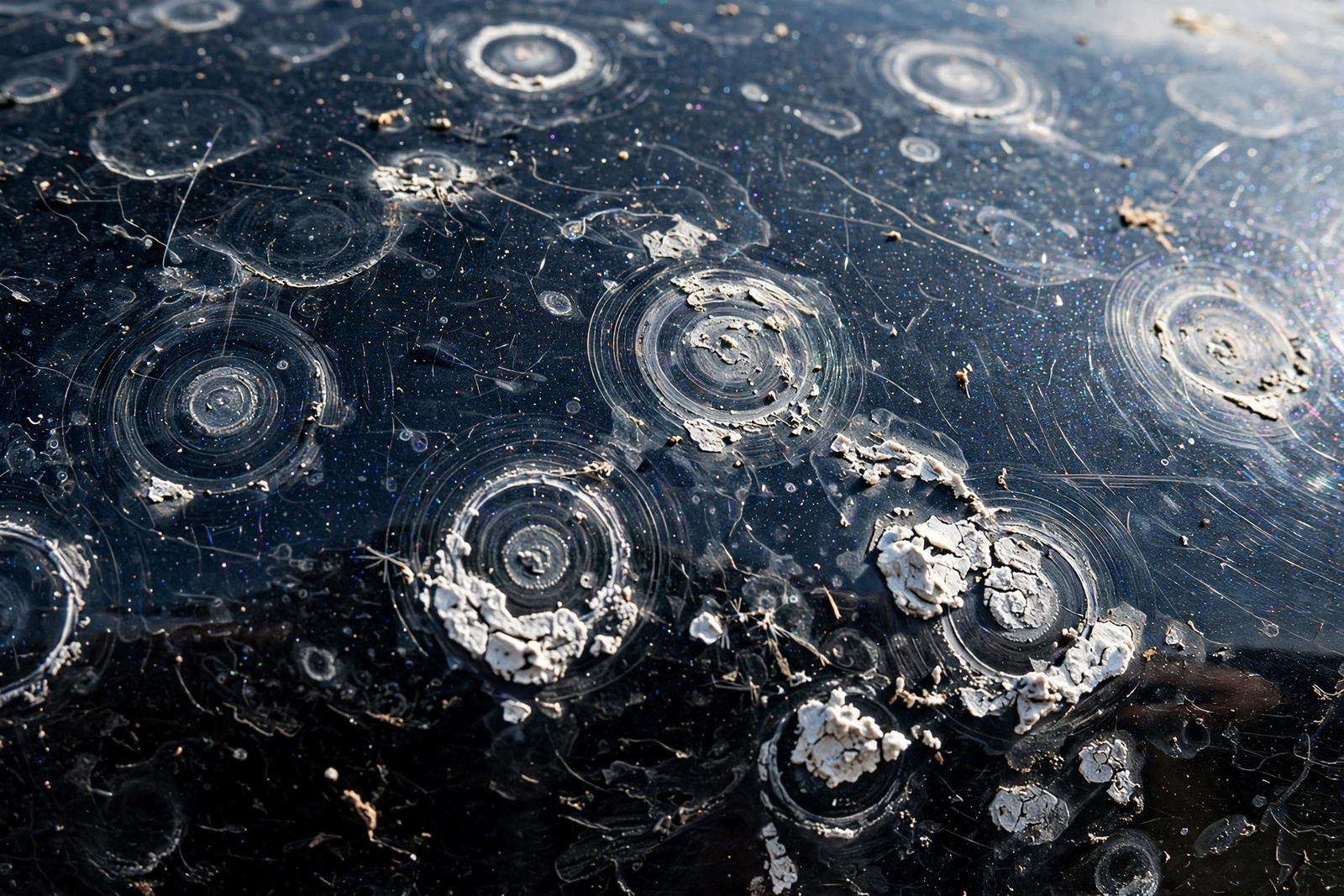
Hard water leaves mineral deposits that bond to paint and glass; left in the sun, they etch. The Chemical Guys gel is formulated to dissolve those mineral deposits chemically rather than abrade them away. The gel consistency matters: it clings to vertical panels instead of running off like a liquid would.
What stands out: it solves the problem compounding cannot. Etched water spots laugh at abrasives; they need chemistry. The 4.0-star rating across 13,000-plus reviews reflects a product that works when the problem is actually mineral deposits.
Worth knowing: it will not fix swirls or scratches, and on badly etched spots even the gel may only improve, not erase. Test in a hidden spot first, follow the dwell time, and rinse thoroughly. For the full wash routine around it, see our detailing kit guide.
Side-by-Side: Two Different Paint Fixes
| Point | Meguiars Ultimate Compound | Chemical Guys Water Spot Remover |
|---|---|---|
| Fixes | Swirls, light scratches, oxidation | Mineral water spots and etchings |
| Method | Diminishing abrasives (mechanical) | Mineral-dissolving gel (chemical) |
| Safe on clear coat | Yes, when used as directed | Yes; test spot first |
| Works on glass | Not its job | Yes, formulated for glass too |
| Rating | 4.4 stars (11,000+) | 4.0 stars (13,000+) |
Buying Guide: Diagnose the Paint Problem First
Diagnose before you buy. Run a finger over the defect. Swirls and light scratches you can barely feel: compound. Crusty, whitish spots that appeared after water dried on the car: water spot remover. Wrong diagnosis, wrong product.
Try the least aggressive fix first. For water spots, the gel before the compound. For swirls, hand application before machine. Paint correction always starts gentle.
Protect after you correct. Freshly corrected paint is exposed paint. A sealant or wax afterward locks in the work; otherwise the swirls return with the next bad wash.
Wash technique prevents both. Most swirls come from bad washing, most water spots from air-drying hard water. Fix the wash and you fix the source.
Who Fits Whom
- Swirled or scratched paint: Meguiars. The compound levels what the eye sees.
- Hard-water spots: Chemical Guys. Chemistry dissolves what abrasives cannot.
- First-time correctors: Meguiars. Forgiving by hand, huge knowledge base.
- Both problems: buy both; they do different jobs.
The Right Order: Wash, Decontaminate, Correct, Protect
Step 1: wash properly. Two buckets, a clean mitt, shade, not direct sun. Most swirls are born in the wash; fixing your technique prevents the next round of correction.
Step 2: decontaminate. After washing, feel the paint with a plastic bag over your hand. Roughness means bonded contaminants; a clay bar or mitt removes them. Never compound over contamination; you will grind it in.
Step 3: correct. Now the compound or the water spot remover, matched to the diagnosed problem. Work a panel at a time, wipe and inspect as you go.
Step 4: protect. Sealant or wax over the corrected paint. Correction without protection is a short-lived victory; the next bad wash or hard-water dry undoes it.
Hand vs Machine: How to Apply Compound
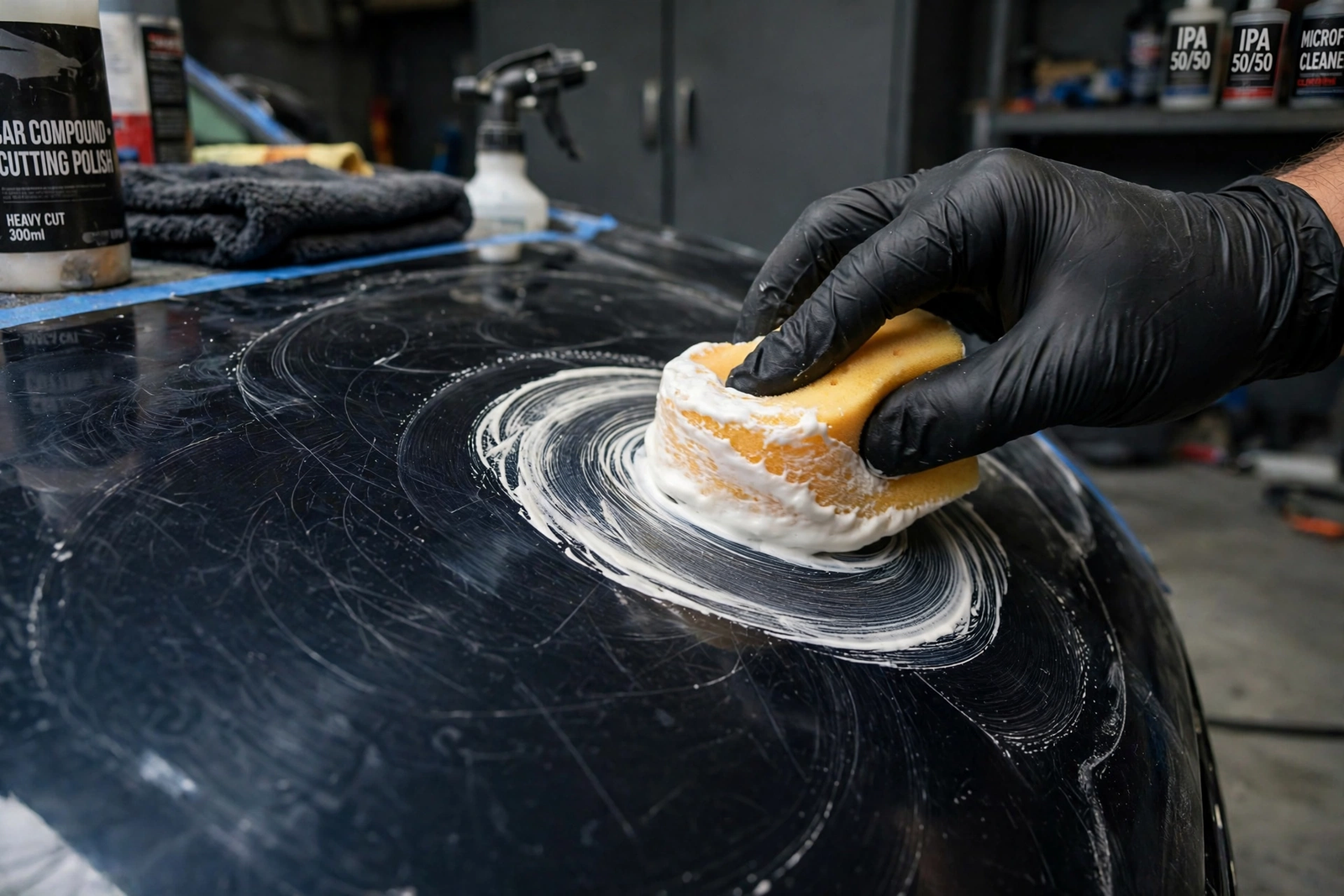
By hand. A foam applicator pad and moderate pressure, working a 2×2-foot section at a time. Wipe off residue with a clean microfiber and inspect before moving on. Hand correction suits spot repairs and first-timers.
By dual-action polisher. Faster, more consistent, and less tiring on large panels. A DA polisher is beginner-safe because the oscillating motion resists burning through paint, unlike a rotary.
Pad matters. Cutting pads for heavier correction, polishing pads for finishing. Start with the least aggressive pad that gets the job done; you can always step up.
Lighting is everything. Swirls hide in shade and reveal in direct light. Inspect with a bright LED at an angle; if it looks good under harsh light, it is good.
The Verdict
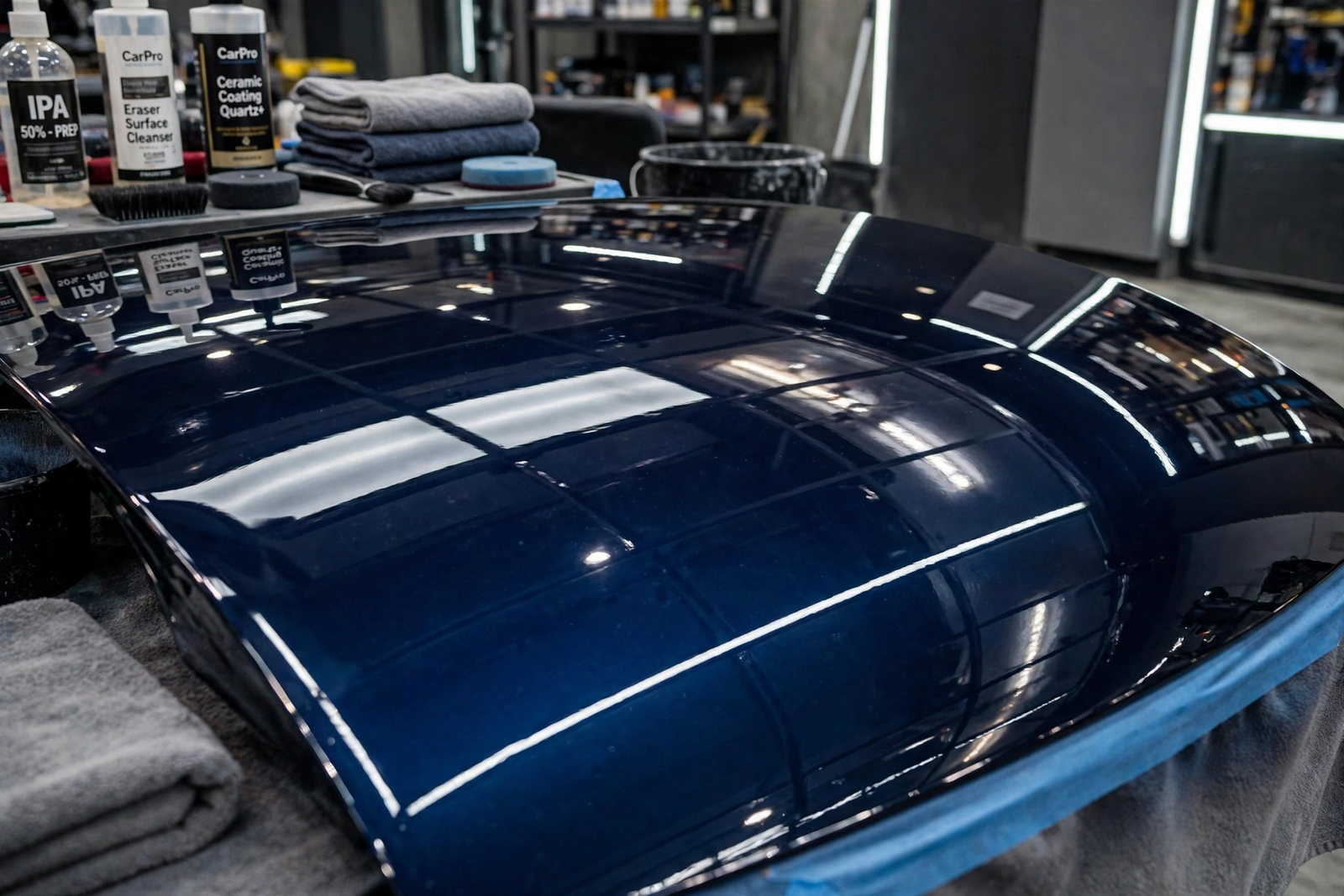
There is no winner because there is no shared contest: Meguiars Ultimate Compound corrects swirls, scratches, and oxidation mechanically, while Chemical Guys Heavy Duty Water Spot Remover dissolves mineral deposits chemically. Look at your paint, name the problem, and buy the fix that matches. Most neglected cars eventually need both, just not on the same day.
Frequently Asked Questions
Should I buy Meguiars Ultimate Compound or Chemical Guys water spot remover?
The meguiars vs chemical guys paint care question is really a diagnosis question: buy the Meguiars compound for swirls, light scratches, and oxidation; buy the Chemical Guys gel for hard-water spots and mineral etchings. They fix different problems, so the right purchase depends on what your paint shows.
Will Ultimate Compound remove water spots?
Only light, unetched water-spot haze. Etched mineral deposits need the chemical approach of a water spot remover; abrasives cannot dissolve minerals.
Is Ultimate Compound safe for clear coat?
Yes, when used as directed. It uses diminishing abrasives designed for clear coats. Work by hand or with a dual-action polisher, keep the pad clean, and do not lean on it.
Can water spot remover be used on glass?
Yes, the Chemical Guys gel is formulated for paint and glass. Test in a small area first and rinse thoroughly.
Do I need a machine polisher?
Not for the Meguiars compound on small areas; hand application with a foam pad works. A dual-action polisher is faster and more consistent on large panels.
What should I do after paint correction?
Protect it. Apply a sealant or wax over the corrected paint, and fix your wash technique (two buckets, clean mitts, dry promptly) so the defects do not return.