Wrapping a Steering Wheel in Leather: A Step-by-Step Guide
A worn steering wheel makes the whole cabin feel tired, because it is the one part of the car your hands touch every time you drive. The leather peels, the rim goes shiny and smooth, and the grip that used to feel solid starts to slip. Wrapping a steering wheel in leather is the fix that does not need a new wheel: a stitch-on leather wrap covers the worn rim, restores the grip, and gives the cabin a fresh, factory-like look for the cost of a kit and an afternoon of stitching.
The short answer: start with the Wheelskins WS10201XX if you want the classic lace-on genuine leather wrap, pick the Mewant Toyota wrap if you want a kit cut to your Toyota model, and pick the Mewant Silverado wrap if you want genuine leather for a Chevy truck. All three are stitch-on wraps you fit yourself, none of them needs the wheel removed, and every one of them takes about 1 to 2.5 hours of hand stitching.
As an Amazon Associate I earn from qualifying purchases.
Quick Pick: Leather Wrap Kits Compared
| Pick | Product | Best For | Check Price |
|---|---|---|---|
| Classic Lace-On Genuine Leather Wrap | Wheelskins WS10201XX Genuine Leather Black Size AXX Steering Wheel Cover | A genuine leather lace-on wrap in size AXX, for drivers who want the classic sew-on cover | Check Price on Amazon |
| Model-Fit Faux Leather Wrap | MEWANT Steering Wheel Cover Wrap for Toyota Tacoma Tundra 4Runner Sienna Highlander Sequoia Land Cruiser Prado 120 Land Cruiser Hilux LS400 GX GX470 | A Mewant wrap cut for Toyota trucks and SUVs, for drivers who want a model-matched fit | Check Price on Amazon |
| Genuine Leather Truck Wrap | MEWANT DIY Steering Wheel Cover for Chevy Silverado 1500 2500HD Classic Trailblazer Custom Version by Genuine Leather | A Mewant genuine leather wrap for Silverado and Sierra trucks, for drivers who want real leather | Check Price on Amazon |
Table of Contents
Wheelskins WS10201XX: The Classic Lace-On Wrap
The Wheelskins WS10201XX is the classic of this guide, and the oldest name in lace-on leather wraps. It is the Wheelskins WS10201XX Genuine Leather Black Size AXX Steering Wheel Cover, manufacturer part number WS10201XX, a genuine leather wrap sized AXX — one of Wheelskins’ larger sizes. Wheelskins has sold lace-on leather covers for decades, and the design has barely changed: a single piece of leather, pre-punched holes along both edges, and a spool of thread to lace it closed around the rim.

The kit ships with the leather cover, a spool of thread, a large needle and instructions, and owners who have fitted one report spending about an hour on the stitching once they know the pattern. That hour is the honest part of wrapping a steering wheel in leather: the lace-on stitch is simple — a criss-cross that pulls the two edges together — but it has to be pulled snug and even all the way around, or the wrap wrinkles at the spokes. The leather is genuine, not a printed imitation, so it wears in rather than peeling, and it takes the shape of the rim as you stitch.
The Wheelskins is the pick in this guide for the driver who wants the proven lace-on wrap and is happy to measure first: the size has to match the wheel, and AXX is a larger size, so check the maker’s size chart against your wheel’s diameter and grip circumference before you order. Our leather steering wheel wrap review compares three other stitch-on wraps, while this guide is the step-by-step for fitting one.
Wheelskins WS10201XX Genuine Leather Black Size AXX Steering Wheel Cover on Amazon: genuine leather lace-on wrap, size AXX, part WS10201XX, thread and needle included, about an hour to stitch per owner reports
Buy the Wheelskins wrap if: you want the classic genuine leather lace-on cover and you have measured your wheel against the maker’s size chart. Confirm the size before ordering.
Mewant Toyota Wrap: The Model-Fit Kit
The Mewant Toyota wrap is the model-fit pick in this guide: a kit cut to a named vehicle instead of a size code. It is the MEWANT Steering Wheel Cover Wrap for Toyota Tacoma, Tundra, 4Runner, Sienna, Highlander, Sequoia, Land Cruiser Prado 120, Land Cruiser, Hilux, LS400, GX and GX470, model CAR0134-1, in microfiber leather with black thread. The listing names the Toyota models it fits, so the fit question becomes a matching question: find your model on the list, then compare your wheel with the listing photos before you order.
The kit includes the wrap, a needle and two sew threads, and the install is the same hand-stitching job as the Wheelskins: fit the leather over the rim, hold it in place, and stitch the edges together as you work around the wheel. Mewant’s own guidance for its hand-stitch covers puts the stitching at about 1.5 to 2.5 hours, and wrapping a steering wheel in leather with the Toyota wrap is no different — it is a patient afternoon’s work, not a ten-minute job. The microfiber leather is the faux-leather option in this guide: it is easy to clean, and it does not need the care real leather does.
The Mewant Toyota wrap is the pick in this guide for the Toyota driver who wants a kit made for their model rather than a size to measure. It suits a Tacoma, Tundra, 4Runner or Land Cruiser owner whose wheel is worn and who wants the wrap to follow the original shape, spokes and all. Our Mewant steering wheel cover review covers the Tesla and Jeep Mewant kits, while this guide uses the Toyota kit as the model-fit example.
MEWANT Steering Wheel Cover Wrap for Toyota Tacoma Tundra 4Runner Sienna Highlander Sequoia Land Cruiser Prado 120 Land Cruiser Hilux LS400 GX GX470 on Amazon: model-fit wrap, model CAR0134-1, microfiber leather with black thread, needle and two sew threads included
Buy the Mewant Toyota wrap if: you drive one of the Toyota models on the listing and you want a wrap cut to that wheel. Compare your wheel with the listing photos first.
Mewant Silverado Wrap: The Genuine Leather Kit
The Mewant Silverado wrap is the genuine leather pick in this guide, and the one with the strictest fit rule. It is the MEWANT DIY Steering Wheel Cover for Chevy Silverado 1500, 2500HD, Classic and Trailblazer, Custom Version by Genuine Leather, manufacturer part number AMZ3-MET2015-CUS, made of genuine leather, suede or PU carbon fiber depending on the option you choose. It fits the Silverado 1500 from 2003 to 2006 and the Classic 2007, the Silverado 2500 and 2500HD of the same years, the TrailBlazer from 2002 to 2009, and the matching GMC Sierra and Envoy models.

The fit rule matters more than the leather. The listing is explicit: the cover is only suitable for a leather steering wheel, and if your steering wheel is rubber or has wood trim, the cover will not fit. That is the kind of line to read twice before ordering, because a model-fit wrap cut for a leather wheel will not sit right on a bare plastic rim. The listing puts hand stitching at about 1 to 2 hours, and the kit ships with the install tools. One honest flag belongs here: the crawl of this listing showed no featured offers available at the time it was read, so confirm the listing shows a live offer before you order.
The Mewant Silverado wrap is the pick in this guide for the truck driver who wants real leather on a Silverado or Sierra wheel that is already leather underneath. It suits a worn factory leather wheel that needs a fresh surface, and it does not suit a rubber or wood wheel at all. Our genuine leather steering wheel cover review looks at slip-on genuine leather covers, while this guide is about stitching a wrap on.
MEWANT DIY Steering Wheel Cover for Chevy Silverado 1500 2500HD Classic Trailblazer Custom Version by Genuine Leather on Amazon: genuine leather wrap, part AMZ3-MET2015-CUS, for Silverado, Sierra, TrailBlazer and Envoy models, leather steering wheels only, about 1 to 2 hours to stitch per the listing. No featured offers showed in the crawl — check the live offer before ordering.
Buy the Mewant Silverado wrap if: your truck’s wheel is leather already and you want a genuine leather wrap cut to that model. Confirm the listing shows a live offer first.
Measure Your Wheel First: Size Is Everything
Every failed leather wrap starts with a skipped measurement. Wrapping a steering wheel in leather only works when the wrap matches the wheel, and the two numbers that decide it are the outside diameter of the wheel and the circumference of the grip where your hands sit. Measure the diameter straight across the wheel, edge to edge through the center, and wrap a tailor’s tape around the thickest part of the grip for the circumference. Write both numbers down before you look at any listing.
The three kits in this guide measure fit in two different ways. The Wheelskins wrap is sold by size — AXX in this guide is one of its larger sizes — so your two numbers go straight onto the maker’s size chart. The Mewant kits are cut to a named model instead, so when wrapping a steering wheel in leather with a model-fit kit the measurement becomes a cross-check: compare your wheel’s shape and size with the listing photos and the model list, and if anything looks different, send the seller a photo of your wheel before you order. A wrap that is even slightly too big will wrinkle and shift under your hands; one that is too small will not close at the seam.
The Tools and Prep Before You Stitch
A leather wrap kit brings most of what you need: the leather, the thread and a needle — the Mewant Silverado kit also includes a thimble and a small blade for tucking the edges. Add a few things of your own before you start: a clean microfiber cloth and a leather cleaner for the wheel, a pair of scissors, masking tape to hold the leather in place while you start (peel it away once the first stitches hold the wrap), and a good light. Stitching in dim light is how crooked seams happen.
Prep is short but it decides the result when wrapping a steering wheel in leather. Clean the wheel first, and let it dry fully — stitching over dust and hand oils traps dirt under the leather and weakens the grip. Dry-fit the wrap before you thread the needle: slip it over the rim, line up the seams with the spokes, and check that the edges meet evenly all the way around. If the leather is stiff, leave it in a warm room for an hour so it softens and follows the rim. Tape the wrap in place at the top and bottom, and start stitching where the seam will be least visible, usually at the bottom of the wheel. Keep every stitch on the rim — never stitch into, or cover, the center airbag pad in the middle of the wheel: the wrap is a rim-only cover.
Wrapping a Steering Wheel in Leather: The Stitching Step
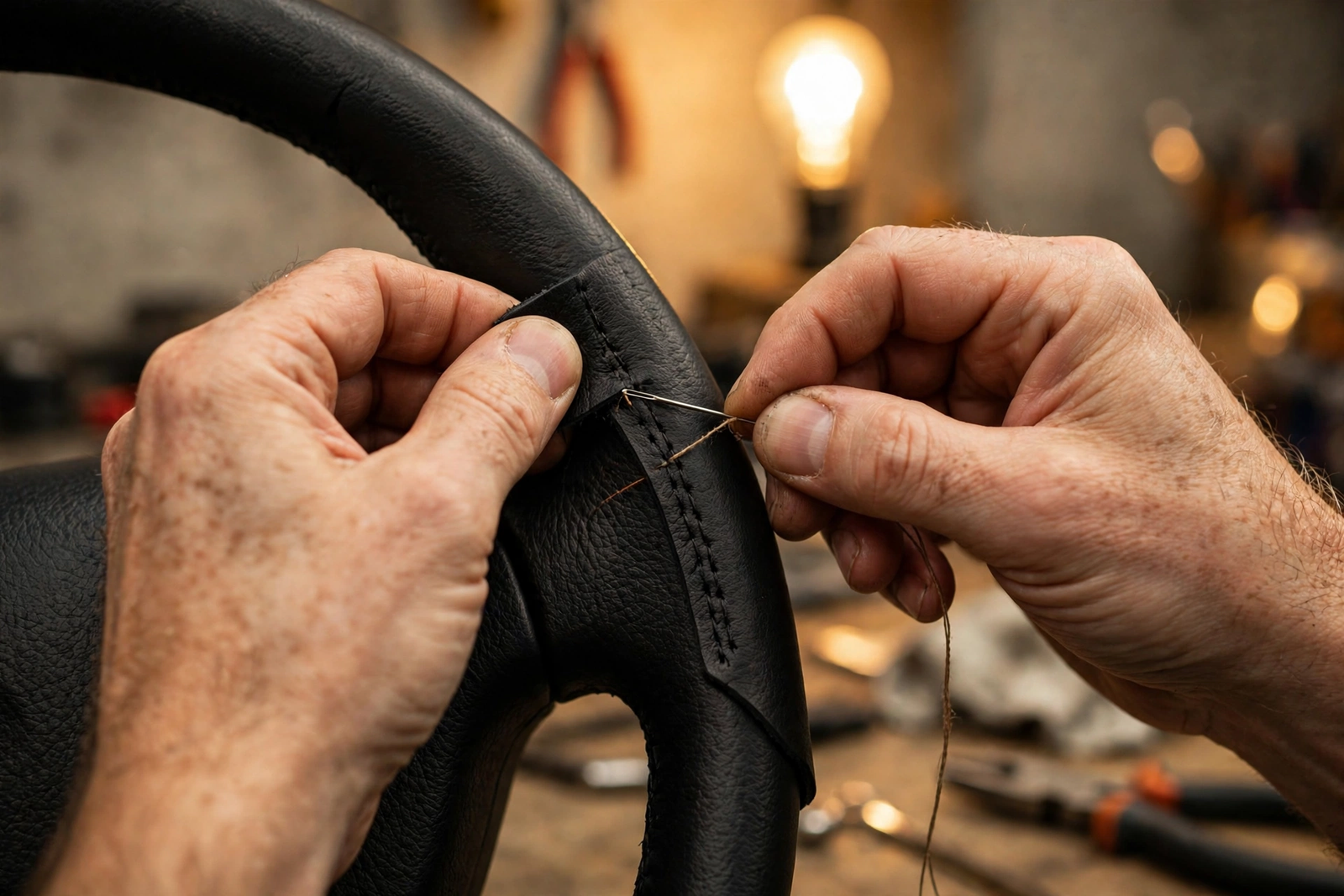
The stitching step is where wrapping a steering wheel in leather is won or lost, and it is the same on all three kits — simpler than it looks. Thread the needle, knot the end, and push it up through a pre-punched hole on one edge of the wrap. Cross to the matching hole on the other edge, pull the thread through, and repeat: up one side, across, up the other side, across. Each stitch pulls the two edges a little closer, and the criss-cross pattern is what holds the leather tight around the rim. Pull each stitch snug before you make the next one — a loose stitch early on shows as a wrinkle later.
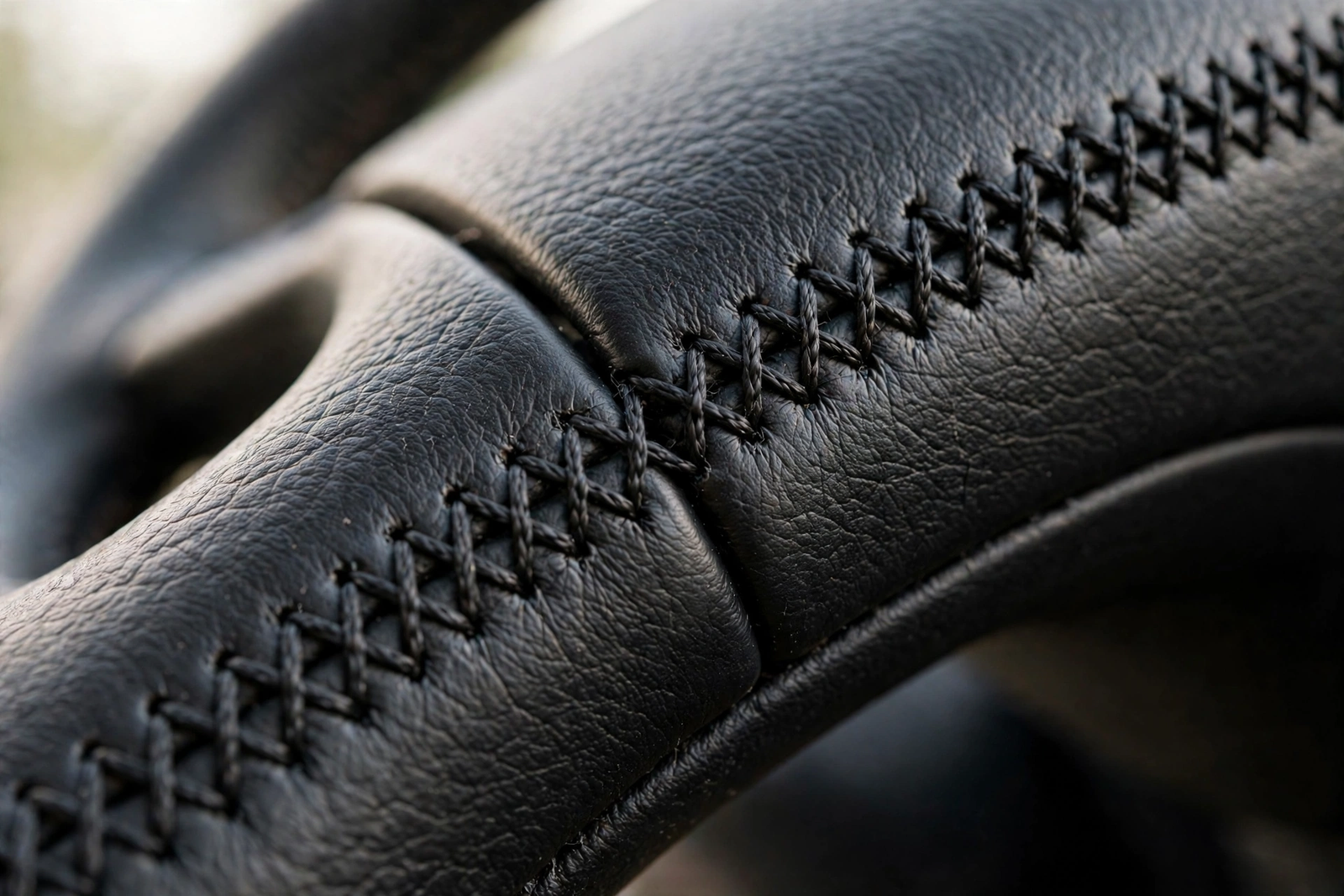
Work in short sections, about a hand’s width at a time, and turn the wheel as you go so the section you are stitching always faces you. At the spokes, slow down: the leather has to fold around the spoke without bunching, and a stitch that skips the spoke edge will leave a gap. When you reach the end, knot the thread on the inside of the wrap, trim the end short, and tuck it under the leather. Then go around the whole wheel once more, pressing the seam flat and checking that no stitch is loose and no edge is lifting.
The last step is the tuck, and a neat tuck is the finish that makes wrapping a steering wheel in leather look factory. A small blade, if your kit includes one, is for pushing the spare leather at the seam into the gap between the rim and the spokes, so the edge sits flush instead of flapping. Work the blade gently — a hard push can cut the thread you just stitched. When the tuck is done, run your hands around the whole wheel: the leather should feel tight, smooth and even, with no soft spots where the wrap is loose and no ridges where it bunched.
Lace-On vs Stitch-On vs Slip-On: Which Wrap to Pick
Lace-on and stitch-on are the same job described two ways: a leather wrap that you sew closed around the rim with needle and thread. All three kits in this guide are that kind of wrap, and wrapping a steering wheel in leather this way is the only kind that truly follows the shape of the wheel, spokes and all. It takes the longest — about 1 to 2.5 hours — but it is also the one that stays put, because the thread holds it tight instead of friction alone.
A slip-on cover is the opposite trade: it stretches over the wheel in a minute, with no stitching and no tools, but it fits by stretch rather than by shape, so it can shift under your hands and it never looks as close to factory as a stitched wrap. Our best steering wheel covers article covers slip-on covers in full, while this guide is about the stitched kind. Pick the stitched wrap when the wheel is worn and you want it to look factory again; pick a slip-on when you only want a quick grip change and you do not mind the looser fit.
Leather Wrap Mistakes to Avoid
The first mistake in wrapping a steering wheel in leather is ordering the wrong size: a wrap that does not match the wheel cannot be stitched into fitting, and the seam will either gape or never close. Measure first, check the size chart or the model list, and compare your wheel with the listing photos. The second mistake is stitching over a dirty wheel — clean it and let it dry, or the dirt stays trapped under the leather.
The third mistake is pulling the thread too hard: a stitch yanked tight enough to pucker the leather will tear the pre-punched holes, and a torn hole cannot be stitched again. Pull snug, not hard. The fourth is starting at the top of the wheel, where the seam shows every time you drive — start at the bottom, where it is out of sight. The fifth is choosing a kit for a wheel it was never made for, like the Mewant Silverado wrap on a rubber or wood wheel: the listing says it will not fit, and no amount of stitching changes that. And the sixth is rushing the last quarter — the final section is where tired stitching goes crooked, so take a break before it, not during it.
Who Should Wrap Their Steering Wheel — and Who Should Not
Wrap your steering wheel if: the factory leather is worn, peeling or shiny-smooth, and you want a fresh grip without buying a new wheel. Wrapping a steering wheel in leather is a straightforward job — a kit, a needle, an afternoon — and the result is visible the same day.
Wrap with care if: your wheel has buttons, heating elements or thick spokes that the leather has to fold around. A model-fit kit handles those shapes better than a size-coded one, so match the kit to the wheel and check the listing photos for the spoke shape before you order.
Do not wrap your steering wheel if: the wheel is damaged underneath — cracked plastic, a loose rim or a faulty airbag area — or the kit’s listing says it will not fit your wheel. A wrap covers wear; it does not repair a damaged wheel, and stitching over a safety problem hides it instead of fixing it. In that case, have the wheel checked first.
The Verdict
The best leather wrap is the one that matches your wheel, and the first rule of wrapping a steering wheel in leather is to match the kit to the wheel before anything else. The Wheelskins WS10201XX is the pick for the classic lace-on genuine leather wrap, when you have measured your wheel and the size chart agrees. The Mewant Toyota wrap is the pick for a Toyota driver who wants a kit cut to their model. And the Mewant Silverado wrap is the pick for a truck driver with a leather wheel who wants genuine leather cut to that truck.
Whichever wrap you choose, check three things before you order: whether the size or the model matches your wheel, whether your wheel is leather already if the listing asks for it, and whether the listing shows a live offer — then measure twice, stitch in good light, pull each stitch snug, and tuck the seam. Wrapping a steering wheel in leather is a slow job done once, and a tight, even stitch is what makes it look factory.
Frequently Asked Questions
How long does wrapping a steering wheel in leather take?
Plan on about 1 to 2.5 hours for your first wrap. The Mewant Silverado listing puts hand stitching at about 1 to 2 hours, Mewant’s guidance for its hand-stitch covers at 1.5 to 2.5 hours, and owners who fitted a Wheelskins cover report about an hour once they know the stitch. Your first wrap will be the slowest — allow a free afternoon, stitch in good light, and do not rush the last quarter of the wheel.
Do I need to remove the steering wheel to wrap it?
No. All three kits in this guide install with the wheel still on the car: you fit the leather over the rim, hold it in place, and stitch it closed while it sits on the column. Removing the wheel makes the stitching easier to reach, but it means dealing with the airbag and the center nut, and none of the three listings asks you to do it. Wrap it in place, and turn the wheel as you work so every section faces you.
What size wrap do I need for my steering wheel?
Measure two things before you order: the outside diameter of the wheel and the circumference of the grip where your hands sit. Wheelskins sizes its covers by those two measurements, so check its size chart against your numbers — the AXX size in this guide is one of its larger sizes. The Mewant kits are cut to a named model instead, so compare your wheel with the listing photos and the model list before you order.
Can I wrap a steering wheel that is not leather already?
It depends on the kit. The Mewant Silverado listing is explicit: the cover is only suitable for a leather steering wheel, and it will not fit a rubber or wood wheel. A Wheelskins lace-on wrap goes over the existing rim whatever it is made of, as long as the size matches. Read the listing before you order — a model-fit kit that expects a leather wheel will not sit right on a bare plastic or rubber one.
Does a leather wrap fit a D-shaped steering wheel?
Some do and some do not, so check the listing rather than assuming. The Mewant kits are cut to the shape of a named model, so a D-shaped wheel needs a kit made for that exact wheel. A lace-on wrap in the right size follows the rim shape as you stitch, but the spokes and the flat bottom still have to match — measure the wheel, compare it with the listing photos, and ask the seller if the shape is not clear.
How do I keep a leather steering wheel wrap clean?
Wipe it with a slightly damp microfiber cloth when it looks dull, and use a leather cleaner made for car interiors when it needs more than water. Do not soak the wrap: water that gets under the leather and into the stitching dries slowly and can loosen the thread. Keep the wheel out of harsh cleaners and dressings that leave a slippery film — your hands need grip on the leather, not shine.