Best Custom Steering Wheel Covers: 3 Picks for Grip
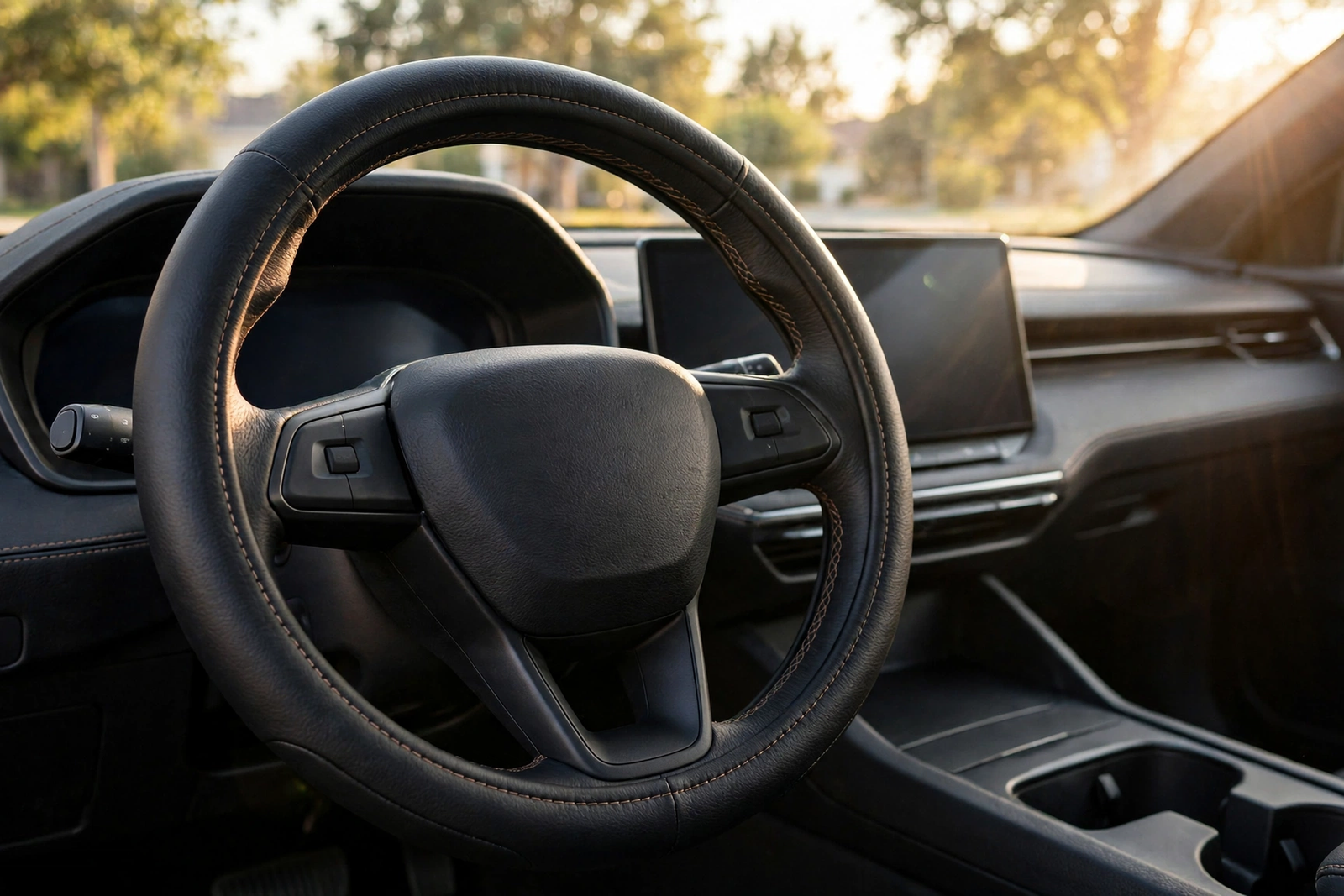
A steering wheel takes more wear than anything else. Hands, sun, heat and years of turning wear the factory surface smooth, and a wheel that once felt grippy starts to feel slick and tired. Custom steering wheel covers fix that without an upholsterer: a cover that fits your wheel, changes how it feels in your hands, and protects what is underneath. The best custom steering wheel covers do three jobs at once — they add grip, comfort on long drives, and make a worn wheel look cared for again.
The short answer: if you want the classic feel, a genuine leather slip-on is the pick — it goes on in minutes and feels like the wheel your car should have had. If you want the softest grip, a microfiber leather cover is the comfortable middle ground. And if you want a fit that looks tailored to your wheel, a stitch-on leather wrap is the one to choose — you sew it to the wheel yourself. The three below cover all three jobs — three different kinds of cover, not three versions of the same slip-on.
As an Amazon Associate I earn from qualifying purchases.
Quick Pick: Custom Steering Wheel Covers for Grip and Comfort
| Pick | Product | Best For | Check Price |
|---|---|---|---|
| Genuine Leather Classic | FH Group Genuine Leather Sport Steering Wheel Cover, Black | A genuine leather slip-on cover for most cars and SUVs, for a classic leather grip that goes on in minutes | Check Price on Amazon |
| Soft Everyday Pick | SEG Direct Black Microfiber Leather Steering Wheel Cover, 15 Inch | A soft microfiber leather cover with a non-slip lining, for everyday driving comfort on a standard-size wheel | Check Price on Amazon |
| Tailored Stitch-On Wrap | Ziciner Genuine Leather Steering Wheel Cover, Stitch-On Wrap, Black and Red Line | A stitch-on cowhide leather wrap you sew to the wheel yourself, for a tailored fit that looks made for your car | Check Price on Amazon |
Table of Contents
FH Group Genuine Leather Cover: The Classic Slip-On
Among custom steering wheel covers, the FH Group slip-on is the classic kind: a genuine leather cover that stretches over your wheel and stays put. The model is FH2005BLACK, in black, and it is made to fit most cars and SUVs with a standard-size wheel. Genuine leather is the material drivers ask for first, because it feels the way a good wheel should feel — firm and slightly textured, with the feel of a good leather wheel rather than the bare factory surface. A leather cover also hides the wear on an older wheel: the scuffs and smooth spots disappear under it, and the wheel looks cared for again.
Among custom steering wheel covers, a slip-on is the easiest kind to fit. There is no sewing, no adhesive and no tool: you work it over the top of the wheel and pull it down into place, and the stretch of the cover holds it snug. The FH Group cover is a universal fit, which means it is made for the standard wheel size most cars use — measure your wheel before you order, because a cover that is too loose will slip in your hands and a cover that is too tight will not go on at all. The listing gives the model as FH2005BLACK, so check the listing before you buy to confirm the colour and fit for your car.
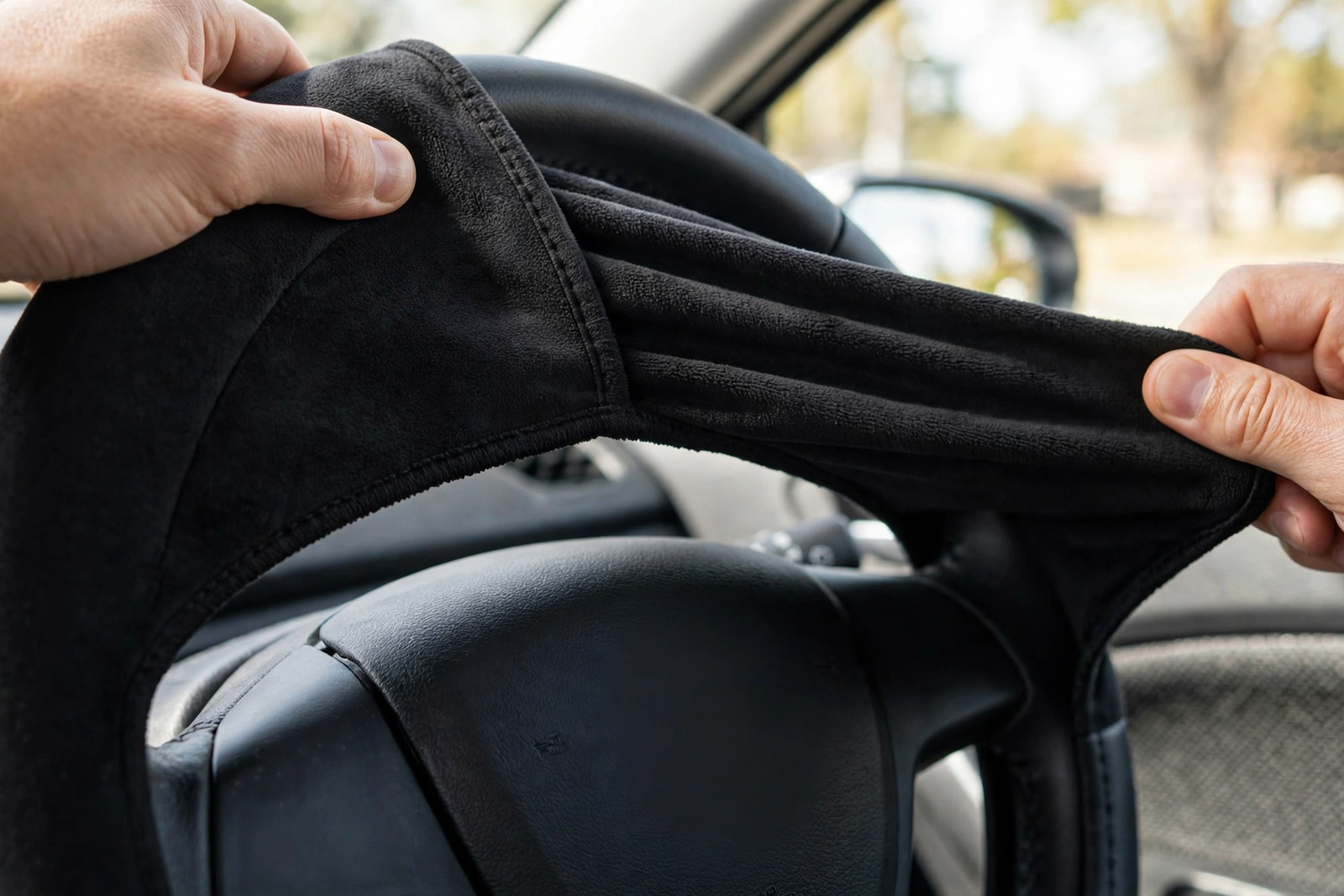
Custom steering wheel covers in leather age well when they are looked after. A wipe with a damp cloth keeps dust and hand oils from building up, and a leather conditioner now and then keeps the surface from drying out. The FH Group cover is the pick in this roundup for a driver who wants the leather feel without the leather-wrap job — the classic slip-on, in the material most drivers choose first.
FH Group Genuine Leather Sport Steering Wheel Cover on Amazon: genuine leather slip-on cover, model FH2005BLACK, black, universal fit for most cars and SUVs.
Buy the FH Group leather cover if: you want a genuine leather grip, a slip-on fit with no sewing, and a cover that makes a worn wheel look and feel cared for again. Of all the custom steering wheel covers in this roundup, it is the pick for the classic leather feel, fitted in minutes.
SEG Direct Microfiber Cover: The Soft Everyday Pick
The SEG Direct cover is the soft option among the custom steering wheel covers in this roundup: a black microfiber leather cover for a 15-inch wheel, made for standard-size steering wheels with an outer diameter of 14.5 to 15 inches. Microfiber leather is the listing’s own description of the material — a soft, fine-grained surface that the listing says is softer than a factory-installed wheel, with a rubber lining inside to keep the cover from slipping. The model number is FBA_AU38WILSWC0020, and the cover is a slip-on, like the FH Group cover, so it goes on without sewing.
Softness is the reason to choose this cover over other custom steering wheel covers. A microfiber surface feels gentle on the hands on a long drive, and the listing says it helps reduce driving fatigue — that is the listing’s claim, not a measured result, and no cover in this roundup was tested for fatigue. What the material does plainly offer is a comfortable grip that stays steady: the rubber lining grips the wheel underneath, and the microfiber surface gives your hands something to hold that is neither slick plastic nor hard leather. The listing also says the cover protects the wheel from sun, scratches, fading, wear and dirt, which is the same protection any snug cover gives.
The 15-inch size is the one to check before you order. Measure the outer diameter of your wheel — 14.5 to 15 inches is the range this cover is made for — and do not guess from the size of your car. A cover that is a little too big will turn on the wheel when you steer, which is worse than no cover at all. The SEG Direct cover is the pick among these custom steering wheel covers for everyday comfort: the softest grip of the three, on the wheel you drive every day.
SEG Direct Black Microfiber Leather Steering Wheel Cover on Amazon: microfiber leather slip-on cover, 15 inch, rubber lining, model FBA_AU38WILSWC0020, black.
Buy the SEG Direct microfiber cover if: you drive every day and want the softest grip of the three covers here, with a non-slip lining and a slip-on fit. Measure your wheel first — 14.5 to 15 inches is the range it is made for.
Ziciner Stitch-On Leather Wrap: The Tailored Fit
The Ziciner wrap is the most tailored of the custom steering wheel covers in this roundup: it is not a slip-on, it is a stitch-on wrap you sew onto the wheel yourself. The listing describes it as a single piece of genuine cowhide leather, breathable and anti-slip, made for a wheel with a maximum diameter of 15 inches, and it comes with the needle and thread for the sewing. The colour in this roundup is black with a red line, glossy finish, and the part number is Ziciner-403SWC. A stitch-on wrap is the closest a cover gets to a retrim: once it is sewn on, it follows the shape of your wheel, spoke by spoke, instead of stretching over it.
The sewing is the job, and it is what makes custom steering wheel covers like this one fit so well — worth going in with open eyes. You wrap the leather around the wheel, line up the edges, and stitch them together with the needle and thread in the box, working your way around the rim. It takes patience — an hour or more for a first attempt is a fair expectation — and the result depends on keeping the stitches even and the leather pulled snug as you go. The payoff is a fit no slip-on can match: the wrap sits tight against the wheel with no loose spots, and the stitched seam looks like it belongs there rather than like a cover pulled over the top.
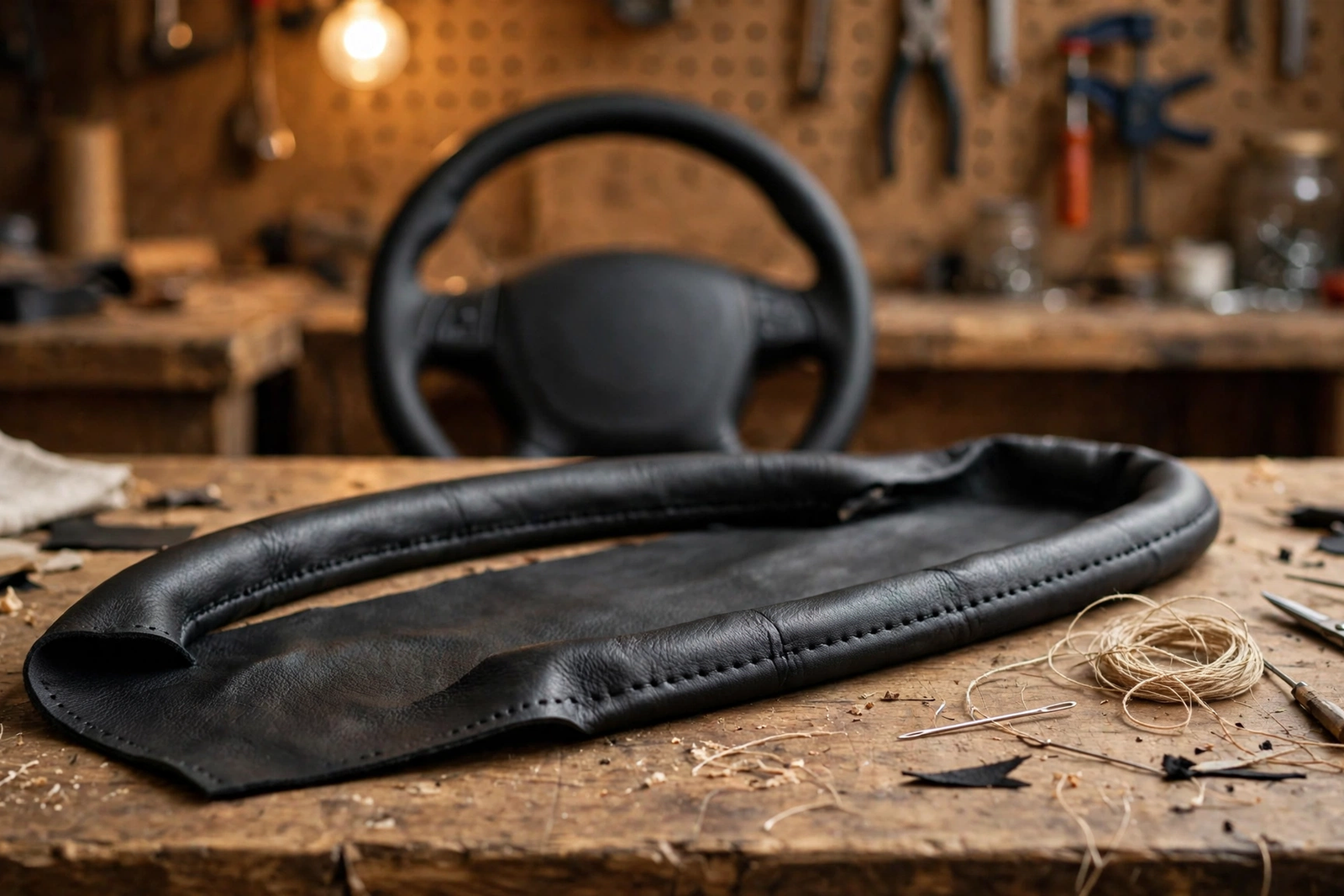
The listing describes the leather as a single piece of cowhide, and the wrap is perforated — the small holes in the leather are part of the breathable design the listing claims. Because each colour of this wrap is sold under its own listing, check the listing before you buy to confirm the colour and finish you want — the black and red line glossy version is the one linked here. The Ziciner wrap is the pick among the custom steering wheel covers in this roundup for a driver who wants the tailored look and is willing to spend the time sewing to get it.
Ziciner Genuine Leather Steering Wheel Cover Stitch-On Wrap on Amazon: single-piece cowhide leather wrap, needle and thread included, for wheels up to 15 inches, black with red line, glossy finish, part number Ziciner-403SWC.
Buy the Ziciner stitch-on wrap if: you want the tailored fit only a sewn wrap gives, and you are happy to spend an hour or so stitching it on. It is the pick in this roundup for a wheel you want to look retrimmed rather than covered.
Leather vs Microfiber Steering Wheel Covers
Two of the three custom steering wheel covers in this roundup are genuine leather and one is microfiber leather, so the material choice is the first decision. Genuine leather — the FH Group slip-on and the Ziciner wrap — feels firm and textured, and it ages: it softens with use and takes on a worn-in feel that many drivers prefer to a new surface. Microfiber leather — the SEG Direct cover — feels softer from the first day, and the listing describes it as softer than a factory wheel. Neither material is objectively better; the choice is about the feel you want in your hands.
Care is where the materials differ most. Genuine leather wants a wipe-down and, now and then, a conditioner to keep it from drying out, especially in a car that sits in the sun. Microfiber is the lower-maintenance of the two: a damp cloth is usually enough, and it does not need conditioning. Durability is a wash in practice — well-fitted custom steering wheel covers of either material last years, and a loose cover of either material wears out fast because it moves against the wheel. If you want the classic feel and do not mind the occasional conditioning, choose genuine leather; our genuine leather steering wheel cover review covers the KAFEEK top-grain cowhide pick in full. If you want the softest grip with the least care, choose microfiber.
Steering Wheel Cover Sizes: How to Measure Your Wheel
Size is the one measurement that decides whether custom steering wheel covers work at all, and it is measured in one way: the outer diameter of your wheel, from one side of the rim to the other, straight across the middle. Most cars use a standard-size wheel of 14.5 to 15 inches, which is the range the SEG Direct cover in this roundup is made for, and the Ziciner wrap is made for wheels up to 15 inches. The FH Group cover is sold as a universal fit for most cars and SUVs, which means the same standard range — but universal fit is a claim about the usual sizes, not a promise for every wheel, so measure yours before you order.
Trucks and larger SUVs often run bigger wheels, and a standard-size cover will not stretch over them. If you drive a full-size truck, our Ford steering wheel cover review covers F-150, F-250, F-350 and Expedition picks, including the larger sizes those trucks need. The measuring itself takes a minute: a tape measure across the wheel, outside edge to outside edge, with the wheel straight. Write the number down and compare it with the size range on the listing — custom steering wheel covers bought a half inch too small will not go on, and a cover a half inch too big will slip when you steer.
How to Fit a Steering Wheel Cover
Fitting slip-on custom steering wheel covers is a job of patience rather than strength. Warm the cover first — leave it in the sun or near a heater for a few minutes — because a warm cover stretches more easily than a cold one. Start at the top of the wheel, work the cover over the rim, and pull it down a little at a time, working your way around until the whole rim is covered. Do not yank one side down and hope the other follows; even pressure around the rim is what seats the cover snug. Once it is on, turn the wheel lock to lock and check that the cover does not move on the rim — a cover that turns under your hands is a loose cover, and a loose cover is a safety problem, not a cosmetic one.

A stitch-on wrap fits differently: you wrap the leather around the rim, line up the edges, and sew them together as you work around the wheel, pulling the leather snug as you go. Take your time with the first few stitches — they set the line for the rest of the wrap. Our Honda steering wheel cover review shows the CAR PASS Line Rider slip-on fitted on Civic, Accord and CR-V wheels, which is a useful picture of how a snug slip-on should sit. Whichever of these custom steering wheel covers you fit, the test is the same: grip the wheel and steer. If the cover stays put, it fits; if it moves, take it off and check the size.
Stitch-On vs Slip-On Steering Wheel Covers
Slip-on and stitch-on custom steering wheel covers are the two kinds in this roundup, and the difference is the fit you get for the time you spend. A slip-on — the FH Group and SEG Direct covers — goes on in minutes, with no tools and no sewing. The fit is good when the size is right, because the stretch of the cover holds it snug, but a slip-on always sits on top of the wheel rather than becoming part of it. A stitch-on — the Ziciner wrap — takes an hour or more and a needle and thread, and the fit is tailored: the leather follows the shape of your wheel, spoke by spoke, and the stitched seam looks like it belongs there.
Choose slip-on custom steering wheel covers if you want the job done today, or if you change covers with the seasons — a slip-on comes off as easily as it goes on. Choose a stitch-on if you want the tailored look and you are willing to spend the time sewing to get it, or if your wheel has a shape a slip-on never sits quite right on. One honest warning applies to both kinds: custom steering wheel covers in the wrong size are worse than no cover, whichever kind they are. A loose slip-on slips in your hands, and a loose stitch-on bunches under the stitching. Measure first, buy once.
Steering Wheel Cover Care: Cleaning and Wear
Custom steering wheel covers are the part of your car your hands touch every time you drive, so they pick up hand oils, dust and sweat faster than anything else in the cabin. Wipe it down regularly with a damp cloth — that alone keeps most covers looking and feeling good for years. For genuine leather, add a leather conditioner now and then to keep the surface from drying out, especially if the car sits in the sun; for microfiber, a damp cloth is usually enough, and the material does not need conditioning.
Watch for the two signs that a cover is worn out: a smooth, shiny patch where your hands rest, which means the grip is gone, and any looseness or movement on the rim, which means the cover no longer fits. Custom steering wheel covers that have gone smooth or loose have stopped doing their job — replace them rather than living with them, because grip is the reason the cover is there. And keep the wheel underneath clean too: when you do take a cover off, wipe the factory wheel before the new cover goes on, so grit trapped underneath does not scratch the surface the cover is meant to protect.
Who Should Buy a Steering Wheel Cover — and Who Should Not
Buy custom steering wheel covers if: your wheel is worn smooth, your hands slip on the factory surface, or you want a softer or warmer grip on long drives. A slip-on suits most drivers; a stitch-on suits a driver who wants the tailored fit and will spend the time sewing it on.
Buy custom steering wheel covers with care if: your wheel is an unusual size, or your car has a heated steering wheel — check the listing before you buy, because a cover over a heated wheel can trap heat, and a standard-size cover may not fit a larger or smaller wheel. If you drive a Jeep, our Jeep steering wheel cover review covers Wrangler picks sized for those wheels.
Do not buy custom steering wheel covers if: your wheel is new and the factory grip suits you, or you are buying one only for the look. A cover is a grip and protection tool first; on a wheel that already feels right, it adds little. And never drive with a cover that slips on the rim — a loose cover is a safety problem, and the fix is the right size, not a tighter grip.
The Verdict
The best custom steering wheel covers are the ones that fit your wheel and feel right in your hands. The FH Group genuine leather cover is the pick for the classic feel: a slip-on in real leather that goes on in minutes and makes a worn wheel feel cared for. The SEG Direct microfiber cover is the pick for everyday comfort: the softest grip of the three, with a non-slip lining, on a standard-size wheel. And the Ziciner stitch-on wrap is the pick for the tailored fit: a sewn cowhide wrap that looks like it was made for your wheel, because in a real sense it was — you sewed it there yourself.
Whichever cover you choose, check two things before you order: the diameter of your wheel, and whether the listing still shows a live offer — listings change, so confirm the offer is live before you buy. Measure first, buy once, and test the fit with the wheel lock to lock before you drive. A steering wheel cover is a small change, but it is one you feel every time you drive.
Frequently Asked Questions
What size steering wheel cover do I need?
Measure the outer diameter of your wheel, from one side of the rim to the other, straight across the middle. Most cars use a standard-size wheel of 14.5 to 15 inches, which is the range the SEG Direct cover in this roundup is made for, and the Ziciner wrap fits wheels up to 15 inches. Trucks and larger SUVs often run bigger wheels, so a standard-size cover will not fit them — measure first and compare the number with the size range on the listing, because a cover a half inch too small will not go on and a cover a half inch too big will slip when you steer.
Are leather steering wheel covers better than microfiber?
Neither is objectively better — the choice is about the feel you want. Genuine leather feels firm and textured, softens with use, and ages into a worn-in feel many drivers prefer. Microfiber leather feels softer from the first day and needs less care: a damp cloth is usually enough, while genuine leather wants a conditioner now and then to keep it from drying out. If you want the classic feel and do not mind the occasional conditioning, choose genuine leather; if you want the softest grip with the least care, choose microfiber.
How do I fit a slip-on steering wheel cover?
Warm the cover first — leave it in the sun or near a heater for a few minutes — because a warm cover stretches more easily than a cold one. Start at the top of the wheel, work the cover over the rim, and pull it down a little at a time, working your way around until the whole rim is covered. Do not yank one side down and hope the other follows; even pressure around the rim is what seats the cover snug. Once it is on, turn the wheel lock to lock and check that the cover does not move on the rim — a cover that turns under your hands is a loose cover, and a loose cover is a safety problem.
How long does a stitch-on steering wheel cover take to fit?
Allow an hour or more for a first attempt. You wrap the leather around the rim, line up the edges, and stitch them together with the needle and thread in the box, working your way around the wheel and pulling the leather snug as you go. Take your time with the first few stitches — they set the line for the rest of the wrap. The payoff is a fit no slip-on can match: the wrap sits tight against the wheel with no loose spots, and the stitched seam looks like it belongs there.
Will a steering wheel cover fit a heated steering wheel?
Check the listing before you buy, because a cover over a heated wheel can trap heat, and the listing may not say whether the cover is made for heated wheels. A slip-on cover comes off easily if the heat feels wrong, which makes it the safer try; a stitch-on wrap is a bigger commitment, so confirm the fit for a heated wheel before you sew it on. If the listing is silent on heated wheels, treat that as unanswered and ask the seller rather than guessing.
How do I clean a leather steering wheel cover?
Wipe it down regularly with a damp cloth to keep hand oils and dust from building up — that alone keeps most covers looking and feeling good for years. For genuine leather, add a leather conditioner now and then to keep the surface from drying out, especially if the car sits in the sun. For microfiber, a damp cloth is usually enough, and the material does not need conditioning. Replace the cover when you see a smooth, shiny patch where your hands rest or any looseness on the rim — a cover that has gone smooth or loose has stopped doing its job.