Best Hitch Cargo Carriers: 3 Baskets for Extra Storage
Your trunk is full, the back seat is full, and the camping gear still has nowhere to go. A hitch cargo carrier solves that problem from outside the car: a steel or aluminum basket that slides into your trailer hitch receiver and carries the bulky, dirty or awkward loads — coolers, luggage, firewood, camping chairs — behind the vehicle instead of inside it. It leaves the cabin free for passengers and keeps muddy gear out of the trunk.
The short answer: start by measuring your hitch receiver — most carriers in this roundup fit a 2-inch receiver, and a 1-1/4-inch receiver needs an adapter or a different carrier. Then match the basket to your load: all three carriers here are rated to 500 pounds by their makers, but your hitch and your vehicle have their own limits, and the lower number always wins. The three below cover the three main choices — a folding steel basket, a lightweight aluminum basket, and a fixed-shank steel basket — so pick the design that fits how you store it and how often you use it.
As an Amazon Associate I earn from qualifying purchases.
Quick Pick: Hitch Cargo Carriers for Extra Storage
| Pick | Product | Best For | Check Price |
|---|---|---|---|
| Folding Steel Basket | CURT 18153 Basket-Style Cargo Carrier, 60-Inch x 23-1/2-Inch x 5-1/2-Inch, Fits 2-Inch Receiver | A folding steel hitch cargo carrier that stands upright when not in use, for drivers who want a big basket and easy storage | Check Price on Amazon |
| Lightweight Aluminum Basket | MaxxHaul 70108 Aluminum Cargo Carrier With High Side Rails, 49-Inch x 22.5-Inch, Fits 2-Inch Receiver | A lightweight aluminum hitch cargo carrier with high side rails, for drivers who fit and remove the carrier alone | Check Price on Amazon |
| Fixed-Shank Steel Basket | CURT 18152 Basket-Style Cargo Carrier, 60-Inch x 24-Inch x 6-Inch, Fits 2-Inch Receiver | A fixed-shank steel hitch cargo carrier with the same big basket, for drivers who leave the carrier on and want no folding joint | Check Price on Amazon |
Table of Contents
CURT 18153 Folding Basket: The Steel Hitch Cargo Carrier
The CURT 18153 is the classic hitch cargo carrier: a basket-style carrier made from heavy-duty tubular steel, with a black carbide powder coat finish that resists rust and scratches. The basket measures 60 inches long by 23-1/2 inches wide by 5-1/2 inches deep, and the listing rates it to a 500-pound load capacity. It fits a 2-inch receiver, and the shank is angled and folding — so when the carrier is not in use, it folds up vertically against the back of the vehicle instead of sticking out behind it.
The folding shank is the feature that sets this hitch cargo carrier apart from the fixed baskets. A fixed basket stays out behind the vehicle until you unbolt it and carry it to the garage; the 18153 folds up in place, which matters in a driveway, a parking garage or a campsite where a sticking-out basket is in the way. The basket has a mesh base, so small items sit on the mesh rather than falling through the frame, and the tubular steel frame is the reason the carrier itself is heavy — published spec guides put its weight at about 70 pounds, so fitting it is a two-person job or a careful solo lift, not a one-handed one.
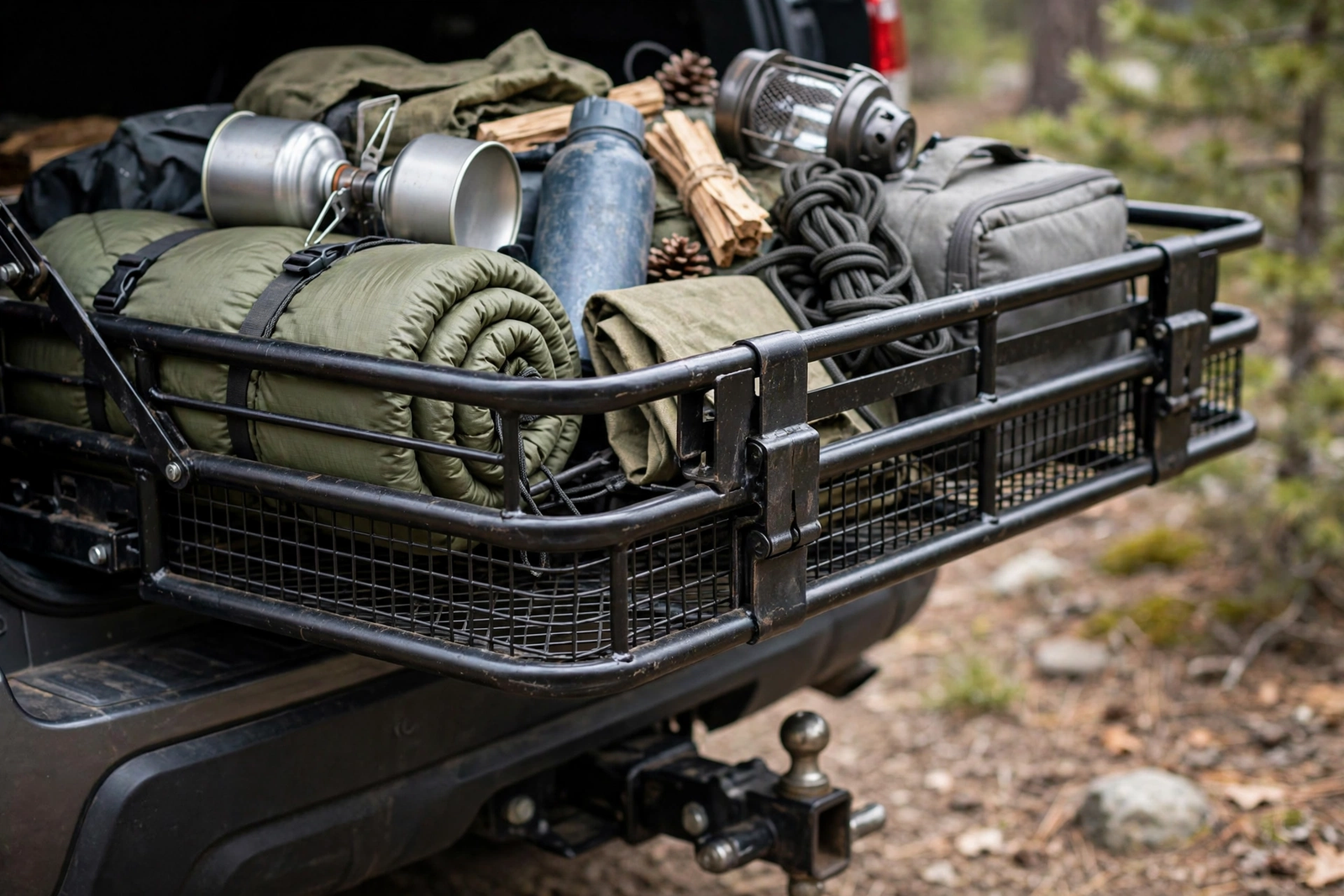
The CURT 18153 is the pick in this roundup for the driver who wants a big basket and the easiest storage. It is the same 500-pound rating as the other two carriers here, with the second-largest footprint of the three, and the folding shank is the honest reason to choose it over the fixed CURT: you get a carrier that lives on the vehicle without getting in the way.
CURT 18153 Basket-Style Cargo Carrier on Amazon: tubular steel basket, 60 x 23-1/2 x 5-1/2 inches, 500-pound capacity, fits a 2-inch receiver, angled folding shank, mesh base, model 18153.
Buy the CURT 18153 folding basket if: you have a 2-inch receiver, you want a big folding basket in this roundup, and you want the carrier to fold up against the vehicle when it is not loaded. Check that your receiver is 2 inches before you order.
MaxxHaul 70108 Aluminum Carrier: The Lightweight Hitch Cargo Carrier
The MaxxHaul 70108 is the lightweight hitch cargo carrier in this roundup: an aluminum basket with a steel under-support frame, built for drivers who fit and remove the carrier by themselves. The basket measures 49 inches long by 22.5 inches wide, with high side rails that reach 7-1/4 inches, and the listing rates it to a 500-pound load capacity — the same rating as the steel baskets, in a much lighter package. It fits a 2-inch receiver, and published spec guides put its weight at about 21.4 pounds, roughly a third of the steel CURT baskets.
That weight difference is the whole point of this hitch cargo carrier. A 70-pound steel basket needs a second pair of hands or a careful lift; a 21-pound aluminum basket is a one-person job to slide into the receiver and pin in place. The aluminum does not rust the way bare steel can, and the high side rails do real work: they keep coolers, bags and boxes from sliding off the sides, which matters on a basket with no walls. Published spec guides say a hitch tightener is included, which takes the wobble out of the carrier once it is pinned in the receiver — a small part that makes a loaded carrier feel far more solid on the road.
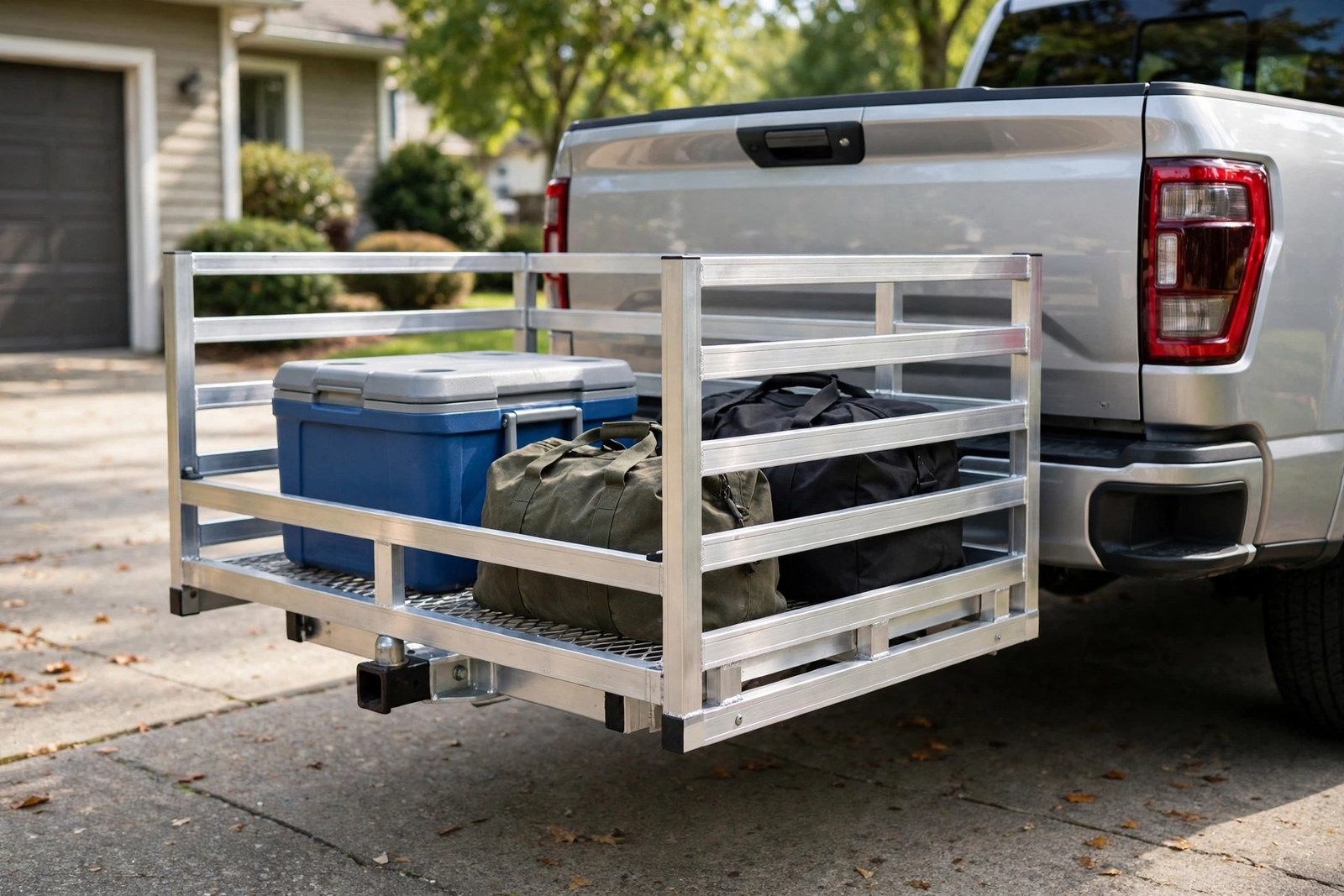
The trade-off is size: at 49 by 22.5 inches, the MaxxHaul basket is smaller than either CURT basket, so it holds less — a cooler and a few bags rather than a full camp load. The shank is fixed, not folding, so when it is not in use you take it off and store it; at 21 pounds that is easy, and it leans against a garage wall instead of needing floor space. This hitch cargo carrier is the pick for the solo driver, the smaller vehicle, and anyone who values a light lift over the biggest basket.
MaxxHaul 70108 Aluminum Cargo Carrier on Amazon: aluminum basket with steel under-support frame, 49 x 22.5 inches, high side rails to 7-1/4 inches, 500-pound capacity, fits a 2-inch receiver, model 70108.
Buy the MaxxHaul 70108 aluminum carrier if: you fit and remove the carrier alone, your loads fit a 49-inch basket, and you want the lightest hitch cargo carrier in this roundup. It needs a 2-inch receiver, and it needs a Class III or IV hitch to carry its rated load.
CURT 18152 Fixed Basket: The Fixed-Shank Hitch Cargo Carrier
The CURT 18152 is the fixed-shank version of the big steel basket: the same basket-style hitch cargo carrier idea as the 18153, without the folding joint. It is made from tubular steel with a black powder coat finish, the basket measures 60 inches long by 24 inches wide by 6 inches deep, and the listing rates it to a 500-pound load capacity. It fits a 2-inch receiver, and the shank is angled and fixed — the angle gives extra ground clearance, and the fixed shank means there is no hinge to wear, rattle or maintain.
The difference between this hitch cargo carrier and the folding 18153 is exactly one joint, and the choice between them is a storage choice, not a strength choice. Both baskets are rated to 500 pounds, both are 60 inches long, and both are heavy steel. The 18152 is a touch deeper — 6 inches against the 18153’s 5-1/2 — and a touch wider at 24 inches. If the carrier lives on the vehicle most of the time, the fixed shank is simpler: nothing to fold, nothing to pin upright, and no hinge to check. If the carrier comes off between trips, the fixed shank is a longer object to store, and the 18153’s folding shank earns its keep.
The CURT 18152 is the pick in this roundup for the driver who leaves the carrier on the vehicle and wants the simplest possible hitch cargo carrier: a big steel basket, a fixed angled shank, and no moving parts beyond the hitch pin. It is also the pick for rough use — a fixed shank has no hinge to take a knock on a rutted track or a steep driveway entry.
CURT 18152 Basket-Style Cargo Carrier on Amazon: tubular steel basket, 60 x 24 x 6 inches, 500-pound capacity, fits a 2-inch receiver, angled fixed shank, model 18152.
Buy the CURT 18152 fixed basket if: you have a 2-inch receiver, you want the biggest basket and the simplest design, and the carrier will stay on the vehicle between trips. Check the ground clearance on steep driveways — the angled shank helps, but a loaded basket still sits low.
Folding vs Fixed: Which Hitch Cargo Carrier Shank Fits Your Life
A hitch cargo carrier hangs off the back of your vehicle on a shank — the square bar that slides into the receiver — and the shank is either folding or fixed. A folding shank, like the one on the CURT 18153, hinges so the basket stands upright against the vehicle when it is empty. A fixed shank, like the ones on the CURT 18152 and the MaxxHaul 70108, holds the basket out behind the vehicle at all times, and the only way to get it out of the way is to pull the pin and take the carrier off.
The folding shank wins when the carrier stays on the vehicle. It folds up in a parking garage, a driveway or a campsite, and it keeps the basket from sticking out into traffic or a walkway. The fixed shank wins when the carrier comes off between trips anyway: there is no hinge to wear, no pin to check, and nothing to rattle. The MaxxHaul shows the other side of the fixed-shank trade — at about 21 pounds, taking it off is easy, so a fixed shank costs nothing in practice. The steel CURT baskets are another matter: at about 70 pounds, taking one off and carrying it to the garage is a real job, and the folding shank starts to look like the better deal.
Hitch Cargo Carrier Sizes: 1-1/4 Inch vs 2 Inch Receivers
Every hitch cargo carrier in this roundup fits a 2-inch receiver, and that is the first thing to check before you buy anything else. The receiver is the square tube under your rear bumper, and its size is stamped on it or listed in your vehicle manual: 2 inches is the common size on trucks, SUVs and larger crossovers, while 1-1/4 inches is common on smaller cars and crossovers. All three carriers here — the CURT 18153, the MaxxHaul 70108 and the CURT 18152 — are built for a 2-inch receiver, and none of them will fit a 1-1/4-inch receiver without an adapter.
A 1-1/4-inch receiver is not a dead end, but it is a different purchase. CURT makes a compact basket, model 18145, with a shank that adapts from 1-1/4 inches to 2 inches, and other makers sell adapter sleeves — but an adapter does not change the receiver’s own weight limit, and a small-car receiver is usually rated far below 500 pounds. CURT’s own instructions rate the 18145 at 500 pounds on a 2-inch receiver but 300 pounds on a 1-1/4-inch receiver, and some guides advise against adapting a 1-1/4-inch receiver up at all — check the manual before you adapt. Measure the receiver first: a tape measure across the inside of the square tube tells you in seconds. Then check your vehicle manual for the hitch weight limit, because the carrier’s rating is only half the story — the other half is covered in the next section.
Hitch Cargo Carrier Weight Capacity: What 500 Pounds Really Means
All three carriers in this roundup are rated to 500 pounds by their makers. That number is the carrier’s own limit — the basket, the shank and the frame, tested by the maker. It is not the limit for your vehicle. Your hitch receiver has its own rating, your vehicle has a tongue-weight limit, and the lower of the three numbers is the one that governs. Some hitch and carrier makers go further and instruct halving the hitch’s tongue-weight rating when a cargo carrier is fitted, because a basket loads the hitch differently from a trailer — check your hitch and vehicle manuals for that derating before you load to the full rating. A 500-pound carrier on a hitch rated to 300 pounds is a 300-pound setup, and loading it to 500 pounds overloads the hitch, not the basket.
In practice, most loads never get near 500 pounds. A cooler full of ice and drinks, two duffel bags and a camp chair come to a fraction of that, and a hitch cargo carrier earns its keep on bulky loads, not heavy ones — the things that do not fit inside, not the things that weigh the most. The weight that matters most is the carrier’s own weight: published spec guides put the CURT 18153 at about 70 pounds of steel against about 21 pounds of aluminum on the MaxxHaul, and that weight hangs on the hitch before you load a single bag. If you camp with a tent as well as a carrier, our best car tents guide covers the tents that pair with a loaded basket, and the same rule applies there: count the carrier, the tent and the gear together against the hitch limit.
How to Load a Hitch Cargo Carrier
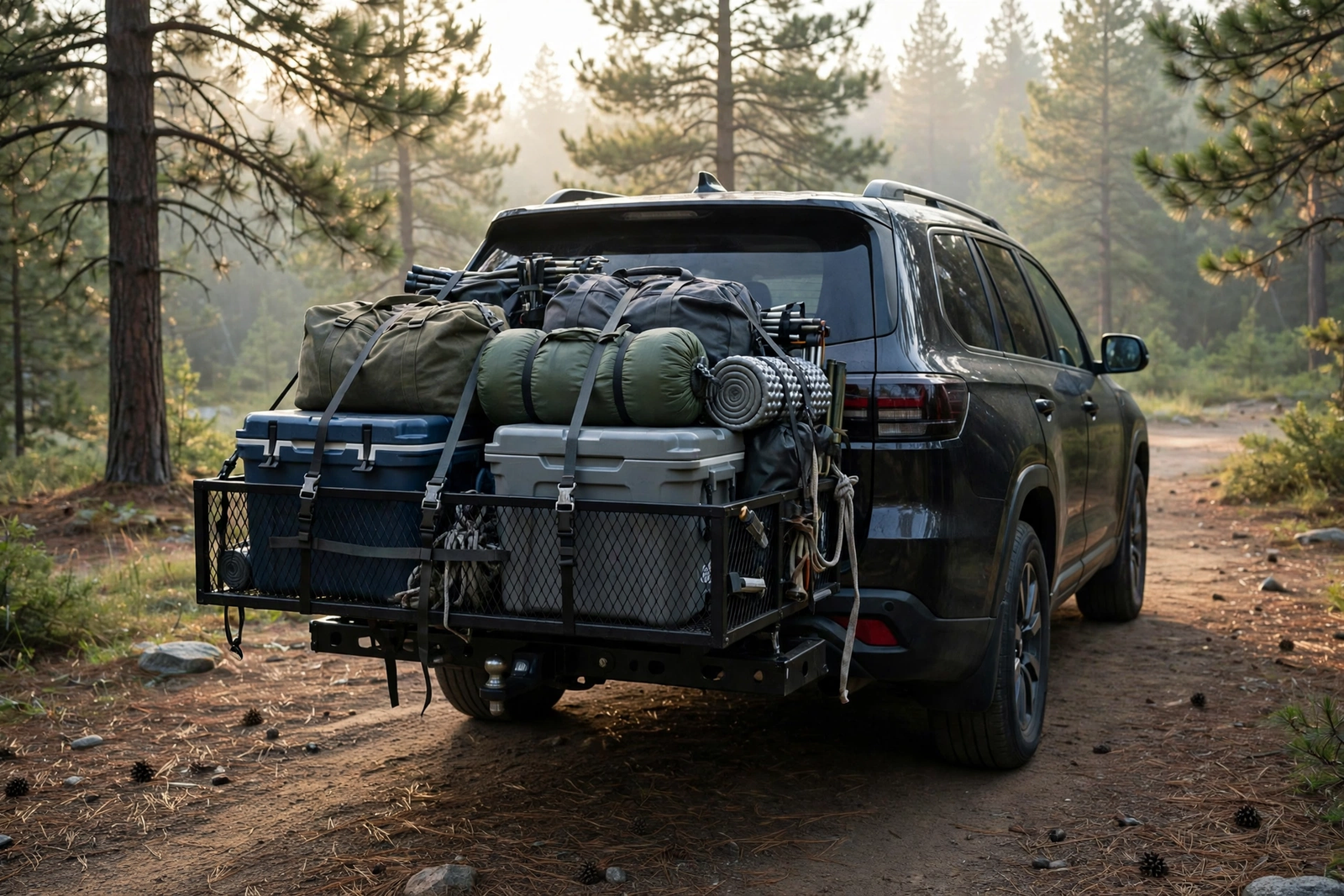
Loading a hitch cargo carrier is simple, and the order matters. Slide the shank into the receiver until the pin holes line up, push the hitch pin through and clip it, then tighten the hitch tightener if your carrier has one — the MaxxHaul 70108 includes one — so the carrier does not wobble in the receiver. Then load the heaviest items first, low and centred over the shank, with lighter items on top. A load that hangs off one side pulls the carrier sideways and makes the vehicle handle oddly; a centred load rides straight.
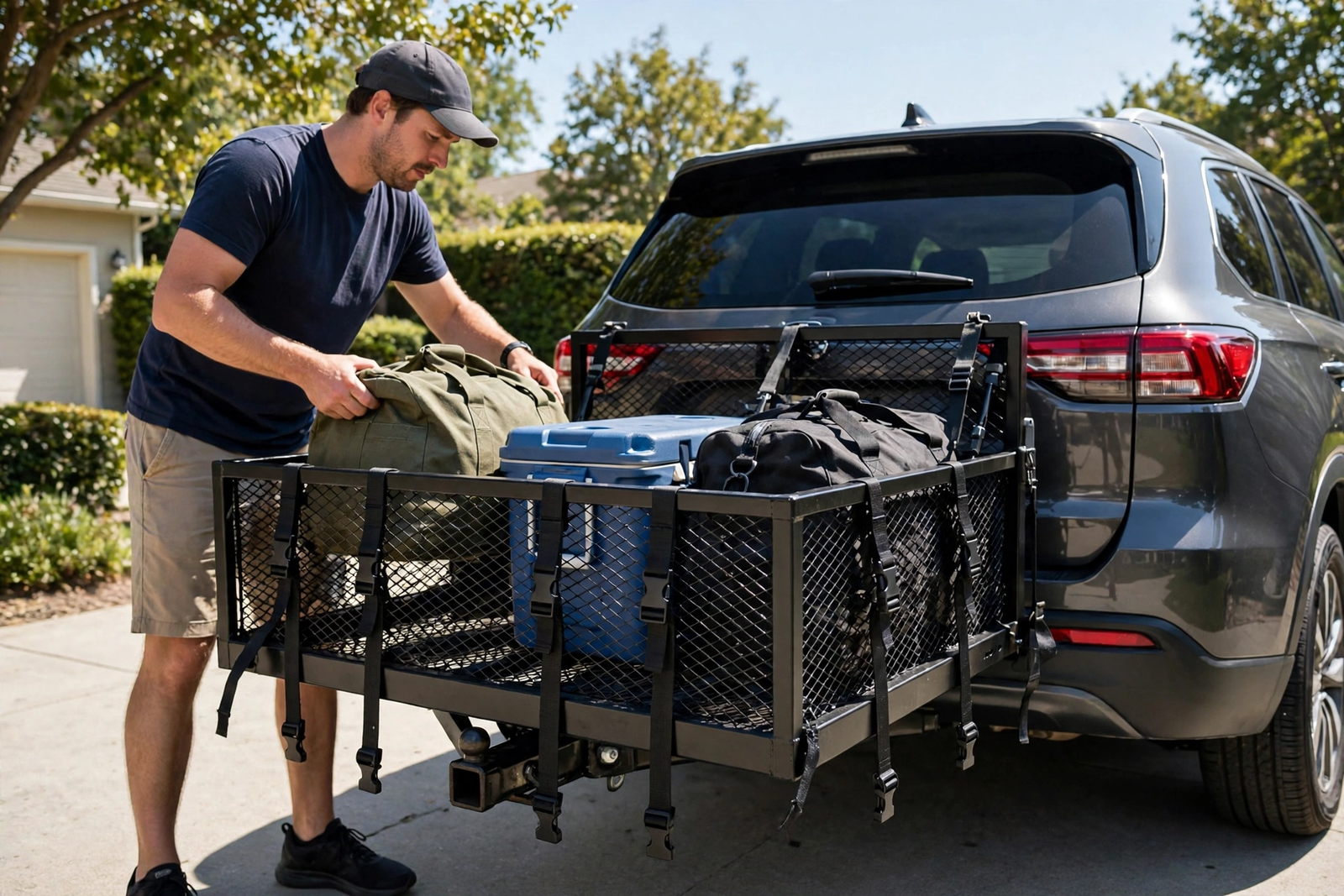
Strap everything down. None of the three carriers in this roundup includes a cargo net or tie-down straps in its listing, so buy a net or a set of ratchet straps with the carrier and use them every trip — a bungee cord is not enough for highway speed, and an unstrapped cooler on a basket is a hazard to the car behind you. Keep the load below the side rails where you can, so nothing can slide off the top, and check the straps after the first few miles: a load settles as you drive, and a strap that was tight at home can go slack on the road.
Hitch Cargo Carrier Mistakes to Avoid
The most common hitch cargo carrier mistake is buying before measuring the receiver. A 2-inch carrier does not fit a 1-1/4-inch receiver, and discovering that in the driveway with a camping trip the next morning is a bad start. The second mistake is loading to the carrier’s rating instead of the hitch’s rating — the lower number always wins, and the hitch rating is in your vehicle manual. The third is skipping the straps: a basket with no net or tie-downs is an open tray, and anything light enough to blow out will blow out at highway speed.
The fourth mistake is forgetting what sits behind the carrier. A loaded basket can block the taillights and the license plate, and a tall load can block the rear window — check all three before you drive, and check your local rules on plate visibility. A cover helps with the weather and with prying eyes: our best car covers guide covers covers for the vehicle itself, and a cargo bag over the load does the same job for the basket. The fifth mistake is leaving a steel carrier on through winter without a wash — road salt eats a powder coat from the edges in, and a rinse after a salty trip is the cheapest maintenance a hitch cargo carrier ever gets. The sixth is reversing without thinking: a basket adds length behind the vehicle, and a reversing camera does not always show it.
Who Should Buy a Hitch Cargo Carrier — and Who Should Not
Buy a hitch cargo carrier if: you regularly run out of space inside the vehicle — camping trips, road trips with a full car, or hauling bulky gear that does not belong in the trunk. A basket behind the vehicle frees the cabin for passengers and keeps dirty or wet gear outside. If your extra space needs to be inside the truck bed instead, our best truck bed covers guide covers the other way to add covered space.
Buy one with care if: your vehicle has a 1-1/4-inch receiver, a low tongue-weight limit, or a reversing camera you rely on. Check the receiver size, check the hitch rating, and check that the basket does not block the camera or the plate before you commit to a 60-inch basket.
Do not buy a hitch cargo carrier if: you have no receiver hitch at all, or you only need extra space once a year. Fitting a hitch just for a carrier is a bigger job than the carrier itself, and a once-a-year trip is better served by a roof bag or a borrowed carrier. A hitch cargo carrier is a tool for regular use — buy it when the space problem is a pattern, not a one-off.
The Verdict
The best hitch cargo carrier is the one that fits your receiver, your load and your storage. The CURT 18153 folding basket is the pick for a big load and the easiest storage: a 60-inch steel basket that folds up against the vehicle when it is empty. The MaxxHaul 70108 is the pick for the solo driver: the same 500-pound rating in a 21-pound aluminum basket that one person can fit and remove. And the CURT 18152 is the pick for the driver who leaves the carrier on: the same big basket with a fixed angled shank and no hinge to maintain.
Whichever basket you choose, check three things before you order: the receiver size, the hitch weight limit, and whether the listing still shows a live offer — listings change, and a listing that showed an offer when this roundup was researched may not show one now. Measure the receiver, load heavy and low, strap everything down, and check the straps after the first few miles. For the rest of the road-trip kit, our best car accessories for road trips covers what else is worth packing.
Frequently Asked Questions
What size hitch does a hitch cargo carrier need?
Most hitch cargo carriers, including all three in this roundup, fit a 2-inch receiver. Measure the inside of the square receiver tube under your rear bumper — 2 inches is common on trucks, SUVs and larger crossovers, while 1-1/4 inches is common on smaller cars. A 2-inch carrier will not fit a 1-1/4-inch receiver without an adapter, and an adapter does not raise the receiver’s own weight limit, so check your vehicle manual for the hitch rating as well as the size.
How much weight can a hitch cargo carrier hold?
All three carriers in this roundup are rated to 500 pounds by their makers. That is the carrier’s own limit — your hitch receiver and your vehicle have their own limits too, and the lowest of the three numbers is the one that governs. A 500-pound carrier on a hitch rated to 300 pounds is a 300-pound setup. In practice most loads never get near 500 pounds: a cooler, two duffel bags and a camp chair come to a fraction of that, and a hitch cargo carrier earns its keep on bulky loads, not heavy ones.
Does a hitch cargo carrier fold up?
Some do and some do not. The CURT 18153 in this roundup has an angled folding shank, so the basket folds up vertically against the vehicle when it is empty. The CURT 18152 and the MaxxHaul 70108 have fixed shanks, so the only way to get them out of the way is to pull the hitch pin and take the carrier off. The MaxxHaul is light enough at about 21 pounds that removing it is easy; the steel CURT baskets are far heavier, which is when a folding shank earns its keep.
Do I need a cargo bag or net with a hitch cargo carrier?
Yes — buy one with the carrier. None of the three carriers in this roundup includes a cargo net or tie-down straps in its listing, and a basket is an open tray without them. A cargo net or a set of ratchet straps keeps the load on the basket at highway speed, and a cargo bag adds weather protection as well. A bungee cord is not enough for highway driving. Strap the load down every trip, and check the straps after the first few miles, because a load settles as you drive.
Will a hitch cargo carrier block my taillights or license plate?
It can. A loaded basket sits behind the vehicle, and a tall load can block the taillights, the license plate or the rear window. Check all three before you drive, keep the load below the side rails where you can, and check your local rules on plate visibility — some places require the plate to stay visible or be moved. No light is included in the listings here, so do not assume the basket comes with one — if your load blocks the taillights, fit separate lights or move the load.
Can I use a hitch cargo carrier on a front hitch?
Yes, if your vehicle has a front receiver hitch of the right size — but check its rating first, because front receivers are usually rated far below a rear hitch, so a 500-pound carrier rating does not carry over to the front. The carriers in this roundup slide into any matching receiver, front or rear. Check that the front receiver is rated for the load, check that the basket does not block the headlights or the license plate, and check your vehicle manual — some vehicles restrict what a front receiver may carry. Most drivers use a rear hitch, and that is the setup this roundup assumes.