As an Amazon Associate I earn from qualifying purchases.
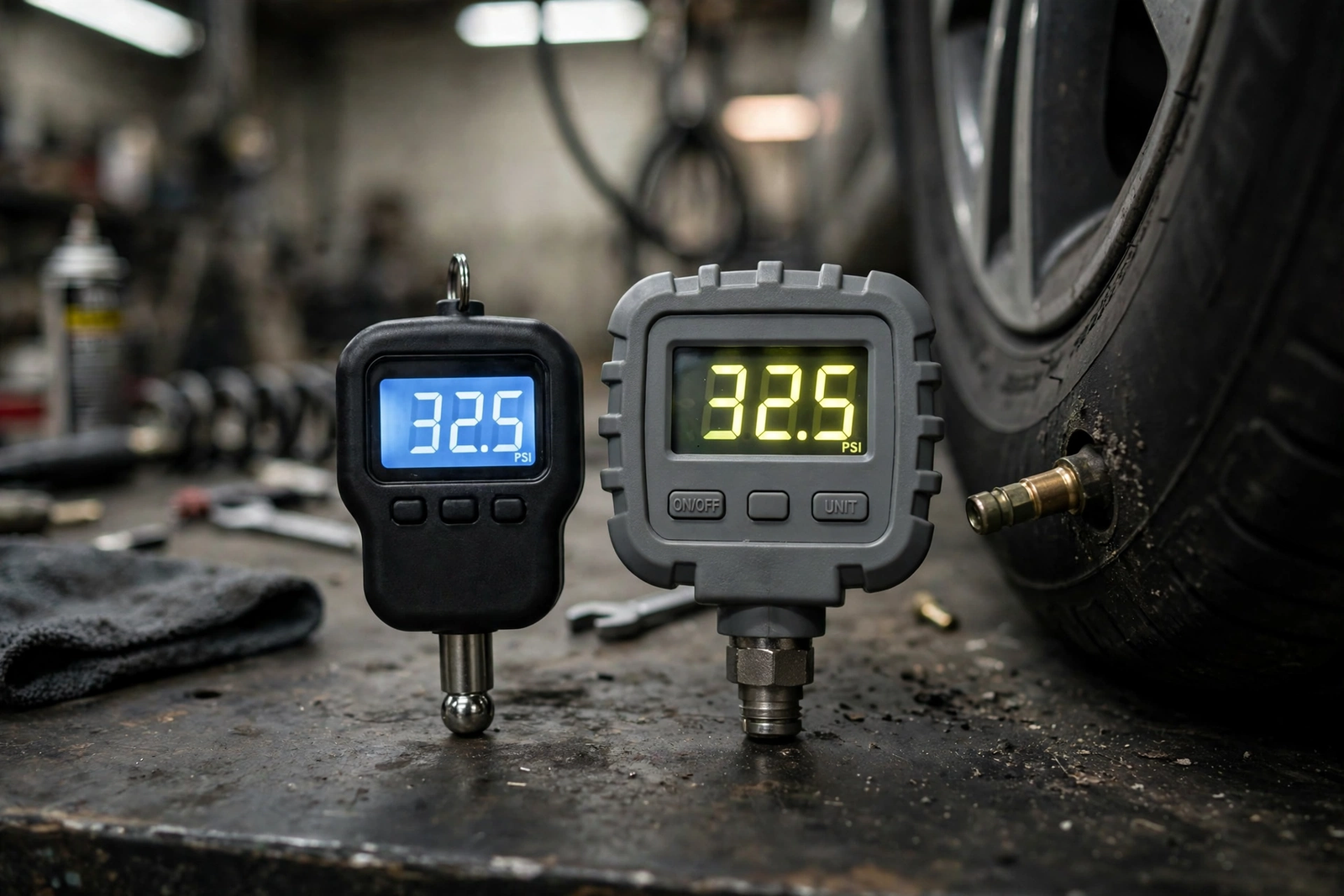
A tire pressure gauge is one of the cheapest tools that actually saves you money. Under-inflated tires wear faster, handle worse, and burn more fuel, and the fix takes sixty seconds with a gauge that costs less than a tank of gas. The two digital gauges buyers compare most are the AstroAI Digital Tire Pressure Gauge (150 PSI) and the ETENWOLF T300 (200 PSI). This AstroAI vs ETENWOLF tire pressure gauge head-to-head compares accuracy, range, display, and batteries so you can pick the right one for your tires.
The AstroAI gauge covers passenger cars, SUVs, and motorcycles with a 150 PSI range, a backlit display, and an illuminated nozzle that helps in the dark. The ETENWOLF T300 stretches to 200 PSI with a thermal-compensation chip, which suits pickups, RVs, and heavy-duty tires that run higher pressures. Drive a normal car and the AstroAI is enough; run a truck or trailer and the ETENWOLF’s extra range is the right call.
Table of Contents
Quick Picks: AstroAI vs ETENWOLF Tire Pressure Gauge
| Pick | Product | Best For | Check Price |
|---|---|---|---|
| Overall Winner | AstroAI Digital Tire Pressure Gauge 150 PSI | Most drivers: cars, SUVs, motorcycles; backlit display + illuminated nozzle | Check Price on Amazon |
| Best Budget | AstroAI Digital Tire Pressure Gauge 150 PSI | Lower price tier; compact 78-gram design | Check Price on Amazon |
| Premium Pick | ETENWOLF T300 Digital Tire Pressure Gauge | Pickups, RVs, trailers: 200 PSI range + thermal compensation | Check Price on Amazon |
AstroAI vs ETENWOLF: Side-by-Side Specs
All figures below come from the products’ listings and published manuals, checked the same day this article was written.
| Spec | AstroAI Digital (150 PSI) | ETENWOLF T300 |
|---|---|---|
| Pressure range | 0-150 PSI | 3-200 PSI |
| Stated accuracy | ±1 PSI (ANSI B40.7) | ±1 PSI (ANSI B40.7 Grade 2A) |
| Resolution | 0.1 PSI | 0.1 PSI |
| Units | PSI, Bar, KPa, Kg/cm² | PSI, Bar, KPa |
| Display | Backlit LCD | Backlit LED screen |
| Nozzle light | Yes, illuminated nozzle | Yes, integrated flashlight |
| Thermal compensation | Not stated | Yes, built-in chip (-4°F to 130°F) |
| Auto shutoff | ~30 seconds | ~30 seconds |
| Batteries | 2× AAA | 2× AAA (replaceable) |
| Weight | ~78 g | ~110 g |
| Valve fit | Schrader | Schrader (Presta adapter not included) |
Accuracy and Calibration: A Near Tie
Both gauges are calibrated to ANSI B40.7, the US standard for pressure gauges, with a stated accuracy of ±1 PSI. In practical terms that means both will tell you whether your tire is at 32 or 35 PSI, which is the only resolution that matters for a passenger car. The ETENWOLF carries the Grade 2A designation and advertises manual calibration, while the AstroAI’s listing states the same ±1 PSI figure. For driveway use, treat them as equals on accuracy.
The one real differentiator is the ETENWOLF’s thermal-compensation chip, which the listing says keeps readings stable from -4°F to 130°F. If you check tires in a freezing garage or a desert summer, that is a genuine edge. In normal conditions, both read the same.
Range and Vehicle Fit: Where They Diverge
This is the section that decides the purchase. The AstroAI measures 0-150 PSI, which covers every passenger car, crossover, SUV, and motorcycle on US roads — most car tires call for 30-36 PSI, and even full-size SUV tires rarely exceed 50. The ETENWOLF stretches to 200 PSI, a range built for pickup trucks, RVs, trailers, and commercial tires that run 65-80 PSI or more.
The rule is simple: buy the range your tires actually need. A 150 PSI gauge is not “worse” for a sedan; the extra 50 PSI on the ETENWOLF buys you nothing on a Camry. But if you tow a trailer or run a heavy-duty truck, the ETENWOLF’s headroom is the correct tool, and its listing explicitly positions it for pickups and RVs.
Display and Low-Light Use
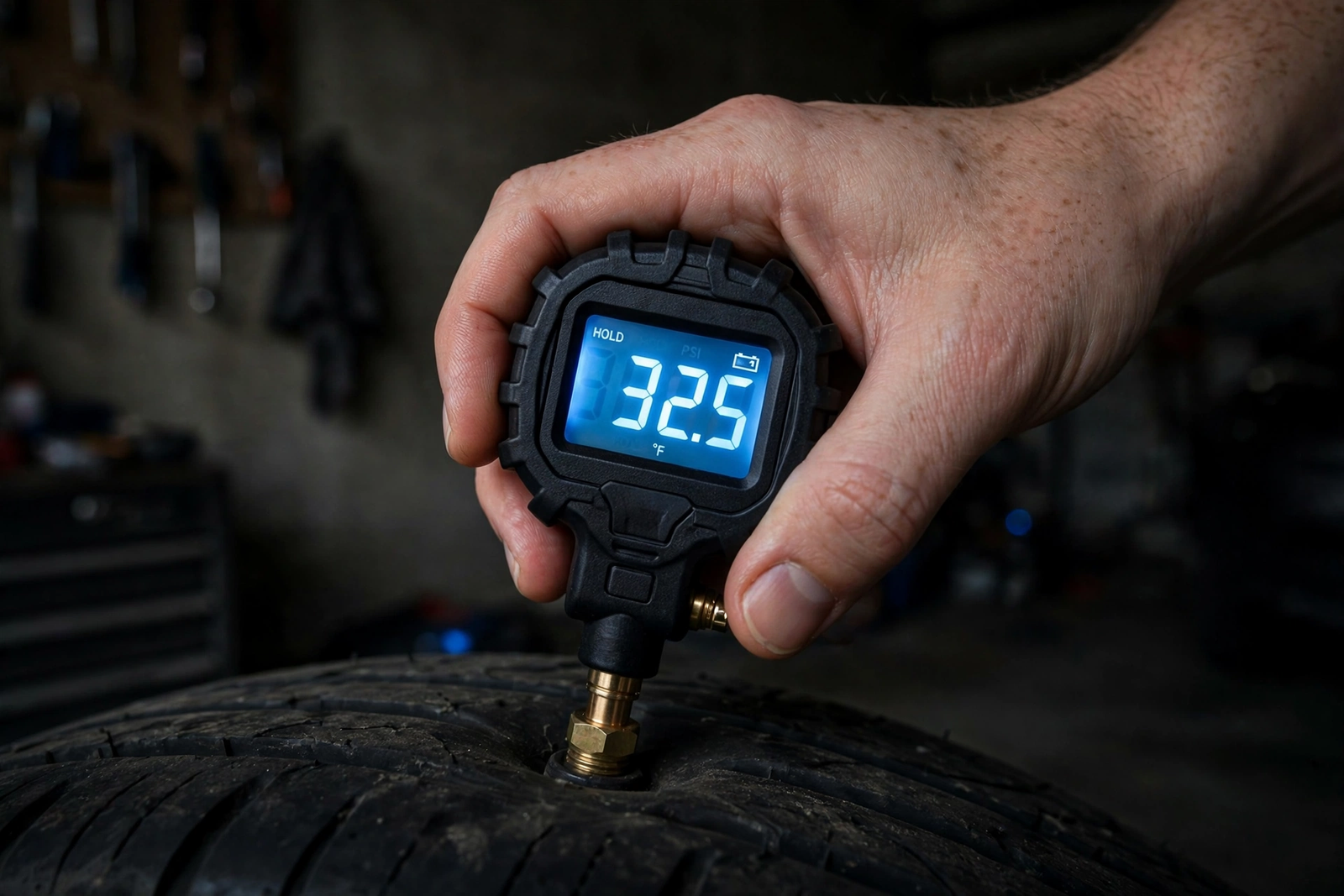
Both gauges have backlit screens, which matters more than it sounds — most tire checks happen in a dim garage, early morning, or after dark. The AstroAI adds an illuminated nozzle, a small light at the tip that helps you find the valve stem in the dark. The ETENWOLF counters with a built-in flashlight and a larger LED screen. Both solve the same problem; the AstroAI’s nozzle light is the slightly more thoughtful touch for the actual moment of measurement.
Power and Everyday Carry
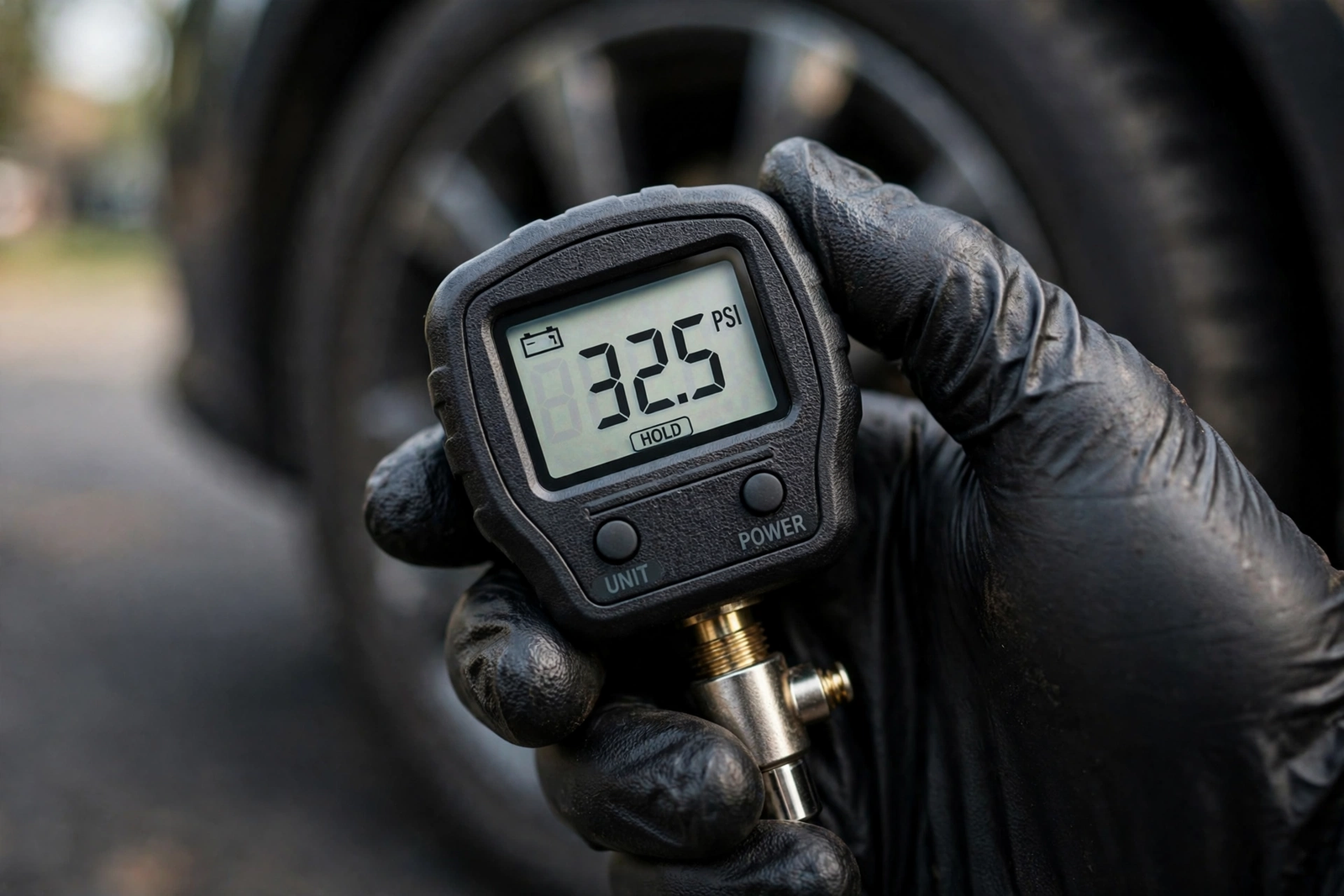
Both run on two AAA batteries and shut off automatically after about 30 seconds, so battery life is a non-issue for either. The AstroAI is the lighter, more compact unit at around 78 grams, which makes it the better glove-box resident. The ETENWOLF is larger and heavier at about 110 grams — still pocketable, but it reads more like a toolbox tool. If the gauge lives in the car full-time, the AstroAI’s size is an everyday advantage.
Who Should Buy the AstroAI vs the ETENWOLF
Buy the AstroAI if: you drive a car, crossover, SUV, or motorcycle; you want the most compact gauge; you check tires in the dark and want the illuminated nozzle. This is most drivers.
Buy the ETENWOLF T300 if: you drive a pickup, RV, or tow a trailer; your tires run high pressures; you check tires in extreme heat or cold and want thermal compensation.
Either works if: you just want a reliable digital gauge for a normal car. In that case the AstroAI’s smaller size and lower price tier make it the default.
Pair either gauge with a portable inflator so you can fix what you measure — our tire pressure tool guide covers the rest of the kit, and our road trip accessories roundup keeps the trunk ready.
The Verdict
The AstroAI vs ETENWOLF tire pressure gauge decision comes down to your tires. The AstroAI’s 150 PSI range, backlit display, and illuminated nozzle cover every passenger vehicle in a lighter, more compact package. The ETENWOLF T300’s 200 PSI range and thermal-compensation chip buy genuine capability for trucks, RVs, and trailers.
If your tires run normal car pressures, buy the AstroAI. If they run high, or you tow, the ETENWOLF earns its place.
AstroAI Digital Tire Pressure Gauge on Amazon: 150 PSI, backlit LCD, illuminated nozzle, ±1 PSI.
ETENWOLF T300 Digital Tire Pressure Gauge on Amazon: 200 PSI, thermal compensation, backlit LED, ±1 PSI.
Frequently Asked Questions
Q: Are digital tire pressure gauges accurate?
A: In this astroai vs etenwolf tire pressure gauge comparison, yes, when calibrated. Both gauges here are calibrated to ANSI B40.7 with a stated ±1 PSI accuracy, which is more than precise enough for maintaining car tires. Digital gauges are generally easier to read precisely than stick gauges, where you squint at a sliding bar.
Q: What PSI should my car tires be?
A: Check the driver’s door jamb sticker, not the tire sidewall — the sidewall shows the maximum, not the recommended pressure. Most cars call for 30-36 PSI. Check pressures when the tires are cold (before driving) for the true reading.
Q: How often should I check tire pressure?
A: Once a month and before long trips. Tires lose roughly 1 PSI per month naturally, and pressure drops about 1 PSI for every 10°F of temperature fall, so autumn is when most drivers discover they are low.
Q: Can I use these gauges on motorcycle or bicycle tires?
A: The AstroAI works on motorcycle tires (Schrader valves) within its 150 PSI range. For bicycles with Presta valves, neither includes a Presta adapter — the ETENWOLF listing states the adapter must be purchased separately.
Q: Do I need a 200 PSI gauge for a regular car?
A: No. Passenger car tires run 30-50 PSI, well within the AstroAI’s 150 PSI range. The ETENWOLF’s 200 PSI ceiling only matters for pickups, RVs, trailers, and commercial tires that run high pressures.
Q: When is the best time to check tire pressure?
A: In the morning before driving, when the tires are cold. Driving heats tires and raises the reading by several PSI, which masks under-inflation. A cold reading against the door-jamb sticker is the correct comparison.